
Law students were taught how to counter misinformation
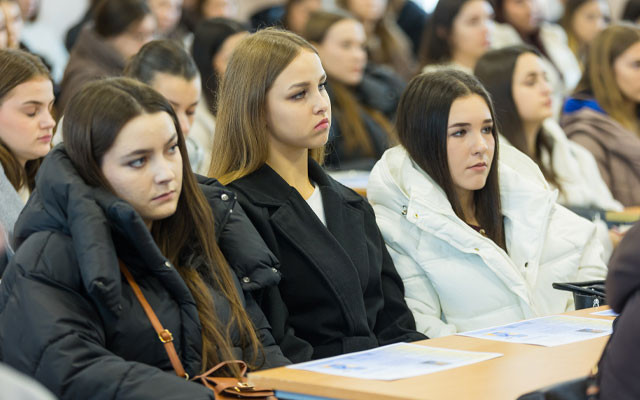
Every day, people are exposed to large amounts of information, much of which contains fake news, manipulation, and misinformation. To protect yourself and others, you need to learn how to verify information and be aware of the risks of the digital space.
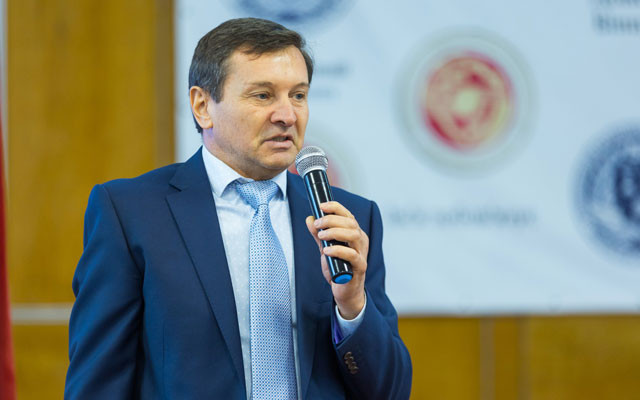
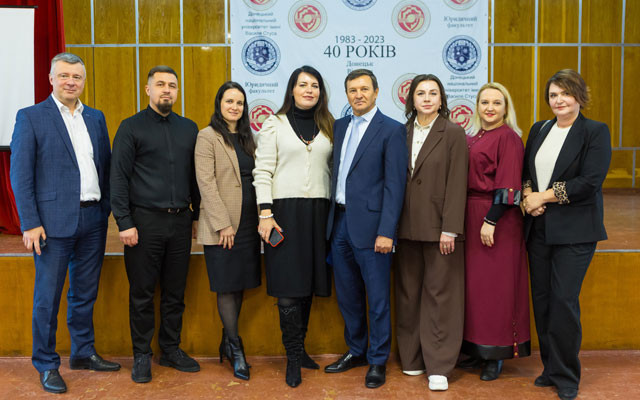
This was emphasized by Iryna Koval, dean of the law faculty at Vasyl Stus Donetsk National University, as she opened an educational seminar for students on «Protection and tools to counter disinformation (fake news and manipulation) in wartime». The event, organized on the initiative of the UNBA Committee on human rights protection, took place on November 6 in Vinnytsia.
The seminar moderator - Oksana Polotnyanko, representative of the Committee in the Vinnytsia region, noted that the problem of disinformation is global, and young people who actively consume content remain the most vulnerable audience. She stressed the need to verify sources and understand how false reports can influence people's perception of events and behavior.
Participants in the event received a memo entitled «How to verify information», which contained the key topics of the seminar:
- a dictionary of disinformation;
- how to recognize manipulation;
- how to verify sources and facts;
- how to protect personal information;
- a checklist for identifying fake news;
- legislative aspects of countering disinformation in Ukraine.
Separately, O. Polotnyanko emphasized the role of artificial intelligence in the spread of disinformation and called on participants to be critical of content generated by algorithms.
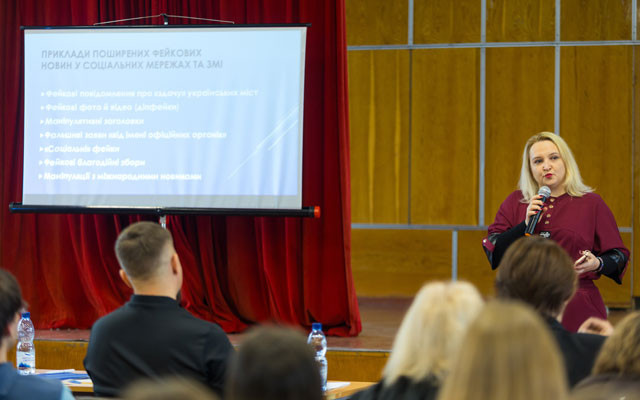
Today, disinformation has become one of the most dangerous tools of influence, especially in a state of martial law, when information becomes not only a resource but also a weapon. This was pointed out by Kateryna Kalachenko, associate professor of the department of economic and administrative law at the law faculty of Donetsk National University. She stressed that Ukraine still lacks a legislative definition of the term «disinformation», but some of its characteristics can be traced in the norms concerning unreliable, false, or incomplete information. Despite the lack of a clear definition, the state is already taking steps in this direction: in particular, a Center for Countering Disinformation has been created under the National Security and Defense Council, and various approaches to regulation are being introduced around the world, including a new UK law on false reporting.
The researcher outlined the main types of false information — unreliable, disinformation, and malicious information — and showed that their key difference lies in the presence of intent and the scale of the damage caused. K. Kalachenko gave common examples: fake reports of cities being «surrendered», deepfakes using artificial intelligence, distorted or manipulative headlines, false statements on behalf of government agencies, and fake charity collections.
Iryna Smirnova, a member of the UNBA Committee on human rights protection, focused on the legislative aspects of countering disinformation in wartime. The advocate emphasized that information today has effectively become a weapon capable of influencing society and determining people's behavior. She cited examples of waves of disinformation, including reports of a «new offensive» on Kyiv and fake street polls that created an impression of panic or despair. I. Smirnova stressed that disinformation is not neutral — it is aimed at undermining trust in state institutions, provoking conflicts, and undermining social unity.
She outlined the key provisions of regulatory acts relating to information security: the Constitution of Ukraine, the laws «On information», «On media», «On national security of Ukraine», the National security strategy, acts on the activities of the National security and defense council and the Center for countering disinformation. I. Smirnova stressed the importance of referring to official sources — in particular, the websites of the Ministry of Defense, law enforcement agencies, and structures responsible for information policy — and called on students to avoid spreading unverified messages, as certain actions may result in administrative or criminal liability.
Serhiy Starenkyi, deputy chairman of the UNBA Committee on human rights protection, emphasized that the main goal of disinformation is to influence a person's emotional state, change their behavior, and alter their perception of events. Disinformation is always created intentionally and is aimed specifically at eliciting an emotional response in a person — fear, anger, or panic. Therefore, S. Starenkyi stressed that even if a person has been targeted by disinformation, they should not become its retransmitter. He called on people to pause and evaluate any information that evokes strong emotions and not to spread it further until it has been verified.
In his speech, he described in detail the basic steps for verifying information: establish the source, compare facts, pay attention to inconsistencies, check whether there is official confirmation on government resources, and use technical tools for complaints and tags on social networks. The advocate focused separately on the issue of deepfakes, naming the key signs for recognizing them: asynchrony between sound and video, distortion during movement, and blurring of small facial features. He urged students to read beyond the headlines, not to react to manipulative wording, and to remember that the speed at which disinformation spreads is «worse than an epidemic», so everyone is responsible for curbing it.
Committee colleague Svitlana Mazur talked about critical thinking techniques, emphasizing the importance of being able to distinguish facts from opinions. She stressed that emotionally charged headlines — «shock», «sensation», «betrayal» — are typical indicators of fake news, created to elicit an immediate reaction and encourage sharing. Mazur reminded the audience that mixed wording, where facts are presented alongside assessments or assumptions, also creates a distorted impression and can be an element of manipulation.
To illustrate how fakes work, the advocate analyzed several real examples. In particular, the news that «the government spent millions on cars for officials», which in fact turned out to be taken out of context and concerned the purchase of special transport for evacuation and humanitarian needs. Another example is the claim that «students are being caught on the streets and taken to the TCC», which contradicts the law on deferment. S. Mazur emphasized that if a news story evokes strong emotions or contradicts basic logic, it is a signal to check the sources and content, and the main tools for countering fakes are attentiveness, analytical thinking, and refraining from automatically reposting.
Representatives of the cyber police and the prosecutor's office — Viktor Storozhuk and Kostyantyn Gozdup — focused on the practical aspects of information security. V. Storozhuk explained how attackers use social engineering and technical tools to spread fake news, citing typical scenarios of manipulation aimed at destabilization and provoking an emotional response. K. Gozdup, in turn, shared real criminal cases, describing how disinformation is used in recruitment schemes, information attacks, and sometimes combined with sabotage activities. He emphasized that curators from the Russian Federation are behind such actions, and law enforcement agencies open hundreds of cases related to information security violations every year.
At the end of the event, Oleksiy Kukhar, Vice President of the Bar Council of Ukraine emphasized to students that the seminar is of particular importance in the context of war, as disinformation is one of the key tools for influencing the stability of society. He thanked the representatives of the prosecutor's office and the police for their participation and stressed that critical thinking is a skill without which it is impossible to resist information attacks. According to him, statistics show that only about a third of people are capable of critical thinking. At the same time, in the legal profession, this figure reaches 70%, according to O. Kukhar, but it is still not absolute. He also noted that the significance of such seminars lies in the fact that they are only possible in a democratic society, since totalitarian regimes, on the contrary, are not interested in critically thinking citizens. The ability to analyze information and draw one's own conclusions is one of the key skills of a lawyer.
© 2026 Unba.org.ua Всі права захищені
"Національна Асоціація Адвокатів України". Передрук та інше використання матеріалів, що розміщені на даному веб-сайті дозволяється за умови посилання на джерело. Інтернет-видання та засоби масової інформації можуть використовувати матеріали сайту, розміщувати відео з офіційного веб-сайту Національної Асоціації Адвокатів України на власних веб-сторінках, за умови гіперпосилання на офіційний веб-сайт Національної Асоціації Адвокатів України. Заборонено передрук та використання матеріалів, у яких міститься посилання на інші інтернет-видання та засоби масової інформації. Матеріали позначені міткою "Реклама", публікуються на правах реклами.