
Financial monitoring and legal privilege: where is the line drawn - discussed at a workshop
For advocates, financial monitoring has become a balancing act: the law requires them to identify risky transactions, while most types of legal assistance are exempt from its provisions. How can they fulfill their duties without compromising professional secrecy and client trust?
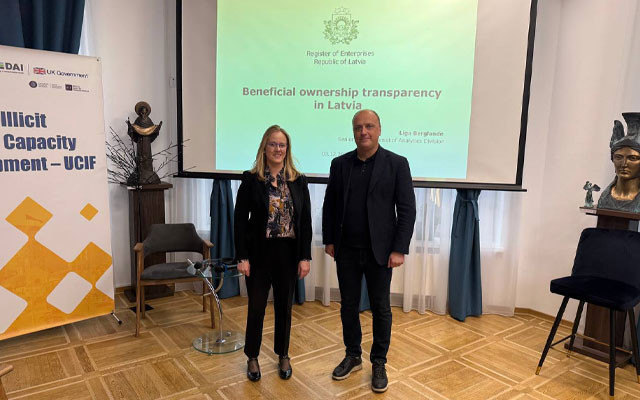
These and other questions regarding the application of Law No. 361-IX «On preventing and combating the legalization (laundering) of proceeds from crime, financing of terrorism and financing of the proliferation of weapons of mass destruction» was the central theme of the workshop «Compliance with AML/CFT requirements for notaries and advocates — balancing obligations and professional secrecy». The event, which took place on December 3, was organized in partnership with DAI Global and with the support of the UK's Foreign, Commonwealth & Development Office (FCDO).
At the invitation of the Centre for finance and security (CFS) at the Royal United Services Institute (RUSI), the workshop was attended by the chairman of the UNBA Committee on investment and privatization Andriy Shabelnikov, who presented the UNBA's position on these issues.
Advocate firms, advocate associations, and advocates practicing individually are required to provide primary financial monitoring (Article 6 of Law No. 361-IX). However, paragraph 1 of part 1 of Article 10 of the same Law stipulates that the requirements apply to advocates only in exceptional cases. An exhaustive list of such transactions includes support for the purchase and sale of real estate when financing construction, transactions with corporate rights or business entities, management of client funds or assets, opening accounts, raising funds to establish legal entities or manage funds, trusts, and similar structures. This list is fixed and cannot be expanded either by the practice of state bodies or by explanations.
At the same time, the vast majority of types of legal practice are not subject to financial monitoring requirements at all. Defense in criminal proceedings, representation in courts, pre-trial settlement of disputes, consultations — all of these are directly classified as exceptions by law. Decision No. 51 of the Bar Council of Ukraine dated July 3, 2021, further clarifies that an advocate's obligation as a financial monitoring entity arises only when three conditions are met simultaneously: a contract for the provision of legal assistance has been concluded, the client has applied specifically in relation to a transaction from the exhaustive list, and the exceptions established by law do not apply. This ensures clarity and predictability in the work of an advocate, preventing interpretations that could violate advocate independence.
A separate emphasis is placed on the limits of an advocate's duty and the preservation of advocate-client privilege. Neither the law nor the decisions of the BCU allow an advocate to submit information to state authorities about persons who are not his clients. Even if an advocate notices risky circumstances regarding the other party while accompanying a transaction, he cannot report this to the State Financial Monitoring Service, since such a person is not in a lawyer-client relationship. This is a key element in maintaining trust in advocacy and preventing interference with attorney-client privilege. At the same time, the Ministry of Justice and its territorial bodies are not included in the list of authorities to which such information may be disclosed.
An advocate must assess the risks associated with the client, jurisdiction, nature of the transaction, method of transfer of assets, and also take into account possible «red flags» — inconsistency of the client's activities with the transaction, unjustified involvement of third parties, concealment of the beneficiary, use of complex schemes without logical explanation, sudden activity, or unusually high fees. When accompanying transactions provided for by law, an advocate is required to identify and verify the client, establish the ultimate beneficiary, understand the purpose of the transaction, and keep the data received from the client up to date.
It should be noted that in recent years, the Ukrainian National Bar Association has been working systematically to ensure that the application of financial monitoring legislation takes into account the guarantees of advocate activity.
At one time, a working group involving the UNBA, the Ministry of Justice, the State Financial Monitoring Service and the Notary Chamber developed a new version of the regulations on financial monitoring. At that time, the Vice President of the UNBA, BCU Valentin Gvozdiy, noted that in implementing the recommendations of the FATF, the Council of Europe, and EU directives, it was fundamentally important to uphold the international standard of independence of the legal profession.
In December 2023, the BCU adopted Decision No. 123 «On the supervision of law firms, law associations, and advocates practicing individually in the field of prevention and counteraction, legalization (laundering) of proceeds from crime, financing of terrorism and financing of the proliferation of weapons of mass destruction».
Detailed recommendations on completing and submitting reporting form N 1-finmon by advocates, offices, and associations that are subject to primary financial monitoring are contained in the information letter of the BCU.
See also the following articles on the UNBA website:
Financial monitoring: when an advocate must submit reports to the Ministry of Justice
What every advocate should know about financial monitoring
Financial monitoring in a legal assistance agreement: when an advocate should warn a client
© 2025 Unba.org.ua Всі права захищені
"Національна Асоціація Адвокатів України". Передрук та інше використання матеріалів, що розміщені на даному веб-сайті дозволяється за умови посилання на джерело. Інтернет-видання та засоби масової інформації можуть використовувати матеріали сайту, розміщувати відео з офіційного веб-сайту Національної Асоціації Адвокатів України на власних веб-сторінках, за умови гіперпосилання на офіційний веб-сайт Національної Асоціації Адвокатів України. Заборонено передрук та використання матеріалів, у яких міститься посилання на інші інтернет-видання та засоби масової інформації. Матеріали позначені міткою "Реклама", публікуються на правах реклами.