
Land 2026: land relations issues discussed at the Lviv Chamber of Commerce and Industry
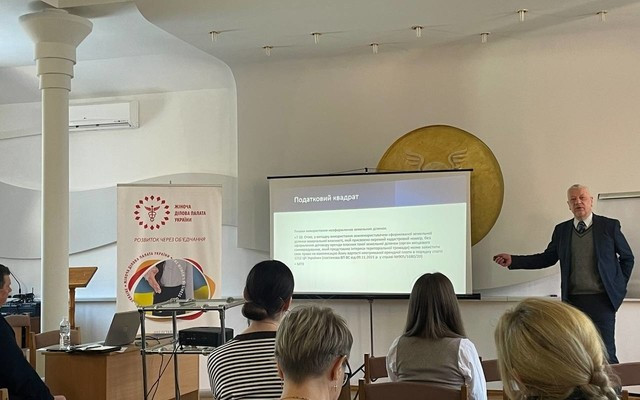
On January 21, the Lviv Chamber of Commerce and Industry hosted a seminar entitled «Land-2026. Current issues in land law», organized jointly by the Lviv Chamber of Commerce and Industry and the UNBA Committee on agricultural, land and environmental law.
Opening the event, CCI Vice President Roman Baran drew attention to the relevance of land issues in the context of European integration and the need to take into account the requirements of European legislation. The participants then moved on to practical issues, ranging from land payments and tax disputes to project analysis of land use and environmental restrictions.
Tax square
Chairman of the UNBA Committee on agricultural, land and environmental law Viktor Kobylansky spoke about land payments in 2026 and the peculiarities of land relations during martial law. He suggested looking at land payments as a legal and administrative issue rather than purely an accounting «technique», noting that it is appropriate at the beginning of the year to reconcile approaches to accruals and declarations, as well as to assess potential disputes regarding the correctness of determining tax liabilities.
Separately, the speaker drew attention to practical failures in the administration of land payments at the community level. According to his logic, inconsistencies are exacerbated when village councils effectively replace tax authorities, taking on functions that the law does not grant them. As an example, he mentioned situations where individuals do not pay land payments due to the lack of receipts, and instead of proper communication from the tax authorities, the council tries to provide these «signals».
As an applied tool for working with tax and land disputes, V. Kobyliansky presented his own analysis method — the «tax square», which consists of four elements: subject, object, base, and tax rate. He emphasized that the absence of any of these elements excludes the obligation to pay tax, and only a formed land plot is subject to taxation, so «payment of tax for part of the whole» is not allowed. To illustrate his approach, the advocate referred to examples from his practice, in particular disputes where the community tries to collect more than the taxpayer considers appropriate, as well as cases concerning payments in the context of multi-apartment buildings.
He also noted that the tax authorities' common formula of «land use in Ukraine is subject to payment» is not universally correct, since general use of land as a natural resource does not give rise to an obligation to pay, while special ownership, formalized by property rights, entails corresponding payments.
A separate part of the speech concerned court practice on the recovery of unjust enrichment under Article 1212 of the Civil Code for the actual use of land without legal grounds.
The speaker emphasized the risk of paying more than the actual tax if the registration of land rights is delayed, and also mentioned certain aspects of emphyteusis. In conclusion, V. Kobyliansky emphasized the importance of ongoing legal support in land and tax matters as a tool for preventing fines and avoiding double payments for the same thing.
Land must work
Project analysis can solve land use problems. This is the conviction of Committee member Andriy Sutkovy, who believes that legal support should be provided at the early stages of planning activities related to land use. When a lawyer is involved after key management decisions have already been made, it often turns out that it is impossible or excessively costly to implement the plan in the desired format.
The advocate also emphasized that it is not advisable to keep land «in reserve»: a plot of land should serve a specific purpose, be included in the logic of the project, and benefit businesses and communities, rather than generate passive costs.
In his opinion, one of the reasons for wrong decisions in land issues is a lack of understanding of land management among lawyers, which leads to errors in legal positions and, ultimately, negative consequences for land owners and users, as well as for decision-making bodies. To illustrate his point, the speaker referred to the analysis of documents and emphasized the importance of meticulous work with documentation as a safeguard against future conflicts.
In conclusion, A. Sutkovy formulated a practical conclusion: high-quality preparation and thorough verification of documents at the outset is an investment in «long-term peace» in land use for 10-15 years and more.
Not a plot, but a territory
How environmental legislation requirements affect land decisions by communities and businesses was explored by Deputy Chairman of the UNBA Committee Sofia Shutyak, in her report «Environmental functions of land: what you need to know about restrictions and encumbrances on land plots». She discussed the practical nuances that should be taken into account when developing urban planning documentation, planning activities, and undergoing strategic environmental assessments and environmental impact assessments.
The speaker emphasized that legal regulation applies not only to established land plots, but also to land as territories. According to her, this is often overlooked in land disputes, although there are territories that are protected by law regardless of whether they are registered as separate objects of ownership or use. As examples, she mentioned coastal protection strips and other nature conservation areas, and also stressed that communities should have full information about the environmental status of their territories.
In practical terms, S. Shutyak drew attention to the need to take into account in the activities of communities the requirements of the Law «On National geospatial data infrastructure», the Procedure for developing a flood risk management plan, approved by Cabinet of Ministers Resolution No. 247 of 04.04.2018, as well as regulatory provisions on the protection of small rivers. In conclusion, she emphasized the complexity of environmental issues and the need to combine environmental protection with economic development through clear rules, a transparent decision-making mechanism, and open discussion of interests.
***
Thus, all three speeches converged on one point: land decisions in 2026 require not «point» reactions, but a systematic approach — from the correct determination of taxation elements and timely registration of rights to project planning and consideration of environmental restrictions. In practice, this means fewer risks in disputes, more predictable costs, and clearer rules for interacting with government agencies.
© 2026 Unba.org.ua Всі права захищені
"Національна Асоціація Адвокатів України". Передрук та інше використання матеріалів, що розміщені на даному веб-сайті дозволяється за умови посилання на джерело. Інтернет-видання та засоби масової інформації можуть використовувати матеріали сайту, розміщувати відео з офіційного веб-сайту Національної Асоціації Адвокатів України на власних веб-сторінках, за умови гіперпосилання на офіційний веб-сайт Національної Асоціації Адвокатів України. Заборонено передрук та використання матеріалів, у яких міститься посилання на інші інтернет-видання та засоби масової інформації. Матеріали позначені міткою "Реклама", публікуються на правах реклами.