
No secret: USA court grants access to defendant's AI correspondence
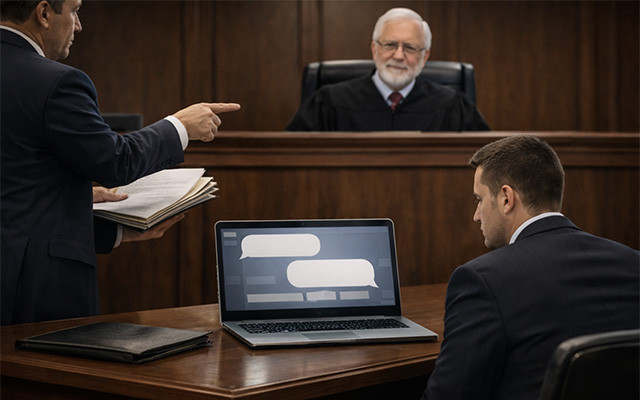
If a person enters facts, a version of events, or information from an advocate into a public chatbot, all of this information is effectively disclosed to a third party and therefore ceases to be confidential within the meaning of criminal procedural law.
The USA District Court for the Southern District of New York is hearing a criminal case against Bradley Heppner (United States v. Heppner, 25 Cr. 503), who is accused of securities fraud and document forgery.
In November 2025, during his arrest, the FBI searched his home and seized documents and electronic devices. Among them were 31 files containing B. Heppner's communications with Anthropic's Claude platform (the defendant used AI to independently prepare materials with possible defense strategies in the criminal case and subsequently transferred them to his advocates). Under criminal procedure law, these materials should have been protected from disclosure as having been produced by the defendant during the investigation or defense of the case. However, the prosecution challenged this status, and on February 10, 2026, Judge Jed S. Rakoff granted the motion.
The judge reasoned that communications with a public generative platform are not covered by either advocate-client communications, which are confidential, or the work product doctrine, which protects materials prepared by the defense for trial.
Thus, AI is not an advocate, so a conversation about the law between two non-advocates does not constitute attorney-client privilege. In addition, the exchange of information was not confidential, as Anthropic's privacy policy provides for the collection of information, the possibility of its use for model training, and disclosure to third parties. Therefore, the user cannot expect confidentiality regarding what is entered and generated. Even if the prompt contained information that the defendant received from advocates, the very fact of entering it into Claude means disclosure to a third party and, accordingly, loss of confidentiality, just as when transferring it to anyone outside the «advocate-client» relationship. And even if B. Heppner intended to transfer these materials to an advocate, they would not have acquired the status of attorney-client privilege because of this.
Even the purpose — obtaining legal assistance — does not give such communication a special status, since, in the court's opinion, it is not the further use of the result that matters, but the nature of the communication at the moment it is made. The lawyers did not instruct B. Heppner to make inquiries to Claude, and the platform itself is not a specialist that advocates are entitled to engage for specific issues. Moreover, the platform itself expressly warns that it does not provide legal advice and advises users to consult a qualified advocate. Therefore, in these circumstances, the court did not accept the logic that such exchanges could be equated with attorney-client privilege.
Regarding the work product doctrine, the court recalled that it is intended to protect the mental processes of an advocate and materials prepared by or on behalf of an advocate in anticipation of litigation or for court. Even if we assume that the AI documents were created for this purpose, this is not enough: they were not prepared by an advocate or on his behalf, but on the initiative of the defendant himself. Therefore, AI documents are not subject to protection.
© 2026 Unba.org.ua Всі права захищені
"Національна Асоціація Адвокатів України". Передрук та інше використання матеріалів, що розміщені на даному веб-сайті дозволяється за умови посилання на джерело. Інтернет-видання та засоби масової інформації можуть використовувати матеріали сайту, розміщувати відео з офіційного веб-сайту Національної Асоціації Адвокатів України на власних веб-сторінках, за умови гіперпосилання на офіційний веб-сайт Національної Асоціації Адвокатів України. Заборонено передрук та використання матеріалів, у яких міститься посилання на інші інтернет-видання та засоби масової інформації. Матеріали позначені міткою "Реклама", публікуються на правах реклами.