
«Freedom or security» — a false formula: speech by L. Izovitova at the conference of bar presidents
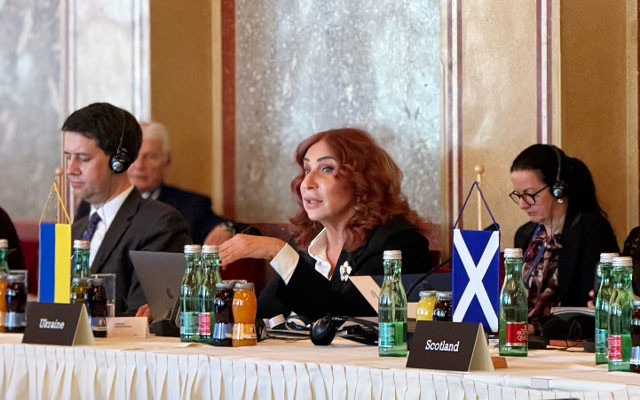
Is the state protecting society from crime today, or is it gradually destroying the rule of law under the guise of this fight? These alarming trends were outlined by the President of the UNBA, BCU Lidiya Izovitova, during her speech at the 54th European Conference of bar presidents.
The event, which is currently taking place in Vienna, has traditionally brought together leaders of the legal profession from around the world.
The chairman of the UNBA noted that the strongest pressure on human rights today comes from those states that, under the banner of security, allow themselves extraordinary powers and increasingly widespread interference in human rights. «We are often offered a simple formula: freedom or security. But from a legal point of view, this formula is flawed, - noted L. Izovitova. - Human rights were not created for peaceful times. They were created precisely for moments of danger. For situations in which the state is tempted to act quickly, harshly, and without proper restrictions and control».
She pointed out that legal practice in Europe and around the world demonstrates a recurring pattern. It is the fight against these threats that becomes the basis for expanding surveillance, weakening judicial control, and narrowing procedural guarantees.
L. Izovitova also cited several examples. In Italy, the long-standing fight against mafia structures led to the introduction of special regimes and extraordinary control instruments, which over time began to affect the sphere of the right to defense. In the European Union, under the banner of combating serious and organized crime, mass data storage was introduced, covering millions of people, most of whom had no connection to crime. In the United Kingdom, the expansion of electronic and mass surveillance powers was a response to the threats of terrorism and organized crime, which again called into question the limits of privacy and professional secrecy. In the field of anti-money laundering, advocacy in many countries has faced systematic pressure on attorney-client privilege under the pretext of combating financial crime.
«In each of these cases, the logic was similar. Security demanded concessions. And the first to come under pressure was the legal process. Unfortunately, Ukraine is no exception to this trend», - concluded the President of the UNBA, BCU.
She noted direct and systematic interference in the activities of lawyers. «They are monitored not only by law enforcement agencies, but also by representatives of the media. On television, on social media, and in the public sphere, materials appear in which advocates are publicly portrayed as criminals or accomplices, while in fact they are simply carrying out their legal activities and fulfilling their constitutional function of providing defense. This is not freedom of speech. This is a gross interference in the independence of the legal profession and a direct undermining of the right to defense», - warns L. Izovitova. At this point, in her view, the state and society cease to see advocates as institutional guarantors. Advocates begin to be perceived as a threat, an obstacle, part of the problem.
At the same time, the very logic of criminal proceedings is changing. People are increasingly less likely to be perceived as bearers of rights. And more and more often — as a potential threat. «The presumption of innocence is becoming declarative. The right to defense — burdensome. The court risks becoming a formality that merely confirms decisions made in advance. It is in this context that the true role of advocacy becomes apparent. But advocacy is not opposed to security, - the President of the UNBA, BCU is convinced. - Advocacy is an institutional safeguard against security becoming an excuse for denying rights».
Izvytova also recalled the adoption by the Council of Europe of the Convention for the Protection of the Profession of Lawyer, which enshrines what the advocacy community has been defending for decades: the independence of advocates, protection from interference, guarantees of professional secrecy, and unconditional recognition of the role of advocates in the justice system.
«We must make full use of this tool, - says the President of the UNBA, BCU. - Not declaratively, but practically: refer to the Convention in national courts, use it in international protection mechanisms, make it part of professional and legal discourse. Because this is not a matter of corporate interests. It is a matter of preserving the rule of law».
«Perhaps the real conflict today is not between freedom and security, but between the rule of law and the temptation to postpone it «until better times». And it is precisely this conflict that advocacy must respond to. Because a state that loses its ability to restrain itself ultimately loses both freedom and security. And a law that cannot withstand pressure ceases to be a law», - concluded L. Izovitova.
© 2026 Unba.org.ua Всі права захищені
"Національна Асоціація Адвокатів України". Передрук та інше використання матеріалів, що розміщені на даному веб-сайті дозволяється за умови посилання на джерело. Інтернет-видання та засоби масової інформації можуть використовувати матеріали сайту, розміщувати відео з офіційного веб-сайту Національної Асоціації Адвокатів України на власних веб-сторінках, за умови гіперпосилання на офіційний веб-сайт Національної Асоціації Адвокатів України. Заборонено передрук та використання матеріалів, у яких міститься посилання на інші інтернет-видання та засоби масової інформації. Матеріали позначені міткою "Реклама", публікуються на правах реклами.