
From prompt to responsibility: on the application of AI in advocacy practice
In legal practice, artificial intelligence can eliminate routine tasks and speed up the analysis of large data sets. However, the typical shortcomings of generative models — from hallucinations and bias to cyber risks — increase the demands on an advocate's professional prudence.
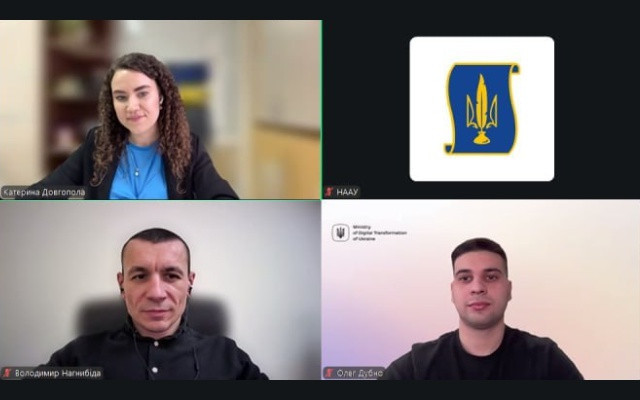
The UNBA NextGen in the Khmelnytskyi region organized and conducted a webinar on «The use of AI in advocacy practice: benefits and risks». At the start, the representative of this Committee Kateryna Dovgopol set the tone for the conversation: AI has already become part of legal work, but there are limits that need to be discussed: confidentiality, attorney-client privilege, and the risks of «fictitious» practice. As an apt epigraph, she quoted a phrase suggested to her by ChatGPT at the beginning of her speech: «Artificial intelligence is a wonderful servant but a dangerous master».
AI manager at the Ministry of Digital Transformation Oleg Dubno presented an approach to the responsible use of artificial intelligence by lawyers. He explained that Ukraine currently lacks regulatory and legal regulation in this area, so the Ministry of Digital Transformation has opted for «preparatory» documents and sectoral guidelines for various areas. In particular, a roadmap for the development of legal regulation in the field of AI was published in 2023, and a «white paper» on the regulation of artificial intelligence was published in 2024. One of the practical tools of this approach was sectoral recommendations on the responsible use of AI, including a separate document prepared for lawyers in cooperation with the Ministry of Justice and experts (available at this link).
O. Dubno emphasized that in legal work, AI can automate routine tasks and assist with the analysis of large volumes of materials, but responsible use remains a key condition. He cited examples where “hallucinations” became a problem in court. Therefore, according to him, in the work of an advocate, the results of AI should be checked every time. At the same time, there is no such thing as an «error rate»: it depends on the field and type of query.
Regarding confidentiality, the expert emphasized that it is important for advocates to focus not on assumptions about the «safety» of a particular version of a software product, but on the policies and terms of its use. If the rules provide for the possibility of using the entered data for further training, then deleting the chat history does not eliminate the risk: the information could have been saved earlier. Therefore, when AI is used to process client data or confidential documents, the client's consent must be obtained and transparency must be ensured regarding how the tool is used.
The practical aspects of the daily use of AI were revealed by the deputy chairman of the International Commercial Arbitration Court at the Ukrainian Chamber of Commerce and Industry Volodymyr Nagnybida. He expressed his conviction that AI is not a competitor to professionals. Competition is created by people who have already mastered the skills of working with these tools.
The speaker talked about moving away from the «Google paradigm» of queries such as «find me» and advised giving more context, clearly defining the role and scope of the answer (process, jurisdiction, area of law). He gave the example of the «ask me» format: when an advocate describes their position in a case and asks the system to ask the most difficult questions that an opponent might ask, or to point out the weak points in the argument.
In the section on applied cases, V. Nagnybida spoke about the use of AI for quickly processing large documents before a hearing, preliminary analysis of contracts for «balance of interests», forming options for editing individual clauses, and preparing draft responses to emails.
The ICAC representative also reported on the court's work on a comprehensive online platform: electronic offices for the parties, access to case materials, submission of documents, video conferences, addition of representatives, and internal user notes. He noted that the team is working on the technical specifications and plans to obtain the first version for further testing, and also mentioned the intention to create a mobile version. Regarding AI tools for the ICAC, he emphasized that the issue of implementation is being considered separately and primarily through the prism of confidentiality, which he called a basic principle of international commercial arbitration.
© 2026 Unba.org.ua Всі права захищені
"Національна Асоціація Адвокатів України". Передрук та інше використання матеріалів, що розміщені на даному веб-сайті дозволяється за умови посилання на джерело. Інтернет-видання та засоби масової інформації можуть використовувати матеріали сайту, розміщувати відео з офіційного веб-сайту Національної Асоціації Адвокатів України на власних веб-сторінках, за умови гіперпосилання на офіційний веб-сайт Національної Асоціації Адвокатів України. Заборонено передрук та використання матеріалів, у яких міститься посилання на інші інтернет-видання та засоби масової інформації. Матеріали позначені міткою "Реклама", публікуються на правах реклами.