
Joint custody after divorce: discussion in the Verkhovna Rada with the participation of advocates
A child has the right to contact with parents who live separately and to be raised by both of them. Therefore, legislative initiatives should promote the development of a model of joint parental care that focuses on the child and his or her best interests. At the same time, the use of a child as a tool to satisfy the whims of adults or conflicts between them should be prevented.
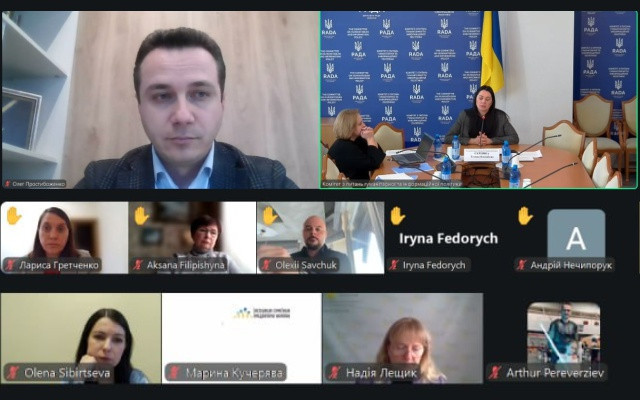
On March 3, the Verkhovna Rada Committee on humanitarian and information policy organized and held a meeting of the working group on parental involvement in child-rearing, during which MPs, human rights activists, representatives of public organizations, and advocates expressed their opinions on the advisability of the changes proposed by the draft laws: The chairman of the UNBA Committee on civil law and procedure Oleg Prostybozhenko, drew attention to the inexpediency of the guardianship and custody authority providing conclusions on cases being decided by the court. This results in delays in the consideration of cases, the actual replacement of the court by the guardianship and custody authority (given the actual duplication of their functions), and also causes corruption risks.
- No. 12123 of 15.10.2024 «On amendments to the Family Code of Ukraine regarding joint parental custody of children»;
- No. 12132 of 17.10.2024 «On amendments to the Family Code of Ukraine regarding the introduction of a model of joint parental custody of children after divorce as the primary model».
He emphasized the need to change the existing paradigm to a child-centered one: the child should be the focus of attention of parents, the court, the guardianship and custody authority, etc., and these persons should «revolve» around the child. In practice, this should manifest itself in the prohibition of unilateral changes to the child's educational institution by one of the parents, arbitrary changes to the child's place of residence, etc.
«It is necessary to simultaneously resolve the issue of determining the child's place of residence and establishing a schedule for the other parent's communication with the child. This approach will avoid lengthy court disputes and help ensure the best interests of the child. In addition, alternating residence of the child with each parent can be implemented not by changing the child's place of residence, but by alternating the parents' residence in the child's home», - O. Prostybozhenko emphasized.
In his opinion, the proposal to secure the claim by establishing the child's place of residence and a schedule for communication, as well as prohibiting a change in the child's educational institution, is quite reasonable. He drew particular attention to the need to increase liability for failure to comply with a court decision concerning parental responsibility.
The equality of parents' rights with regard to the child derives from the rights and interests of the child itself to harmonious development and proper upbringing. This was noted by the chairman of the UNBA Committee on family law Larysa Gretchenko. Family relationships are characterized by multiplicity and diversity, which makes it impossible to apply a general rule to each individual situation.
In addition to judicial protection, it is important to improve the mechanisms for contractual settlement of disputes involving children or relating to their interests, mediation as an alternative means of settling family disputes, and to enshrine guarantees for their practical implementation.
According to L. Gretchenko, the cyclical nature of family disputes can be continuous: often, after the completion of court proceedings to determine the child's place of residence with one of the parents, a lawsuit is immediately filed to change it, or there is a risk of the other parent arbitrarily changing the child's place of residence. The methods of participation of one of the parents in the upbringing of the child and the established schedule of communication, determined by the decision of the guardianship and custody authority or the court, often encounter obstacles in their implementation, which necessitates a repeat application to the court with a request to remove them. Long-term court proceedings and the parents' conflictual behavior within the family dispute create the risk of the child developing alienation syndrome towards the parent who lives separately, which is considered a manifestation of psychological violence.
«Parental divorce is a factor that can lead to difficult life circumstances and negatively affect the life, health, and development of the child. Legislation should focus not only on making decisions about parental involvement in the child's upbringing after divorce, but also on ensuring that the child is accompanied and supported during the lengthy resolution of the family dispute, - said L. Gretchenko. - It is urgent to develop special legislative provisions regarding the child's right to have their interests represented by an independent advocate, as well as access to psychological assistance in the absence of parental consent — as guarantees of adequate protection of children by the state. This approach requires not fragmentary changes to the Family Code of Ukraine, but systemic changes to legislation on child protection, social services, enforcement proceedings, and a number of other regulatory and legal acts».
© 2026 Unba.org.ua Всі права захищені
"Національна Асоціація Адвокатів України". Передрук та інше використання матеріалів, що розміщені на даному веб-сайті дозволяється за умови посилання на джерело. Інтернет-видання та засоби масової інформації можуть використовувати матеріали сайту, розміщувати відео з офіційного веб-сайту Національної Асоціації Адвокатів України на власних веб-сторінках, за умови гіперпосилання на офіційний веб-сайт Національної Асоціації Адвокатів України. Заборонено передрук та використання матеріалів, у яких міститься посилання на інші інтернет-видання та засоби масової інформації. Матеріали позначені міткою "Реклама", публікуються на правах реклами.