
Expert assessment of intellectual property: practical guidance for advocates
In disputes over intellectual property, the defense strategy is sometimes determined by expert testimony. Therefore, it is crucial for advocates to formulate questions correctly, prepare materials and understand the limits of expert competence.
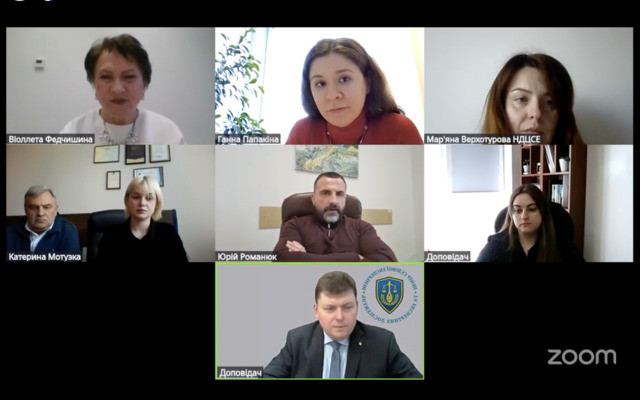
The practical aspects of forensic examination of intellectual property were discussed at a roundtable organized by the UNBA Committee on expert support for legal practice in collaboration with relevant institutions: the Research center for Forensic Expertise in Information Technology and Intellectual Property of the Ministry of Justice, the Center for Forensic Expertise and Expert Research and the All-Ukrainian Public Organization «Union of Experts of Ukraine». The participants were welcomed by the acting director of the Research Center Hanna Papakina, who emphasized the relevance of the topic and wished the participants a fruitful professional discussion.
Where does the boundary of competence lie
Director of the Center for Forensic Expertise and Expert Research and President of the Union of Experts of Ukraine Igor Starodubov drew attention to the difference between the two types of forensic expertise in the field of inventions and utility models (regarding the use of an object and regarding the invalidation of a patent). According to him, in the case of use, the patent is in force, so the expert must examine the features set forth in an independent claim of the patent specification in relation to the technical result and then establish their presence in the subject matter of economic activity. However, when deciding on the invalidity of a patent, the expert similarly identifies a list of features that correlate with the technical result, but in this context, the question arises regarding the appropriateness of determining the materiality of the features.
He expressed the view that when examining the actual use of the subject matter, determining the materiality of the features is inappropriate, since the expert would then partially assume the functions of the agency that granted legal protection.
I. Starodubov also addressed the role of the court expert and the preparation of materials for the examination. He emphasized that the expert has no right to independently collect materials and works only within the scope of the documents provided; therefore, the preparation of documents for the examination falls on the applicants, representatives, advocates, and patent agents.
The speaker noted that advocates often focus primarily on the formal aspects of the opinion, whereas, in his view, what matters most are the subject and object of the examination, as well as the examination procedure itself and the answers to the questions posed.
The logic of trademark examination
Head of the sector at the Ministry of Justice’s Research Center Kateryna Motuzka dedicated her presentation to the examination of means of individualization. She noted that trademarks are the most common among them and categorized them into word, figurative, and combined marks. The speaker also outlined the main tasks of an expert in such cases: establishing the identity or similarity of means of individualization, as well as determining whether a particular designation could mislead consumers regarding goods or services.
She explained that when examining word marks, phonetic, graphic, and semantic similarity is analyzed; when examining figurative marks, the nature of the image, its content, geometric shape, and combination of colors and tones are examined; and in the case of combined marks, these characteristics are combined and examined sequentially.
The expert also outlined the grounds and materials required for conducting such an examination. According to her, the grounds may be a procedural document—a ruling or resolution—as well as a request from an advocate or a natural or legal person, on the basis of which a contract is concluded. For trademark examination, she noted, the expert first and foremost needs objects for comparison: designations used on products, in brochures, on signs, or in advertisements; certified copies of trademark certificates; extracts from the state register; and, in the case of a trade name, extracts that allow determining the business activities of the relevant legal entity.
Mistakes at the start
Advisor to the director of the Center for Forensic Expertise and Expert Research Natalia Begush focused on practical issues that arise as early as the stage of contacting an expert.
She noted that following changes to procedural law in 2017, the parties gained the ability not only to request the appointment of an expert examination but also to submit expert opinions independently. Such an opinion in cases involving intellectual property is very often key or plays an important role in the decision-making process. She emphasized that an expert examination should be planned even before filing a lawsuit, as this allows for taking into account the timeframe for its completion, formulating questions independently in light of one’s legal position, and assessing the case’s prospects before going to court.
N. Begush listed common mistakes when requesting an expert opinion. Among them, she cited general or legal, evaluative questions such as whether there has been an infringement of intellectual property rights, whether there was unlawful use of the object or plagiarism, as well as an excessive number of questions and duplication of questions.
In addition, she highlighted issues such as the absence or insufficiency of materials for examination, poor documentation of evidence, inconsistencies between the questions posed and the objects provided, as well as improper recording of information.
The speaker advised clearly indicating certificate numbers, titles of works, and objects of study; asking non-legal questions; specifying the type of legal proceeding for which the opinion is being prepared for submission to the court; and, if necessary, contacting the institution for preliminary consultation regarding the formulation of questions even before the expert examination is appointed.
The weight of the opinion
The procedural and non-procedural aspects of an expert opinion were outlined by a forensic expert at the Research Center Konstantin Kovalyov. He noted that a key component of protecting intellectual property rights is the conduct of a forensic examination or expert study, the results of which are documented in a written opinion.
The speaker outlined the grounds for engaging an expert: in a procedural context — by decision of a court, an investigating judge, a pre-trial investigation body, or a party to the case; and in a non-procedural context — based on a contract with an expert or an expert institution following a written request from the client specifying the details, list of questions, and objects provided.
Separately, K. Kovalyov drew attention to the formatting of the expert opinion. According to him, when an expert examination is ordered by a court or a pre-trial investigation body, the expert is warned of criminal liability for a knowingly false opinion and for refusing to provide an opinion. If, however, the expert examination is conducted at the request of a party to the case, the opinion must state that it was prepared for submission to the court and that the expert is aware of criminal liability for a knowingly false opinion.
He also stated that when conducting an expert examination or expert study in the field of intellectual property, the expert may seek the necessary information from sources that can be unambiguously identified, including on the Internet. At the same time, he noted that an opinion prepared by a specialist who is not a certified forensic expert and operates outside the scope of procedural law does not acquire the status of a source of evidence in the case but serves only an informative purpose.
When there are too many experts
In the final part of the discussion, the chairman of the UNBA Committee on intellectual property Yuriy Romanyuk, drew attention to a practical problem that, in his words, often arises in cases of this category: an expert opinion is key evidence, but in a single case there may be several opinions on the very same issue, based on the same evidence, yet with diametrically opposed results. That is why he proposed holding a separate joint meeting involving advocates practicing in the field of intellectual property and experts to discuss the practical aspects of preparing and evaluating such opinions.
The Committee chairman also raised the issue of works created using artificial intelligence.
He noted that advocates are already asking questions about which methodologies to use to examine such objects, whether there are appropriate specialists for this, what type of expert examination they should fall under, and exactly what questions to ask the expert. This topic, according to Y. Romanyuk, also deserves further professional discussion.
The chairman of the UNBA Committee on expert support for legal practice Violleta Fedchyshyna, who also served as moderator, commented on the event’s outcomes. «This roundtable demonstrated that forensic expertise in the field of intellectual property requires ongoing professional dialogue between advocates and experts. Today, we outlined the procedural and practical aspects of preparing expert opinions and raised issues that require further professional discussion. I hope that the results of this meeting will be useful for advocates’ daily practice and will serve as a foundation for future joint events», - she noted.
© 2026 Unba.org.ua Всі права захищені
"Національна Асоціація Адвокатів України". Передрук та інше використання матеріалів, що розміщені на даному веб-сайті дозволяється за умови посилання на джерело. Інтернет-видання та засоби масової інформації можуть використовувати матеріали сайту, розміщувати відео з офіційного веб-сайту Національної Асоціації Адвокатів України на власних веб-сторінках, за умови гіперпосилання на офіційний веб-сайт Національної Асоціації Адвокатів України. Заборонено передрук та використання матеріалів, у яких міститься посилання на інші інтернет-видання та засоби масової інформації. Матеріали позначені міткою "Реклама", публікуються на правах реклами.