
Personal data, evidence and investigations: highlights of the conference in Dublin
Internal investigations, economic analyses, and the handling of large volumes of personal data increasingly require advocates to demonstrate procedural precision and an understanding of regulatory risks. This is especially true when a case has an international element or involves EU jurisdictions.
These issues were discussed in Dublin during the international conference «Investigations in 2026: legal, forensic and regulatory aspects».
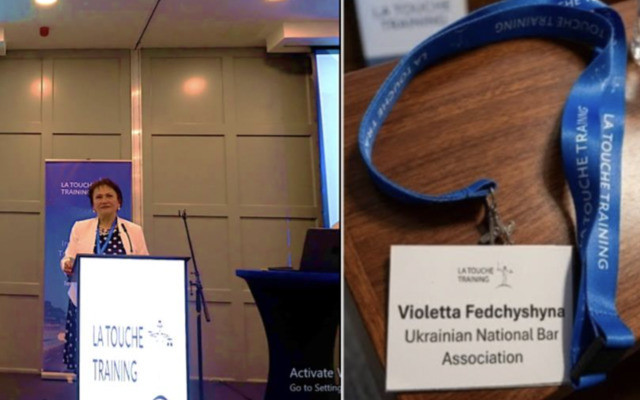
The event was attended by Violleta Fedchyshyna, chairman of the UNBA Committee on expert support for legal practice.
One of the key topics of the conference was the strengthening of regulatory oversight in the field of personal data protection in accordance with the GDPR. Participants noted that it is no longer sufficient for businesses and lawyers to merely have internal policies in place. In today’s environment, the ability to demonstrate actual compliance with data processing rules — particularly the principles of lawfulness, minimization, confidentiality, and accountability — is becoming increasingly important.
For legal practice, this is of direct relevance in cases involving financial documents, banking information, and data on employees, counterparties, or clients. Such materials may be required for internal investigations, preparing a legal position, or conducting economic expert analyses. At the same time, their improper collection, transfer, or storage can create additional risks for the party, the expert, and the evidence itself.
Separately, the conference discussed internal investigations in cases involving corporate violations, fraud, employee complaints, misconduct by officials, and the protection of whistleblowers. The discussion focused on the need to balance effective evidence collection with respect for individual rights, confidentiality, disclosure requirements, and the procedural integrity of the investigation itself.
Conducting a legally sound investigation requires specialized knowledge.
In this context, V. Fedchyshyna joined the discussion on approaches to obtaining and establishing the necessary economic indicators, as well as the formation of an expert economist’s opinion as admissible evidence in court proceedings.
Economic expertise often involves working with large volumes of financial information, which may contain personal data. Therefore, the legal basis for the expert’s access to such data, the proper formalization of contractual relations with the client, the confidentiality of document exchange, and the secure storage of working files are crucial.
Such approaches are also relevant to Ukrainian practice, particularly in light of Ukraine’s European integration efforts and the gradual alignment of national regulations on personal data protection with European standards.
Therefore, when commissioning or using an economic expert report, it is advisable to assess in advance not only its substantive evidentiary value but also the method of obtaining, processing, and transferring data. If information is not necessary to prove a specific economic fact, it is advisable not to disclose it or to conceal it appropriately.
© 2026 Unba.org.ua Всі права захищені
"Національна Асоціація Адвокатів України". Передрук та інше використання матеріалів, що розміщені на даному веб-сайті дозволяється за умови посилання на джерело. Інтернет-видання та засоби масової інформації можуть використовувати матеріали сайту, розміщувати відео з офіційного веб-сайту Національної Асоціації Адвокатів України на власних веб-сторінках, за умови гіперпосилання на офіційний веб-сайт Національної Асоціації Адвокатів України. Заборонено передрук та використання матеріалів, у яких міститься посилання на інші інтернет-видання та засоби масової інформації. Матеріали позначені міткою "Реклама", публікуються на правах реклами.