
The UNBA proposes updating tax treatment of advocates' expenses
The tools, services, and conditions under which advocates practice their profession are constantly changing: from digital platforms and CRM-systems to home offices and backup power solutions. At the same time, the State Tax Service’s guidelines for determining advocates’ expenses when calculating taxable income remain tied to realities that took shape over 13 years ago.
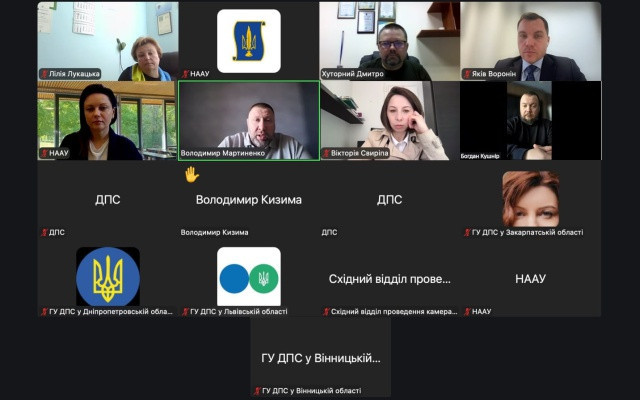
The issue was examined during a roundtable discussion titled «Updating approaches to determining advocates’ expenses in accordance with State Tax Service Order No. 1185», organized by the UNBA Committee on legal practice and the UNBA Committee on customs and tax law. The subject of discussion among advocates and tax officials was the general tax consultation approved by State Tax Service Order No. 1185 of December 24, 2012.
There are many regulations in Ukraine that have not been revised for a long time, - noted Bogdan Kushnir, chairman of the UNBA Committee on legal practice. Some of them, he said, are outdated not only in terms of when they were adopted but also in terms of content, as they contain provisions that are no longer relevant or contradict current regulatory acts. That is why, he noted, the participants gathered to explore ways to rectify the situation and prepare proposals for changes.
He was supported by Yakiv Voronin, chairman of the UNBA Committee on customs and tax law, who noted that over the past 14 years, the nature and substance of advocates’ expenses as self-employed individuals have changed. Therefore, he said, it is important to bring approaches in line with current conditions and standardize the application of the rules. He noted that advocates and the State Tax Service must have a shared understanding of what can be included in expenses, as clear rules also reduce the administrative burden.
Vyacheslav Datsenko, deputy director of the state tax service’s Department of individual taxation, acknowledged that the State Tax Service’s order does not take current realities into account. At the same time, he noted that expenses not directly listed in the general tax consultation may still be taken into account provided they meet the requirements of para. 178.3 of Art. 178 of the Tax Code and are supported by documentary evidence. According to him, the list provided in the order is not exhaustive, but the mere fact that an expense is included in the list does not mean it will automatically be taken into account without the proper documentation.
This structure became one of the key issues of the discussion. Participants noted that an advocate, upon opening Order No. 1185, should see a clear guideline rather than having to determine each time whether a specific expense will be accepted by the tax authority. As an example, participants cited office repairs or window replacement following damage to the premises: on the one hand, this may be related to the functioning of the workplace; on the other hand, in every case, the question arises regarding documentary evidence and the legal classification of such expenses.
Y. Voronin explained that the current guidance serves as a reference for advocates and tax authorities, but the current challenge is to provide both parties with clarity regarding modern expenses and reduce the number of misunderstandings. According to him, the UNBA is initiating the preparation of a new advisory opinion or an update to the current document, as legal certainty on this issue is needed by both advocates and representatives of the State Tax Service.
Among the expenses requiring clarification, participants cited the digital work environment first and foremost. This included legal databases, professional applications, services, subscriptions, CRM systems, and other tools that advocates use in their work. The issue of expenses for marketing, social media management, and other modern methods of communication with clients and the professional audience was also raised.
The topic of home offices was also discussed. According to Y. Voronin, following the COVID-19 pandemic, some advocates have been working from home, raising the question of which expenses are related to an individual’s living costs and which are related to the performance of legal work. In his view, these issues also require separate consideration.
Participants classified the following as wartime expenses: office repairs following damage, window replacement, forced relocation, and expenses related to energy independence. Dmytro Khutornoy, deputy chairman of the UNBA Committee on legal practice, mentioned power banks, uninterruptible power supplies, generators, charging stations, and inverters. He noted that without electricity, computers, printers, and the internet do not work, and therefore energy stability is linked to the ability to provide legal assistance in a timely manner.
The discussion also touched on expenses related to professional development. Participants noted that mandatory training for advocates is a clear-cut category; however, situations where an advocate undergoes more training than the minimum required — such as courses abroad, language courses, or training related to new technologies — require further clarification.
In addition, the discussion touched on issues such as business trips, transportation costs, car rentals, write-offs for fuel and lubricants, as well as banking and foreign exchange transactions.
Volodymyr Kyzyma, director of the Department of individual taxation at the State Tax Service, noted that the tax service sees a need to update its approaches, particularly due to digitalization and the emergence of new tools. At the same time, he was critical of the idea of creating a new list, which would require revision in a few years anyway. Therefore, he said, it is worth considering not only a specific list of expenses but also general criteria regarding their connection to professional activities.
Following the discussion, participants outlined the next steps. First, the UNBA must compile the proposals from the legal community and relevant Committees regarding expenses that require clarification. Afterward, the resulting list will be discussed with the State Tax Service to coordinate approaches to its practical implementation. Subsequently, these proposals must be submitted to the Ministry of Finance, as it is responsible for shaping state tax policy.
In this regard, the UNBA calls on advocates to participate in developing proposals to improve approaches to determining expenses and to submit their ideas for further consolidation and review.
© 2026 Unba.org.ua Всі права захищені
"Національна Асоціація Адвокатів України". Передрук та інше використання матеріалів, що розміщені на даному веб-сайті дозволяється за умови посилання на джерело. Інтернет-видання та засоби масової інформації можуть використовувати матеріали сайту, розміщувати відео з офіційного веб-сайту Національної Асоціації Адвокатів України на власних веб-сторінках, за умови гіперпосилання на офіційний веб-сайт Національної Асоціації Адвокатів України. Заборонено передрук та використання матеріалів, у яких міститься посилання на інші інтернет-видання та засоби масової інформації. Матеріали позначені міткою "Реклама", публікуються на правах реклами.