
Legal certainty in demining: advocates, operators and the government seek common ground
A comprehensive set of technical procedures, standards, and documents has been established in the field of humanitarian demining. However, this field remains new to law enforcement and judicial practice. How can we ensure legal certainty and a common approach to evaluating the work performed?
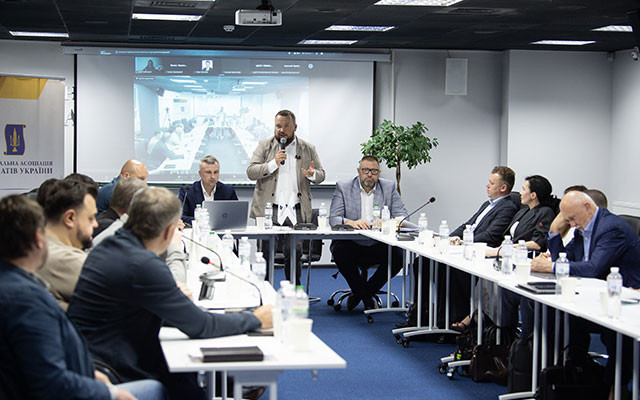
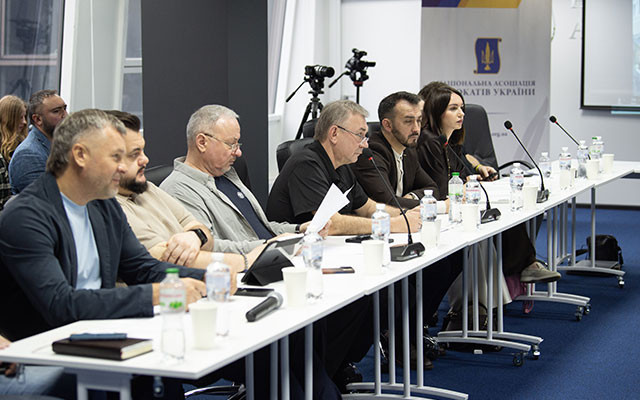
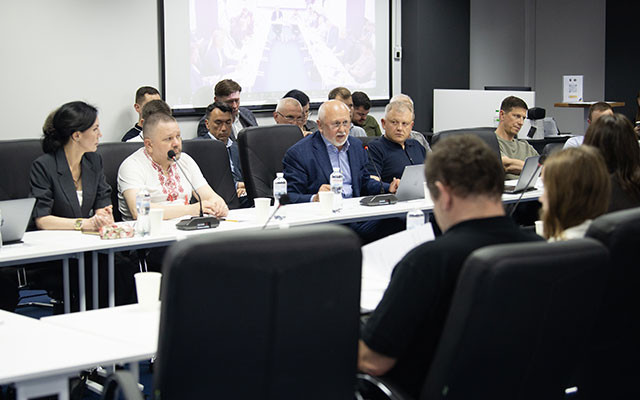
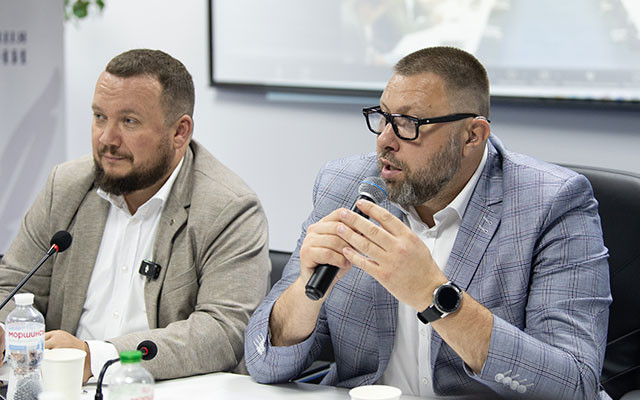
Practicing advocates, scholars, business representatives and officials from the relevant ministry sought answers to practical questions during the roundtable discussion «Specifics of law enforcement practice in the field of mine action», held on June 8, 2026, at the initiative of the UNBA Committee on legal practice.
The Committee’s deputy chairman Volodymyr Martynenko emphasized that the event should result in materials that can be applied in practice. «The lack of clear regulation of the legal and organizational foundations of mine action in Ukraine presents legislators and law enforcement officials with the task of finding answers to a whole range of related questions. This concerns, in particular, vast contaminated territories — areas spanning several thousand hectares. To put this into perspective, according to various estimates, the figure ranges from 138,000 to 175,000 hectares as of now», - he noted. According to him, the sector requires legislative refinements and collaborative efforts among the legal community, mine action operators, service users, and government institutions.
The potential and best practices in the field of humanitarian demining must be properly formalized within a legal framework. This was highlighted by Deputy Minister of economy, environment and agriculture Ihor Bezkaravaynyi. According to him, fieldwork is carried out in accordance with standards, regulations, and operational procedures; however, this framework must be developed and adapted to the challenges facing Ukraine.
The essence of the issue under discussion was articulated by a member of the Supervisory Board of the Yaroslav Mudryi National Law University Mykhailo Isakov. «Today, Ukraine is effectively establishing a new practice at the intersection of criminal law, international humanitarian law, and technical standards, - he noted. - At the same time, the enforcement of regulatory acts may create a risk of excessive criminalization of the professional demining process».
He emphasized that military, operational, and humanitarian demining are distinct legal institutions. The scholar characterized humanitarian demining as «an economic activity carried out by certified mine action operators with the aim of fully clearing territories for safe socio-economic and agricultural use». This is not a single action but a technological chain: non-technical survey, technical survey, clearance, marking, and external quality control.
The speaker also drew attention to the process of releasing territories. According to him, it is impossible to bypass non-technical and technical surveys and proceed directly to clearance and quality control. Therefore, the operator’s costs for such surveys are justified even when no mines were found or detonated based on their results: such work confirms the safety service.
M. Isakov asked whether the mere fact of cultivating a land plot listed in the register of contaminated or potentially contaminated territories could change its status.
The scientist’s answer was unequivocal: neither cultivation, nor a sown field, nor a harvested crop, nor a certificate from a company or farmer constitutes grounds for removing a plot from the registry without the legally mandated set of mine action measures.
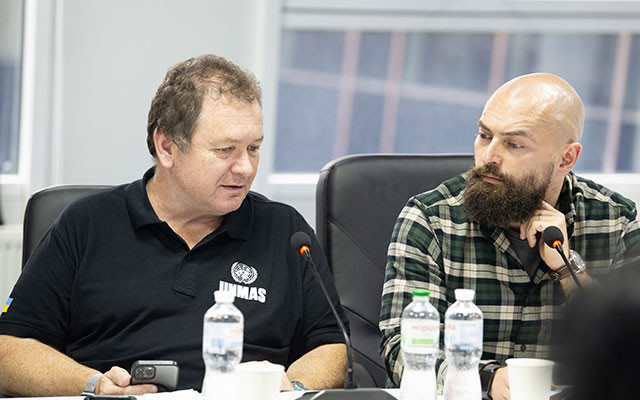
A representative of one of the mine action operators Valery Dema also spoke about the difference between the everyday and the legal-technical understanding of demining. According to him, operators and external stakeholders often fail to understand each other at the conceptual level. The everyday perception of demining as the physical search for and removal of mines, as well as the notion that cleared land is automatically safe, do not align with the humanitarian demining processes stipulated by the state standard.
He cited an example where, according to the system, an area is contaminated but is actually being cleared. In such a situation, the operator cannot simply confirm the safety of the site without a procedural inspection. If he issues a guarantee without an inspection and an explosion occurs later, law enforcement will have questions for the operator. If, however, the operator conducts an inspection of a cleared field, another question may arise — what was he doing in a field that had already been cleared.
In this regard, advocate Serhiy Mityurin drew attention to the use of the phrase «fictitious demining». According to him, this concept has become one of the key terms in disputes surrounding humanitarian demining, although its meaning is unclear. He cited an example where a verdict regarding a farmer who pleaded guilty after a plea agreement (the verdict states that the farmer admitted: by signing the act, he was aware of «fictitious demining») could subsequently be used in a dispute with the operator, even though this verdict does not establish the guilt of the operator or its officials.
Among possible areas for improvement, head of the Department of criminalistics at Yaroslav Mudryi National Law University Viktor Shevchuk cited the refinement of draft law No. 15108-1 dated April 15, 2026, No. 15108-1, amending the Criminal Code and the Code of Criminal Procedure, establishing special provisions regarding crime scene investigations in mine-hazard zones, and introducing a new type of forensic examination and a compensation mechanism for civilian mine victims.
Head of the Department of criminal law at Yaroslav Mudryi National Law University Ruslan Orlovsky noted that mine action in this context constitutes economic activity. «Some entities perform certain work or provide certain services, while others pay for them, - he explained. - And where there are people and money, violations and abuses — including those subject to criminal punishment — usually arise». The scholar reminded the audience that, from a criminal law perspective, the basis for liability is the elements of a criminal offense, and the key factor for legal assessment is the objective aspect of the act, the unlawfulness of which must be proven.
«It is important for the Committee that this discussion not end with the mere fact of holding a roundtable. The issues raised must be further developed — in the form of legislative proposals, approaches to law enforcement, and practical mechanisms that will help avoid differing interpretations of the same procedures, - commented chairman of the UNBA Committee on legal practice Bohdan Kushnir on the event’s outcomes. - After all, advocacy can serve as the professional platform where the positions of operators, government agencies, scholars, and lawyers are transformed into clear legal decisions. Therefore, the task is to bring this work to a conclusion that will be significant not only for individual disputes or proceedings but for the establishment of consistent practice in the field of mine action».
© 2026 Unba.org.ua Всі права захищені
"Національна Асоціація Адвокатів України". Передрук та інше використання матеріалів, що розміщені на даному веб-сайті дозволяється за умови посилання на джерело. Інтернет-видання та засоби масової інформації можуть використовувати матеріали сайту, розміщувати відео з офіційного веб-сайту Національної Асоціації Адвокатів України на власних веб-сторінках, за умови гіперпосилання на офіційний веб-сайт Національної Асоціації Адвокатів України. Заборонено передрук та використання матеріалів, у яких міститься посилання на інші інтернет-видання та засоби масової інформації. Матеріали позначені міткою "Реклама", публікуються на правах реклами.