
MMC and ETAIDF abroad: advocates pointed out barriers to remote procedures
For certain categories of Ukrainians living abroad, the law provides for the possibility of undergoing medical and social procedures remotely. In practice, however, barriers arise even before a case is considered: due to referral requirements, translation needs, the need to verify foreign medical documents and the lack of support.
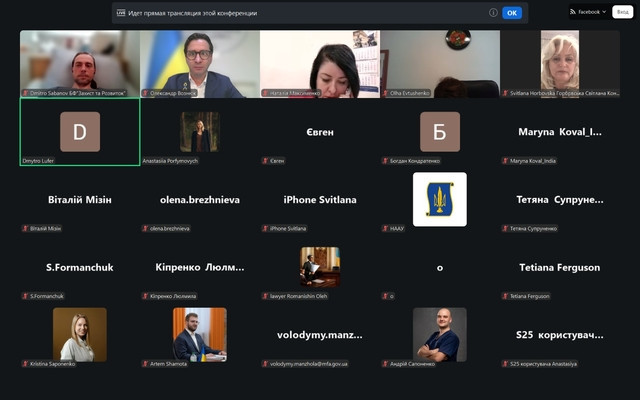
These issues were discussed during the roundtable «MMC and ETAIDF abroad», organized by the UNBA Committee on the protection of the rights of persons with disabilities. The meeting was moderated by the Committee chairman Oleksandr Voznyuk.
The procedure for assessing a person’s daily functioning, approved by Cabinet of Ministers Resolution No. 1338 of November 15, 2024, provides for the assessment of citizens who are abroad. A consultant for the Ministry of Health Dmytro Lufer drew attention to this issue, noting that difficulties arise with patients who do not have medical records or doctors who are treating them in Ukraine. Another problem is the timeliness of medical information, as some citizens have been abroad for years, and expert teams need up-to-date data on their health status to make a decision.
A representative of the Ministry of Defense added that remote medical examinations for military personnel undergoing treatment abroad are provided for by Cabinet of Ministers Resolution No. 1125 of September 10, 2025, on the implementation of a pilot project. At the same time, amendments to the Regulations on Military Medical Examinations in the Armed Forces of Ukraine (Ministry of Defense Order No. 402 dated August 14, 2008) regarding the procedure for conducting remote medical examinations to determine fitness for service are still in the approval stage.
However, she noted that practical difficulties have already been identified during remote examinations. Some service members do not know how to proceed or are physically unable to gather the necessary documents on their own. This applies, in particular, to bedridden patients or individuals who are unconscious. Therefore, service members undergoing treatment abroad require assistance.
Regarding the ECOPFO assessment abroad, a member of the UNBA Committee Oleg Romanishyn noted that the evaluation of a person’s daily functioning concerns not only the diagnosis but, above all, the degree of impairment in that person’s functioning. The law provides for an in absentia assessment based on documentation and a telemedicine assessment when the expert team deems the documentation insufficient and additional communication with the individual is required.
He identified the issuance of referrals as the greatest practical challenge. The procedure for assessing a person’s daily functioning stipulates that a referral may be issued by a family physician, a specialist, the chairman of the Medical Examination Commission, or the chairman of a medical or physician expert commission. However, in practice, difficulties arise if a person does not have a registration with a doctor, has not used the Ukrainian healthcare system for a long time, or is abroad and cannot undergo an in-person examination.
According to the advocate, the doctor is, in fact, professionally responsible for ensuring the adequacy of the submitted documents, but may not see the patient in person and may lack a clear protocol for evaluating documents issued by foreign medical institutions. As a result, patients may be asked to appear in person in Ukraine or be informed that their documents are insufficient. At the same time, such a refusal is not always documented in writing.
Issues related to the translation and verification of foreign medical documents were discussed separately. Participants noted that in EU countries, a significant portion of medical documentation is generated through electronic health care systems. Such documents may not contain a wet seal, a handwritten signature, or International Classification of Diseases (ICD) codes, even though they may be considered official in the patient’s country of residence.
This raises questions about what exactly should be submitted to Ukrainian authorities, how to verify the authenticity of an electronic document, and who should assess the quality of medical terminology translations. Participants also noted that translating large sets of medical documents can be expensive, and errors in medical terminology create additional difficulties for doctors and expert teams.
Acting deputy director of the Consular Service Department at the Ministry of Foreign Affairs Olena Brezhneva explained that certification of translations, apostille, and legalization of documents are distinct procedures. She also noted that specific cases involving problems with consular actions or the certification of translations can be addressed individually upon receipt of relevant requests and supporting documents.
Among the possible solutions, the advocates suggested appointing dedicated coordinators for citizens abroad, establishing a special procedure for military personnel undergoing medical treatment or rehabilitation, and setting deadlines for issuing referrals or providing a reasoned response regarding a refusal or the need to correct deficiencies.
It was also proposed to consider the possibility of having specialized expert teams or designated officials handle documents from abroad, as well as engaging professional translators to work with medical documentation. According to the participants, this could reduce the number of documents returned for revision and simplify the procedures.
Following the meeting, the organizers plan to compile the proposals and practical case studies. They intend to use these materials to further address issues related to remote MMC and the ETAIDF for Ukrainian citizens residing abroad.
© 2026 Unba.org.ua Всі права захищені
"Національна Асоціація Адвокатів України". Передрук та інше використання матеріалів, що розміщені на даному веб-сайті дозволяється за умови посилання на джерело. Інтернет-видання та засоби масової інформації можуть використовувати матеріали сайту, розміщувати відео з офіційного веб-сайту Національної Асоціації Адвокатів України на власних веб-сторінках, за умови гіперпосилання на офіційний веб-сайт Національної Асоціації Адвокатів України. Заборонено передрук та використання матеріалів, у яких міститься посилання на інші інтернет-видання та засоби масової інформації. Матеріали позначені міткою "Реклама", публікуються на правах реклами.