
Law clerk or in-house counsel: which path to a career in advocacy should you choose?
A paralegal and a corporate advocate have different starting points before entering advocacy, but both need to understand how to pass the bar exam, whether an internship is required, and how to structure their first year of practice.
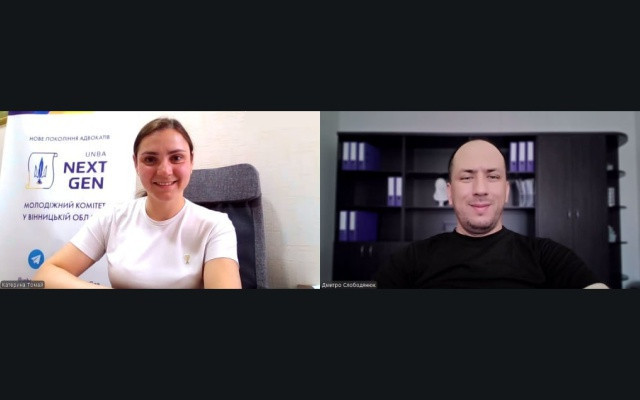
This was discussed during the webinar «The path to becoming an advocate: legal assistant & advocate», organized by the UNBA NextGen in the Vinnytsia and Mykolaiv regions.
The two paths were compared by the Committee’s regional representatives Kateryna Tomay, who worked as a paralegal, and Dmytro Slobodyanyuk, who had experience as an advocate.
K. Tomay explained that working as a paralegal allowed her to gain an inside look at document preparation, strategy development, and pre-trial work. Such early experience also reveals the responsibilities of the profession, as a legal assistant already works in accordance with the Law «On advocacy and the practice of law» and the Rules of Professional Conduct for Advocates. Therefore, anxiety about the exam may relate not only to taking the test itself but also to the question of what to do after receiving the license.
D. Slobodyanyuk described another path — working as an in-house counsel at companies. According to him, such experience can be in-depth in certain areas but does not always provide the variety of situations that a legal assistant gains while working alongside a practicing advocate. For a lawyer in the corporate sector, the breadth of the qualifying exam’s questions poses a challenge, as their accumulated knowledge is often strong only in specific areas.
K. Tomay noted that for an advocate’s assistant, part of the exam preparation already takes place in practice, since the candidate has previously drafted many procedural documents on the job. At the same time, the oral portion requires the ability to respond not only within one’s usual area of specialization but also regarding other branches of law. The commission may ask follow-up questions where it perceives a lack of experience, so it is important not to panic and to calmly structure your response. D. Slobodyanyuk advised against writing excessively long documents in the written portion of the exam and instead recommended focusing on the mandatory elements required by procedural law.
The difference between the two paths becomes apparent even after the exam: K. Tomay, as a former advocate's assistant, did not undergo a legal internship, while D. Slobodyanyuk spent six months on it.
Speaking about his first year in the profession, D. Slobodyanyuk cautioned against an approach where an advocate obtains a license without a clear plan for future actions. After being laid off from his job as a legal counsel, he faced a choice: to look for a new job or to start a solo practice.
From this experience, he concluded that the first year should be planned carefully, with a clear understanding of the nature of the work, sources of clients, and professional strategy.
In his opinion, a solo practice gives an advocate freedom, but it is more difficult to handle the workload and the variety of legal issues on one’s own. Working as part of a team allows for the distribution of specializations and client workload; however, the rules governing collaboration, revenue sharing, and decision-making must be agreed upon from the outset.
K. Tomay also highlighted another risk of the first year — communication skills with early clients: the client’s expectations versus the actual results that can be achieved during the course of the collaboration. As an example, she cited a case involving reimbursement of legal fees, which the court may not award in full, even if the case is decided in the client’s favor.
In summary, the speakers advised young advocates to use professional events, continuing education, and communication with colleagues as tools for entering the legal community. D. Slobodyanyuk also advised advocates to create a five-year development plan specifically as a business plan, rather than merely as a description of professional ambitions.
© 2026 Unba.org.ua Всі права захищені
"Національна Асоціація Адвокатів України". Передрук та інше використання матеріалів, що розміщені на даному веб-сайті дозволяється за умови посилання на джерело. Інтернет-видання та засоби масової інформації можуть використовувати матеріали сайту, розміщувати відео з офіційного веб-сайту Національної Асоціації Адвокатів України на власних веб-сторінках, за умови гіперпосилання на офіційний веб-сайт Національної Асоціації Адвокатів України. Заборонено передрук та використання матеріалів, у яких міститься посилання на інші інтернет-видання та засоби масової інформації. Матеріали позначені міткою "Реклама", публікуються на правах реклами.