
How can an advocate recharge if fatigue persists after the weekend?
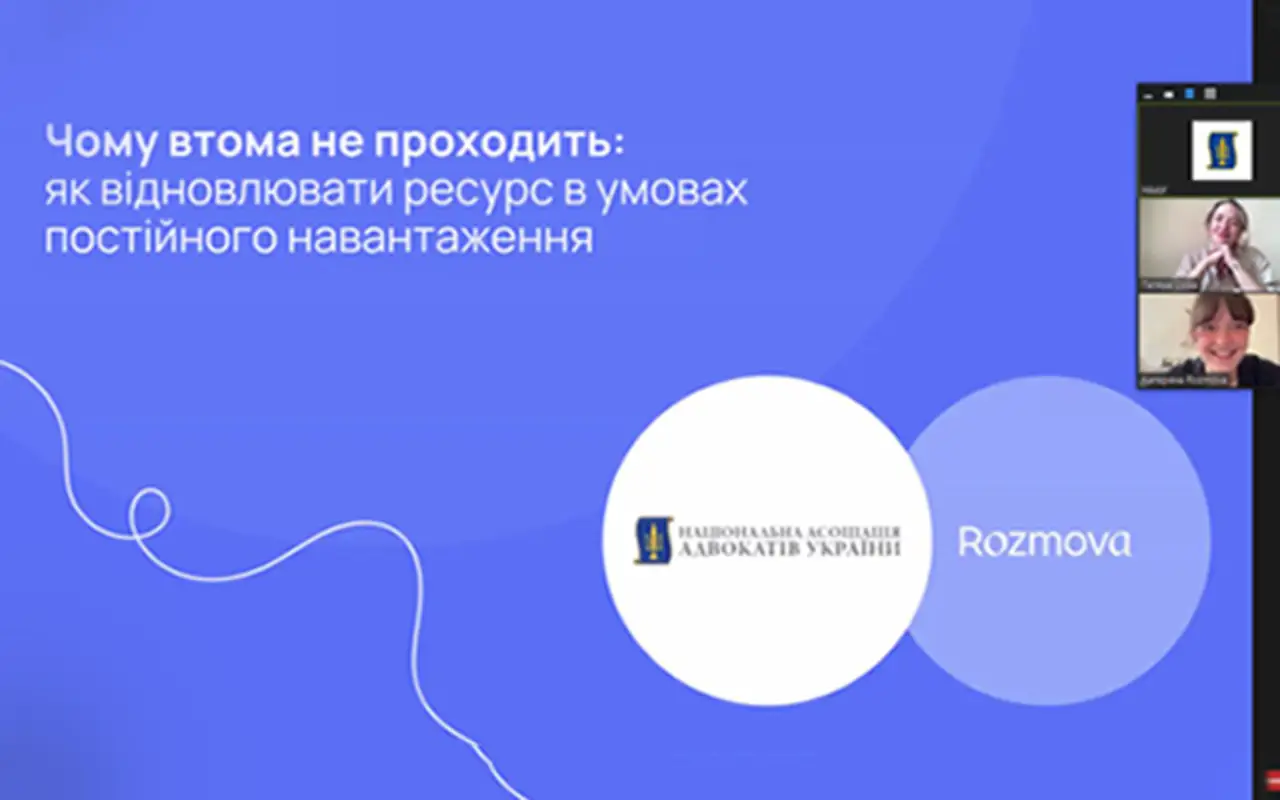
Fatigue resulting from prolonged stress does not always go away after sleep, a weekend, or a vacation. In situations of chronic stress, it is important for advocates not only to «take a break» but also to understand exactly which resource has been depleted and what type of rest is needed.
This topic was discussed during the webinar «Why fatigue doesn’t go away: how to restore resources under constant stress», organized by the Ukrainian National Bar Association with the support of the International Bar Association (IBA). The event’s speaker was Tetyana Sova, a practicing psychologist from the Rozmova platform.
She explained that even after adapting to difficult conditions, the mind continues to grapple with the effects of chronic stress, a compromised sense of security, and financial, time-related, or physical instability. Under such circumstances, the baseline level of fatigue naturally increases, and it is important to acknowledge it rather than ignore it or «heroically» mask it with work.
T. Sova noted that fatigue is a natural state of temporary depletion of the body’s physical, cognitive, or emotional resources, signaling a need for recovery. At the same time, situations require special attention when fatigue persists over time, occurs without an obvious intense workload, or its severity does not correspond to the amount of effort expended.
In such cases, she said, it is important to assess not only one’s psychological but also physiological state, consult specialists, review one’s schedule, and seek support. It is crucial to recognize in a timely manner that one’s usual routine no longer ensures recovery.
The speaker pointed out that fatigue is not uniform. It can be physical, cognitive, social, emotional, and informational, and different types of fatigue can accumulate simultaneously. For legal practice, cognitive strain from complex cases and constant decision-making, emotional strain from interacting with clients, and informational fatigue from news, notifications, and the digital environment can be particularly pronounced.
That is why each type of fatigue requires an appropriate form of rest. If a person is exhausted not physically but emotionally or cognitively, simply sleeping or switching activities may not be enough.
T. Sova distinguished between work, active, and passive activities. Active rest such as a walk, sports, hobbies, or meeting with friends can replenish one’s resources, but it does not replace the passive component, during which a person has the right to do nothing and not be constantly engaged in tasks. Passive rest is often underestimated, even though it is the energy-conserving part of activity. If a person is lying down but at the same time worrying, planning work, replaying conversations, or criticizing themselves for inactivity, this state does not allow for full recovery.
According to the psychologist, quality recovery should encompass three levels: the body, emotions, and thoughts. At the physical level, this involves sleep, nutrition, moderate physical activity, health, and sensory relief; at the emotional level recognizing one’s own state, managing stress, and reassessing social interactions; and at the mental level managing anxiety, cognitive biases, focus and the right to rest.
However, not every break is true rest. T. Sova classified the following as «pseudo-rest»: active engagement with content, excessive use of social media, constantly switching between stimuli, sensory overstimulation, as well as situations where a person is technically resting but feels shame or guilt about it.
In conclusion, the speaker advised developing sensitivity to one’s own state, distinguishing between types of fatigue, utilizing various forms of rest, maintaining «information hygiene», and staying connected to one’s environment. She emphasized that under current conditions, rest is not a luxury but a necessity for survival, and people need more recovery time than ever before.
© 2026 Unba.org.ua Всі права захищені
"Національна Асоціація Адвокатів України". Передрук та інше використання матеріалів, що розміщені на даному веб-сайті дозволяється за умови посилання на джерело. Інтернет-видання та засоби масової інформації можуть використовувати матеріали сайту, розміщувати відео з офіційного веб-сайту Національної Асоціації Адвокатів України на власних веб-сторінках, за умови гіперпосилання на офіційний веб-сайт Національної Асоціації Адвокатів України. Заборонено передрук та використання матеріалів, у яких міститься посилання на інші інтернет-видання та засоби масової інформації. Матеріали позначені міткою "Реклама", публікуються на правах реклами.