
Ukraine could be the first to implement a European mechanism for the protection of advocates. What’s holding it back?
Ukraine has a chance to be the first country to ratify the Council of Europe Convention on the Protection of the Professions of Lawyer. Political support for this exists, but the government’s legislative package has not yet been submitted to parliament. Meanwhile, the number of violations of advocates’ rights is on the rise.
Next step
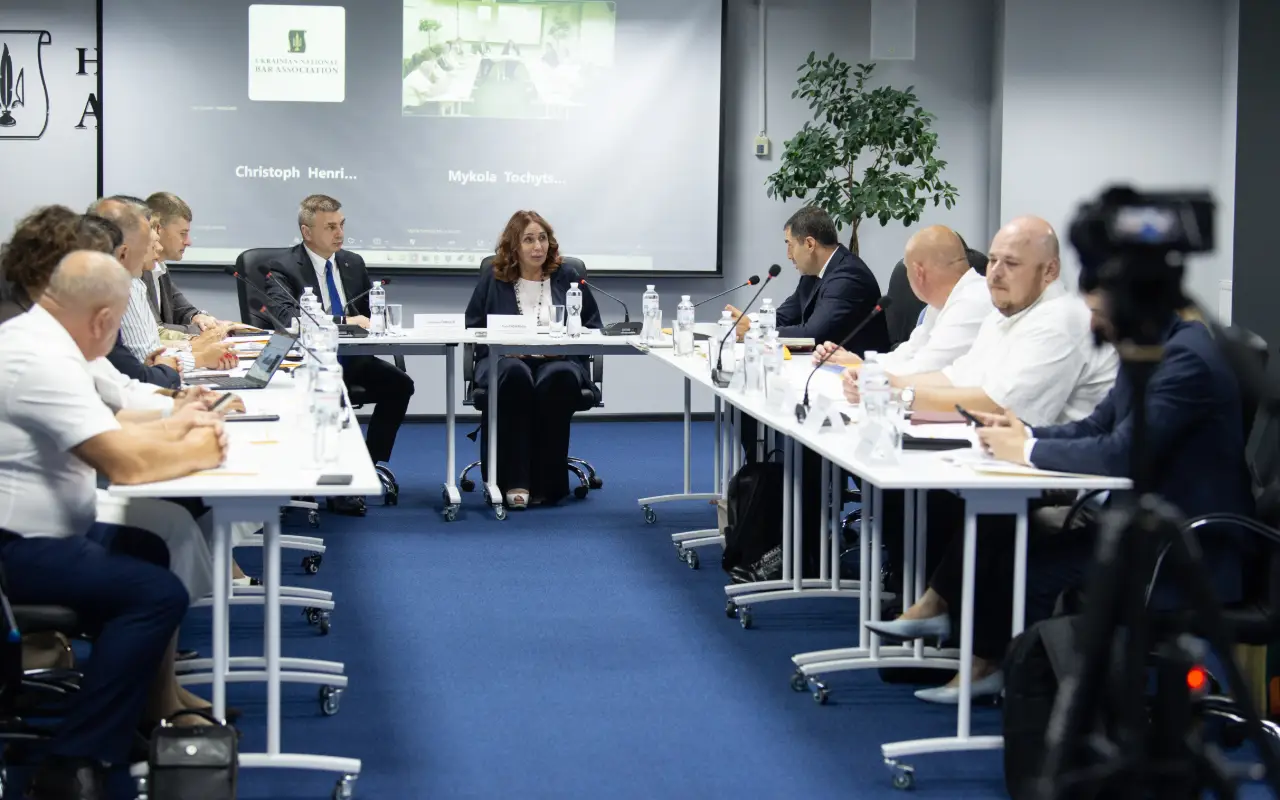
Representatives of the bar, parliament, government agencies, and European professional institutions gathered at the UNBA office for a roundtable discussion titled «The Council of Europe Convention on the Protection of the Professions of Lawyer: a future part of Ukrainian legislation», reports the publication «Law and Business». Participants sought to determine what is needed today for the ratification and implementation of this international treaty. The discussion was moderated by the Vice President of the UNBA, BCU Valentin Gvozdiy, who represented Ukraine during the drafting of the convention.
The President of the UNBA, BCU Lidiya Izovitova asked participants to answer the key question: Is Ukraine ready to ratify the convention? After all, the protection of the legal profession is not merely an internal matter for the advocacy community itself. A person’s right to a defense can only be realized if there are effective guarantees of an advocate’s independence, the preservation of attorney-client privilege and protection against pressure and unlawful interference.
She noted that preparations for ratification did not begin today and have already gone through several important stages. This process has been accompanied by systematic parliamentary work, primarily on the part of the Committee on Legal Policy. During five special working meetings attended by representatives of Parliament, the Office of the President, the Ministry of Justice, the Ministry of Foreign Affairs, and the UNBA, participants discussed the translation of the convention, necessary legislative changes, timelines, responsible authorities, and the further ratification mechanism. Subsequently, the Ministry of Justice, together with the UNBA, worked out the amendments, and the main substantive discrepancies have already been resolved. The Ministry of Foreign Affairs, for its part, provided the official translation of the document.
Thus, following the drafting, signing, and preparation of legislative amendments, the next step should be ratification. L. Izovitova urged that the progress already made not be turned into a new period of waiting and suggested that government officials and international stakeholders assess whether the state is ready to take this step.
The discussion then turned to the violations that advocates face in their professional practice.
A defender without protection
The Verkhovna Rada Commissioner for Human Rights Dmytro Lubinets expressed his support for the convention’s ratification as soon as possible. «This must be done as quickly as possible to set an example for other countries: even amid full-scale aggression by the Russian Federation, the Ukrainian parliament and government agencies are functioning effectively», - the ombudsman noted. In his view, it is impossible to build an effective system for protecting human rights without independent and professional advocacy.
D. Lubinets outlined the typical violations that advocates face today. He identified the most problematic issue as the practice of denying them access to TCC facilities, which prevents people held there from receiving legal assistance. «During 2025–2026, I received numerous complaints from advocates regarding TCC representatives obstructing their work. At my insistence, documents were sent to the Minister of Defense regarding the regulatory framework for admitting advocates to the premises of the TCCs — through the inclusion of relevant provisions in the Ministry of Defense’s regulatory acts or in the Regulations on TCCs», - he noted.
In addition to reports of denial of access, there were also threats to confiscate cell phones, the use of physical force, and the infliction of bodily harm on advocates while they were performing their professional duties. In one such instance, a TCC employee injured an advocate from Kharkiv who was acting within the scope of her authority. The incident was entered into the Unified Register of Pre-trial Investigations only after the Ombudsman intervened; however, no investigative actions were taken for a long time.
Problems also arise in places of detention. An advocate’s access to a person in a temporary detention facility is effectively contingent upon the pre-trial investigation authority receiving notification of the advocate’s involvement. Following a separate inquiry, the Ministry of Internal Affairs reported that the National Police is drafting amendments to the relevant instruction, taking into account proposals from advocacy.
Additionally, during martial law, advocates were prohibited from bringing their own computer equipment into pretrial detention centers and were instead required to use the facility’s equipment. According to D. Lubinets, reviewing defense materials on the detention center’s equipment poses a direct threat to attorney-client privilege; therefore, the controversial provisions must be removed.
The duty to investigate
Statistics from the Ukrainian National Bar Association also attest to the scale of the problem. Deputy chairman of the UNBA Committee on the protection of advocates’ rights and guarantees of legal practice Vadym Semenov reported that in 2023, 167 criminal offenses against advocates were registered, but only 5 cases were referred to court and one verdict was handed down. Of the 344 registered criminal cases, suspects were notified in three, and there were two convictions. The number of complaints regarding violations by the TCC received by the relevant UNBA Committee rose from one in 2022 to 42 in 2025.
A member of the Verkhovna Rada Committee on legal policy Olesya Otradonova explained that in such cases, it is necessary to prove not only the fact of violence or bodily injury but also the connection between the crime and the defender’s activities. According to her, it is easier for prosecutors to classify an incident as a general criminal offense without this additional element, which is why advocates need stronger safeguards.
That is why the convention imposes an obligation on the state to effectively investigate violations of advocates’ rights and provides a mechanism to monitor compliance. As explained by chairman of the Council of Europe’s Committee of Experts on the Protection of Advocates Christoph Heinrichs the document guarantees advocates, among other things, access to clients in places of detention, protection from persecution due to association with a client, and the preservation of professional secrecy. Compliance with these standards is to be monitored by an independent body authorized to identify systemic shortcomings, make recommendations, and bring issues to the level of political dialogue.
Under review
But how quickly can these guarantees become part of Ukrainian law?
Ukraine’s Permanent Representative to the Council of Europe and Ambassador Extraordinary and Plenipotentiary Mykola Tochytskyi, who signed the convention on behalf of Ukraine, explained that once the Verkhovna Rada grants its consent to the convention’s binding nature, it will become part of national law. «Now we need to get down to the specifics. And I am very grateful for this initiative to engage in dialogue with the members of parliament, because, by and large, the ball is in their court», - the diplomat concluded.
However, as it turned out, the government’s part of the preparations is not yet complete. Deputy director of the Directorate — head of the Main Department for Justice within the Directorate of Justice and Criminal Justice of the Ministry of Justice Ulyana Stefanyuk reported that the ministry, together with the UNBA, has already drafted preliminary amendments to the Law «On the advocacy and the practice of law», the Criminal Procedure Code, as well as civil, commercial and administrative procedural legislation.
«For now, this is at the stage of internal coordination within the Ministry of Justice. The next step will be coordination with other relevant agencies. And only when this draft law leaves the Ministry of Justice with the minister’s signature will we consider that the process toward ratification of the convention has begun», - explained U. Stefanuk.
There is support
Meanwhile, Parliament is ready to launch its part of the process, as confirmed by representatives of the Verkhovna Rada Committee on legal policy. Specifically, chairman of the Subcommittee on the organization and activities of the advocacy and legal aid agencies Volodymyr Vatras stated that following preliminary meetings, agreement had been reached on two legislative tracks. The Ministry of Justice is responsible for the government’s ratification package, while lawmakers, together with the UNBA and the ministry, have prepared a draft amendment to the Law «On the advocacy and the practice of law» in connection with the signing of the convention. According to him, the parliamentary part is already ready for registration.
Chairman of the Subcommittee on political reform and constitutional law Maksym Dyrdin proposed not waiting for all government procedures to be completed. He stated that members of parliament intend to register a bill on the implementation of the convention’s key provisions in the near future. At the same time, the Ministry of Justice and the Cabinet of Ministers must finalize the document that the President will submit to parliament for ratification. In his view, registering the parliamentary bill could speed up the executive branch’s work. «Everyone is waiting, but for some reason we’re standing still. Everyone is saying something, but we’re not moving forward», - M. Dyrdin noted.
The participants in the discussion had no doubts about the outcome of the vote. Chairman of the Subcommittee on the adaptation of Ukrainian legislation to the provisions of European Union law (EU acquis) and the implementation of Ukraine’s international legal obligations in the field of European integration Mykola Stefanchuk stated that Parliament is awaiting the ratification package. «As soon as all the necessary technical issues are finalized, you will see more than 226 votes on the scoreboard — significantly more», - he predicted.
Deputy chairman of the Committee Ivan Kalaur also expressed confidence in a positive outcome. According to him, Committee members are ready to make every effort to ensure that the ratification of the convention becomes one of the achievements of this session of the Verkhovna Rada.
After their remarks, the MPs left the roundtable early: they had a scheduled meeting with Justice Minister Denys Maslov, who, prior to his appointment, had headed the Verkhovna Rada Committee on legal policy. They were to discuss the same issue — preparations for the convention’s ratification.
Ukraine could be the first
While Ukrainian institutions are going through internal procedures, EU member states are awaiting a decision from the Union itself. Eight ratifications are required for the convention to enter into force. Thirty-five states have signed the document, but none have ratified it yet.
The reason for this pause was explained by the chairman of the CCBE Committee on the European Convention Laurent Pettiti, an advocate with the Paris Bar. The European Union has been invited to accede to the Convention as an international organization, and the European Commission is preparing the relevant decisions regarding its signing and subsequent accession.
At the same time, European institutions need to resolve a number of legal issues. Specifically, these include defining the concept of an advocate and extending the Convention’s scope to in-house counsel, its application to individuals who may appear before international courts, as well as the EU’s financial contributions to the future monitoring mechanism. L. Pettiti emphasized that these issues are of a technical nature and do not constitute fundamental obstacles to the Union’s accession to the document.
Due to the need to delineate the competences of the EU and its member states, the latter are also taking their time with their own procedures.
K. Heinrichs explained this using Germany as an example: the country is awaiting the European ratification package to determine which provisions fall under national competence and which fall under the exclusive competence of the EU. According to L. Pettiti, among European countries, the United Kingdom had begun preparations for ratification at that time. «We no longer need just signatures — that battle has already been won. Now the main thing is the ratification race, in which no country has yet crossed the finish line. And Ukraine may well be the first», - noted the CCBE representative.
V. Gvozdiy saw a procedural advantage for Ukraine in this situation. Since the country is not a member of the European Union, it does not need to wait for the completion of the Union’s internal coordination of its position. «Not being an EU member is a small advantage for us right now. We can ratify this convention a little faster than EU member states, which must wait and do so in unison», - concluded the Vice President of the UNBA, BCU.
There are also no internal constitutional obstacles to such a step. Chairman of the UNBA Committee on the rule of law and a former member of the Venice Commission representing Ukraine Marina Stavniychuk emphasized that the provisions of the convention do not contradict the Constitution. «The provisions of the convention clearly correspond to those of the current Constitution of Ukraine; they imbue them with new meaning, expanding and deepening them. This is a key point that makes the ratification process straightforward», - she emphasized.
Following ratification, in her view, the Constitutional Court may need to clarify the approach set forth in its decision regarding the so-called «attorney monopoly». At the same time, M. Stavniychuk noted that Article 1312 of the Constitution concerns not the privileges of advocacy, but the mechanism for protecting human rights and the role of the defense attorney within the justice system.
Furthermore, early ratification has practical international significance. According to the representative of the UNBA, this will give Ukraine the opportunity to nominate a Ukrainian expert to participate in the future Group of Experts on the Protection of the Advocate's Profession (GRAVO), which will monitor the implementation of the convention by the participating states.
M. Tochitsky also highlighted the significance of ratification for European integration. According to him, the implementation of Council of Europe standards has not only a legal but also a political dimension for Ukraine, as it confirms the state’s fulfillment of the requirements necessary for future EU membership. «I am convinced that such a step would demonstrate that Ukraine not only supports the development of new European standards but is also ready to be among the first to incorporate them into national legislation», - the diplomat emphasized.
© 2026 Unba.org.ua Всі права захищені
"Національна Асоціація Адвокатів України". Передрук та інше використання матеріалів, що розміщені на даному веб-сайті дозволяється за умови посилання на джерело. Інтернет-видання та засоби масової інформації можуть використовувати матеріали сайту, розміщувати відео з офіційного веб-сайту Національної Асоціації Адвокатів України на власних веб-сторінках, за умови гіперпосилання на офіційний веб-сайт Національної Асоціації Адвокатів України. Заборонено передрук та використання матеріалів, у яких міститься посилання на інші інтернет-видання та засоби масової інформації. Матеріали позначені міткою "Реклама", публікуються на правах реклами.