
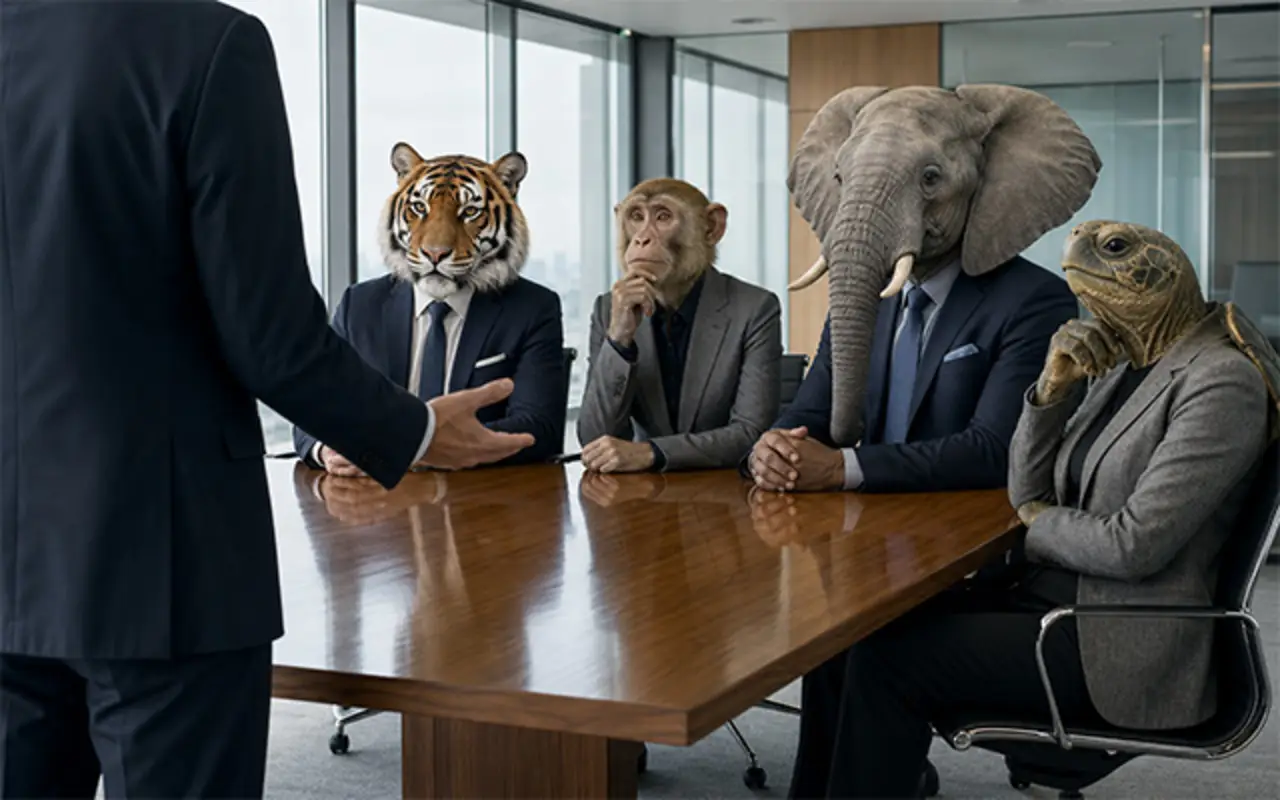
How DISC helps manage «tigers», «monkeys», «elephants» and «turtles»
The same instruction from a manager may motivate one employee to take action, while leaving another without the necessary guidance. People perceive work tasks differently: for some, a deadline and the expected outcome are enough, while others need explanations, time or a detailed plan.
The Ukrainian National Bar Association with the support of the International Bar Association (IBA) held a webinar for advocates titled «Different people — one team: how the DISC model helps find common ground».
As psychologist Viktoria Kravets explained, the model is based on four behavioral types described by William Marston. Over time, the system came to be used as a practical tool for teamwork, helping to understand employees’ characteristics and how to interact with them.
The DISC model identifies four behavioral styles: dominance, influence, steadiness and conscientiousness. At the same time, this classification is not absolute: individuals typically exhibit traits of several styles, one of which is dominant, and these traits vary over time and depending on circumstances. Therefore, the speaker explained how to adapt the wording of a single work task to each of these styles.
V. Kravets used the images of a tiger, a monkey, an elephant, and a turtle, which correspond to types D, I, S and C. The results-oriented «tiger» takes responsibility and makes decisions quickly; the «monkey» motivates, generates ideas, and finds unconventional solutions; the «elephant» supports people and reduces tension within the team; the «turtle» analyzes facts, monitors quality and assesses risks.
As an example of adapting communication, V. Kravets suggested informing people of the four styles about a deadline change. For the «tiger» you should immediately state the key points: the new deadline, the expected outcome, and specific actions without unnecessary details. For the «monkey» the message can be more emotional, emphasizing trust in the team and the new challenge.
«Elephants» should be warned in advance, given time to adapt, asked how they’d prefer to organize their work and not be pressured. «Turtles» need an explanation of the reasons for the change, a new plan, a step-by-step sequence, figures and details.
The speaker also illustrated the difference in styles using the example of a «tiger» manager who assigns tasks in a single sentence, and a «turtle» employee who won’t start work without details and a logical framework. In such a situation, both may view each other as incompetent. She advised the manager to provide a clear sequence, facts, and sources of information, and advised the «turtle» to ask a few general questions and then work out the details on their own.
In conclusion, V. Kravets emphasized that the challenge lies in adapting communication approaches. «There are no bad people, no bad types. When we are different, we must adapt our own approach to communication, rather than trying to change the other person… So speak to a person in their own language, and they will most likely hear you», - V. Kravets concluded.
© 2026 Unba.org.ua Всі права захищені
"Національна Асоціація Адвокатів України". Передрук та інше використання матеріалів, що розміщені на даному веб-сайті дозволяється за умови посилання на джерело. Інтернет-видання та засоби масової інформації можуть використовувати матеріали сайту, розміщувати відео з офіційного веб-сайту Національної Асоціації Адвокатів України на власних веб-сторінках, за умови гіперпосилання на офіційний веб-сайт Національної Асоціації Адвокатів України. Заборонено передрук та використання матеріалів, у яких міститься посилання на інші інтернет-видання та засоби масової інформації. Матеріали позначені міткою "Реклама", публікуються на правах реклами.