
From the condition of the railcar to the cause of the accident: how railroad accident investigations work
Railway and transportation expertise makes it possible to assess the technical condition of rolling stock and tracks, determine the technical cause and mechanism of an incident, assess whether employees’ actions complied with regulatory requirements, and ascertain whether, from a technical standpoint, a derailment, collision, impact, or other incident could have been prevented.
The possibilities of such investigations were discussed during the roundtable «Railway and transportation expertise in legal practice: from car inspections to the analysis of railway and transportation accidents», organized by the UNBA Committee on expert support for legal practice. The discussion was moderated by the Committee chairman Violleta Fedchyshyna. The key speakers at the event were representatives of the Railway and Transportation Research Laboratory at the Lviv National Research Institute of Railway Engineering and Safety.
The laboratory’s head Oleg Dzhus explained that experts examine the technical condition of rolling stock, the circumstances and mechanism of the accident, as well as the upper and lower track structures. The subjects of investigation may include railcars, locomotives, their assemblies, components, and infrastructure elements. Experts investigate the circumstances and mechanisms of derailments, collisions, impacts, and structural failures.
The scope of the investigation may cover the condition of the braking system, the locomotive crew’s compliance with regulatory requirements, the immediate technical cause, the sequence of contributing factors, and the possibility of preventing the accident. O. Dzhus advised dividing the issues into categories, as the results of one investigation can serve as input data for the next.
An investigation into a derailment illustrates how this works in practice. The laboratory’s forensic expert Andriy Batig explained that after an incident, the railway conducts an internal investigation: it documents evidence, the positions of the train, cars, and components, and the scattered cargo, and takes photographs and videos. These materials are used in the forensic examination.
In the laboratory’s practice, there have been cases where the internal investigation inaccurately determined the cause of the derailment. In particular, when privately owned railcars were involved, the cause of the incident might have been attributed to malfunctions in that specific rolling stock. The forensic examination, however, must determine which railcar’s or locomotive’s wheel derailed first and what caused the accident.
To do this, details are correlated with specific railcars, and the diagram, photographs, speedometer data, train separation, pressure drop in the brake line, and emergency braking are analyzed. The incident is reconstructed from the train’s final position to the start of the derailment, after which a chain of causes and effects is established.
Initial evidence may be irretrievably lost. To preserve evidence, the expert recommended not touching the fracture surfaces with fingers, not covering them with adhesive tape, not striking the rails with parts, and not throwing them. If a railcar was repaired before the expert’s inspection, evidence necessary for the investigation may be lost.
The roundtable participants discussed accidents at railroad crossings. A leading research scientist at the laboratory Oleg Voznyak advised starting with a technical hypothesis that must be confirmed or refuted.
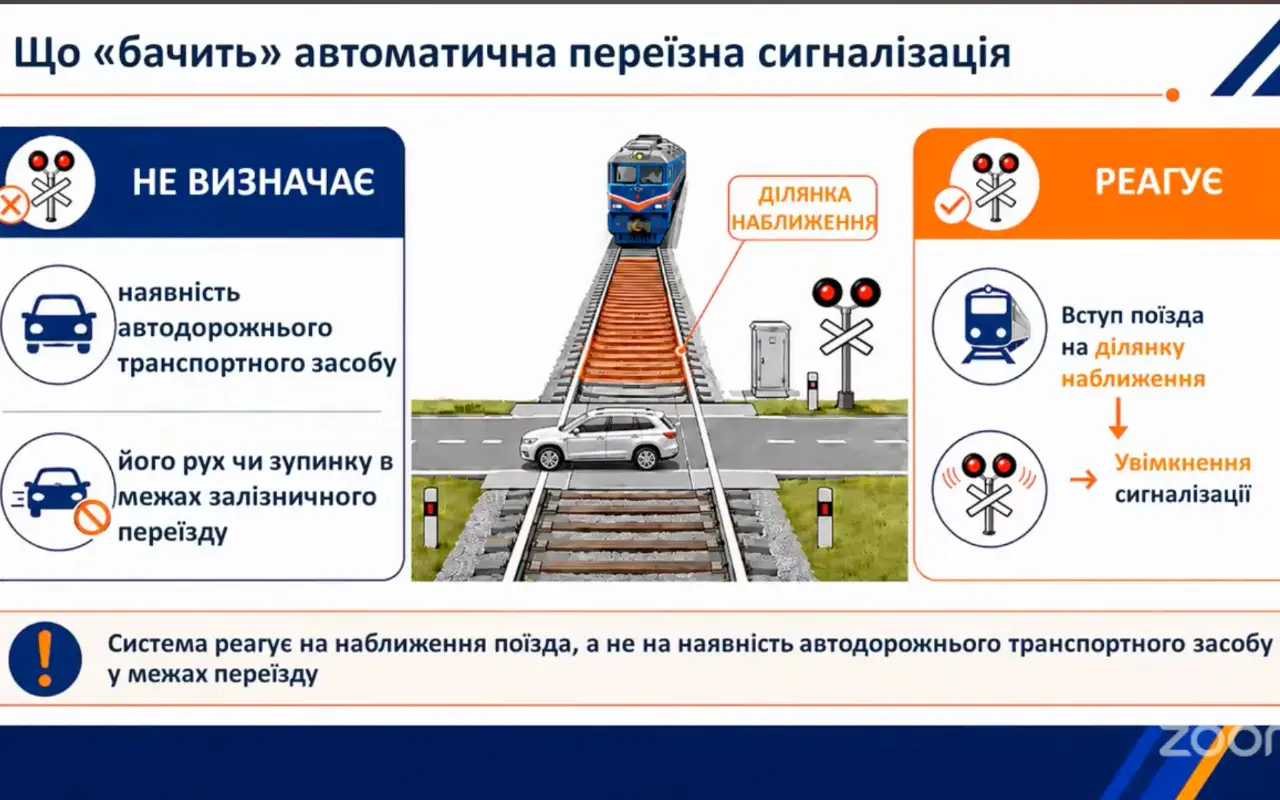
Level crossing automation responds to trains, not cars; therefore, the expert needs a diagram, photos, and videos; the level crossing certificate; data on the signaling system; train parameters; and a track plan and profile. A collision with a car may require the comprehensive involvement of both railroad and automotive experts.
Inspecting railcars is a separate method of assessing their condition. The head of the research and testing center that conducts inspections and technical diagnostics of railcars Oleksandr Osipov noted that technical diagnostics of railcars that have reached the end of their service life are performed to determine whether that service life can be extended. During the inspection, they determine whether the railcar in service meets safety requirements, what documents confirm such compliance, and what markings it must bear.
© 2026 Unba.org.ua Всі права захищені
"Національна Асоціація Адвокатів України". Передрук та інше використання матеріалів, що розміщені на даному веб-сайті дозволяється за умови посилання на джерело. Інтернет-видання та засоби масової інформації можуть використовувати матеріали сайту, розміщувати відео з офіційного веб-сайту Національної Асоціації Адвокатів України на власних веб-сторінках, за умови гіперпосилання на офіційний веб-сайт Національної Асоціації Адвокатів України. Заборонено передрук та використання матеріалів, у яких міститься посилання на інші інтернет-видання та засоби масової інформації. Матеріали позначені міткою "Реклама", публікуються на правах реклами.