
In Nicosia discussions focused on the protection of labor rights under occupation
How can a person’s labor rights be protected if the employer, the archives, and the employment record book remain in the occupied territory? And does a court that takes into account a document issued there legitimize the occupying authority?
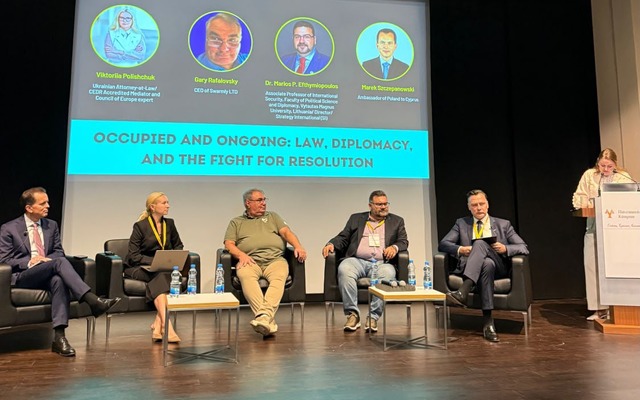
The UNBA representative in the Republic of Cyprus and chairman of the UNBA Committee on labor law Viktoria Polishchuk presented Ukraine’s experience in addressing these issues at the international «Civil Resistance Forum 2026» in Nicosia. She delivered a presentation titled «Protecting labor rights in conditions of war and occupation: lessons from Ukraine».
The advocate presented Ukraine’s experience in providing legal protection to workers who were forced to leave the temporarily occupied territories due to the armed aggression of the Russian Federation. She focused on the legal consequences of the occupation for labor relations: the suspension and termination of employment contracts, the restoration of lost documents, the verification of work history, the employment of internally displaced persons, and access to social benefits. As she explained, the suspension of an employment contract should be distinguished from its termination.
V. Polishchuk emphasized that temporary occupation should not result in citizens effectively losing their labor and social rights. An employer may be unreachable, and archives or original documentation may have been destroyed or left behind in the occupied territory, creating additional legal obstacles. Overcoming these obstacles, in her view, requires effective national protection mechanisms and consideration of international human rights standards. The speaker noted that Ukrainian procedures allow for the verification of employment history through alternative evidence and, in certain cases, through witness testimony.
The speaker also analyzed the practice of the European Court of Human Rights (ECHR) in cases related to Cyprus – «Loizidou v. Turkey» and «Cyprus v. Turkey» as well as in the case of «Moser v. the Republic of Moldova and Russia». According to her, these decisions are important for understanding the responsibility of a state that exercises effective control over an occupied territory. They also define approaches to protecting the rights of people who live or have lived in such territories.
The advocate noted that, in exceptional cases, the evaluation of documents issued in occupied territories may be necessary to protect fundamental human rights. Ukrainian courts have already considered such documents as evidence, notably in Supreme Court Case No. 200/6694/21-a. At the same time, V. Polishchuk emphasized that considering such documents as evidence does not imply legitimizing the occupation administrations.
In conclusion, the speaker outlined three lessons from Ukraine’s experience: to defend rights even when ordinary institutions are not functioning; to preserve evidence without legitimizing the occupation; and to restore people’s ability to work, receive payments, and seek compensation.
© 2026 Unba.org.ua Всі права захищені
"Національна Асоціація Адвокатів України". Передрук та інше використання матеріалів, що розміщені на даному веб-сайті дозволяється за умови посилання на джерело. Інтернет-видання та засоби масової інформації можуть використовувати матеріали сайту, розміщувати відео з офіційного веб-сайту Національної Асоціації Адвокатів України на власних веб-сторінках, за умови гіперпосилання на офіційний веб-сайт Національної Асоціації Адвокатів України. Заборонено передрук та використання матеріалів, у яких міститься посилання на інші інтернет-видання та засоби масової інформації. Матеріали позначені міткою "Реклама", публікуються на правах реклами.