
Advocates' access to the AEPS: Ministry of Justice promises changes by the end of the month
Following the update to the AEPS, advocates lost the ability to remotely access the materials of their clients’ enforcement proceedings. In response to a request from the UNBA, the Ministry of Justice proposed a solution: advocates will log into the system using their own Qualified Electronic Signature (QES) with an access code generated by the client. The changes are expected to be implemented in the near future.
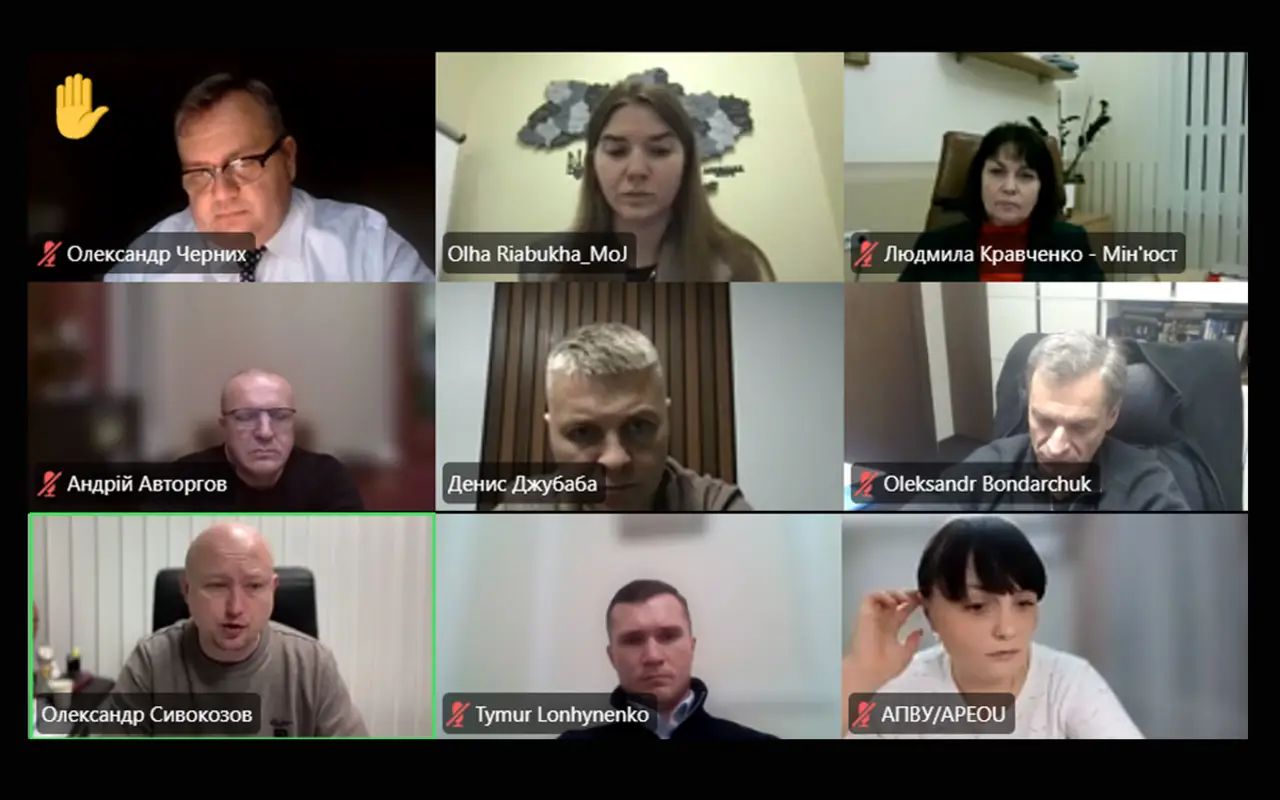
The mechanism was presented on November 3 at a meeting at the Ministry of Justice with representatives of the legal community, public and private enforcement officers and arbitration administrators.
The Ministry of Justice was represented by Deputy Ministers of Justice Olga Ryabukha, Andriy Gaychenko and Lyudmyla Kravchenko. Experts from the State Enterprise «National Information Systems» (NAIS) also participated in the meeting. Speaking on behalf of the UNBA was chairman of the UNBA Committee on enforcement of judgments Oleksandr Chernykh.
As a reminder, the issue arose after the main provisions of Law No. 4833-IX dated April 7, 2026, took effect on October 23. During the update of the AEPS, access to materials using previously issued identifiers was discontinued. Instead, an electronic account for parties was introduced, requiring authorization via a qualified QES. However, the system did not provide for a mechanism whereby an advocate could independently gain access based on power-of-attorney documents. Consequently, the UNBA Committee on Enforcement of Judgments urgently prepared a legal position, emphasizing that the law allows parties to act through representatives, and that the new electronic identification mechanisms should not restrict representation. Based on this position, the UNBA appealed to Minister of Justice Denis Maslov with a proposal to introduce a mechanism allowing representatives to independently access case materials.
The Ministry of Justice held a meeting to present a decision which, according to O. Ryabukha, was developed in response to numerous requests regarding access for representatives in enforcement proceedings. The Deputy Minister explained that logging into the system with an QES was introduced primarily to log users and generate a record confirming that a party has reviewed the case materials. Now, a unique code will be added to this mechanism. The party logs into th AEPS and signs a consent form containing the code. The party will then provide this code, along with the enforcement proceeding number, to their representative. The representative logs into the system using their own digital signature, enters the code, and gains access to all case materials.
Some private enforcement agents have expressed concern that the code will repeat the problem of the old identifiers, which allowed anyone to view the materials. O. Ryabukha emphasized that the representative will also log in using their own digital signature. Thus, the system will record who viewed the materials and when. According to the UNBA Committee, this mechanism will allow advocates to work with the materials without having to share their clients’ personal digital signatures.
The revisions cover both regulatory and technical aspects. According to L. Kravchenko, amendments to the Regulations on the AEPS will be adopted in about a week and a half. The State Enterprise «NAIS» aims to complete the system’s refinements in three weeks. O. Ryabukha set a deadline of no later than the end of November.
At the same time, in the opinion of the UNBA, the proposed solution removes only some of the obstacles. The consent and code are generated by the party logging into the system using an QES. Therefore, the issue of an advocate’s independent access based on a warrant remains unresolved, particularly when the client an elderly person, a person with a disability, a military servicemember, or a citizen abroad — does not have an electronic signature or, for objective reasons, cannot generate the consent themselves. The Committee also considers it necessary to define the procedure for verifying a representative’s authority, the term of validity and revocation of access, and the scope of documents available to the representative.
Other meeting participants raised a similar issue. Legal entities have dozens or even hundreds of representatives. Therefore, deputy chairman of the UNBA Committee on electronic judicial proceedings Tetyana Rabko proposed granting access to the AEPS to those representatives who already have electronic powers of attorney in the Electronic Court. L. Kravchenko promised to review the proposal.
«We support the automation of enforcement proceedings and technical progress. But the rights of the parties to enforcement proceedings come first, followed by technical implementation», - emphasized O. Chernykh. He thanked the Ministry of Justice for its prompt response and assured that the Committee is ready to participate in drafting regulatory changes. The Committee will also continue to collaborate with the Ministry of Justice and the State Enterprise «NAIS» on issues that remain unresolved.
© 2026 Unba.org.ua Всі права захищені
"Національна Асоціація Адвокатів України". Передрук та інше використання матеріалів, що розміщені на даному веб-сайті дозволяється за умови посилання на джерело. Інтернет-видання та засоби масової інформації можуть використовувати матеріали сайту, розміщувати відео з офіційного веб-сайту Національної Асоціації Адвокатів України на власних веб-сторінках, за умови гіперпосилання на офіційний веб-сайт Національної Асоціації Адвокатів України. Заборонено передрук та використання матеріалів, у яких міститься посилання на інші інтернет-видання та засоби масової інформації. Матеріали позначені міткою "Реклама", публікуються на правах реклами.