
In Odessa experts offered advice on how to protect intellectual property and prepare evidence for court
The outcome of an intellectual property dispute is often decided even before a lawsuit is filed. It is important whether the rights holder was able to document the infringement, whether they submitted evidence during the pretrial proceedings, and whether they can explain to the court why one expert opinion is more convincing than another.
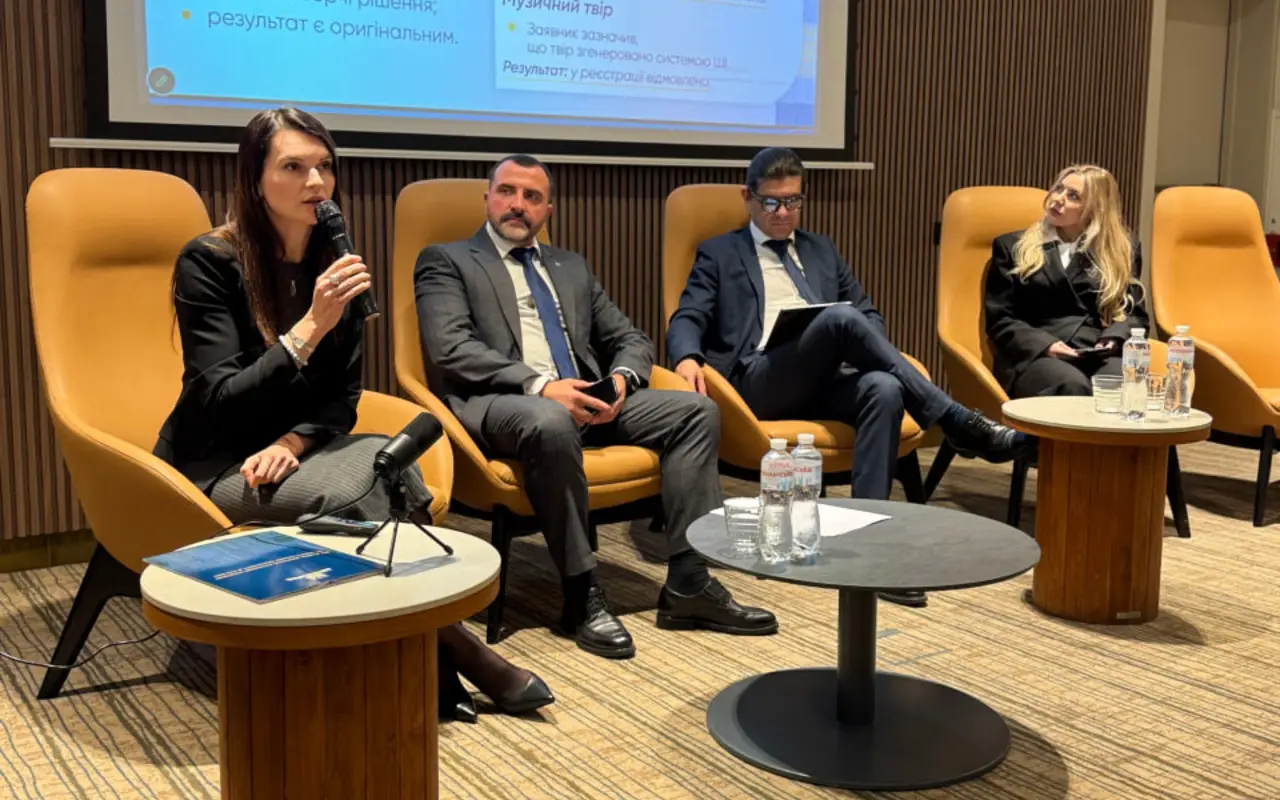
These issues were discussed during the first «IP Friday» panel discussion, which took place on November 6 in Odesa. The event was organized by the Odesa Regional Bar Association at the initiative of its Committee on continuing legal education and the UNBA’s Committee on intellectual property, with the support of the Ukrainian National Office of Intellectual Property and Innovation (UKRNOPI/IP Office).
Opening the event, the acting chairman of the Odesa Regional Bar Association Olena Dzhaburia noted that intellectual property issues particularly those related to generative artificial intelligence directly concern the professional practice of advocates, as clients are already raising these matters. She thanked Yuriy Romanyuk, chairman of the UNBA Committee on Intellectual Property and Head of the Department for the Protection of Intellectual Property Rights at UKRNOVI, as well as the IP Office as a whole, for co-organizing the event.
Over the course of three sessions, advocates, judges, representatives of the IP Office, and forensic experts discussed the protection of results generated by AI, international case law, business protection strategies, mediation, and the presentation of evidence. The discussion moved from the creation of an intellectual property object and the registration of rights to the choice of protection methods and the mistakes that could lead to losing a dispute.
Where does AI’s work end and authorship begin
Deputy director of UKRNOPI Lyubov Maidanik explained which results of work with generative artificial intelligence can be protected under copyright law. The decisive factor is human creative input: the use of AI does not in itself preclude protection, but a result generated entirely without human creative control does not qualify as a copyrighted work.
In practice, this requires distinguishing between the author’s contribution and the system’s output. For music created using AI, the human contribution such as song lyrics may be protected. An original prompt can be protected as a literary work. As the speaker explained, the office refused to register it as a computer program but registered it as a literary work. At the same time, not every instruction is original. A separate discussion focused on the sui generis right to non-original objects generated by a computer program.
The rights to data uploaded to an AI system are governed by the terms of service. Therefore, L. Maidanik advised reading them, at least in the sections on intellectual property, and taking care to protect confidentiality. In software development contracts, she recommended specifying the author’s guarantees and the stages of result verification in greater detail, particularly when AI was used during the development process.
A single product may have several levels of protection
Supreme Court Justice Tetyana Malashenkova presented international case law on cases involving the protection of intellectual property rights. Using examples from European court decisions, she discussed the protection of trademarks, industrial designs, copyrighted works, and non-traditional means of individualization.
The discussion focused on the distinctiveness of designations, the relationship between different protection regimes, and approaches to assessing infringements. A single commercial product may be protected simultaneously by several intellectual property rights. For an advocate, this means determining exactly which rights the client holds and on which of these grounds to base their claims.
Strategy begins before an infringement occurs
Head of the Department for the protection of intellectual property rights at UKRNOPI and chairman of the UNBA Committee on intellectual property Yuriy Romanyuk distinguished between the protection of intellectual property and its defense. Protection covers the entire life cycle of an intellectual property asset, from creation to commercialization and IP audits. Enforcement begins when a right has already been infringed or there is a real threat of infringement.
The choice between court proceedings, administrative appeals, and mediation depends on the nature of the infringement, the evidence, the costs, and the outcome the client seeks. According to the speaker, an administrative appeal to the Appeals Chamber may be faster and less expensive than court proceedings. Mediation allows the parties themselves to reach a mutually agreed-upon solution.
Y. Romanyuk illustrated the interplay between copyright and trademark rights using the example of a trademark dispute in Odesa. As the speaker explained, the court classified one party’s trademark as an adaptation of a work of visual art, the property rights to which the author had transferred to the other party under a contract. Therefore, the dispute hinged not only on the registration of the marks but also on the origin of the image and the documents evidencing the transfer of rights to it.
The dispute was settled by a compromise agreement on appeal. The speaker used this example to explain why, when defending a brand, it is important to verify the entire chain of rights: from the author of the graphic work to the company that uses it. Y. Romanyuk advised formalizing the transfer of property rights through a contract, rather than merely a deed of acceptance and transfer, and treating the registration of a brand’s graphic elements as works of authorship. Properly formalizing copyrights can provide an additional basis for defense when a conflict appears, on the surface, to be merely a dispute between trademark owners.
The founder’s brand and the company’s rights
Advocate Oleksandra Morozova examined intellectual property as a business asset. A company may use a brand for years, but the rights to it will remain with the founder. If the relationship is not formally documented, such an asset becomes a source of risk for the business itself.
An IP audit helps determine who owns the assets and on what grounds the company uses them. The speaker highlighted the importance of registering rights, contracts with employees and contractors, trade secret protection, and monitoring intellectual assets. Legal measures must be combined with organizational and technical ones: a certificate alone is not enough to protect a business.
Settlements can be reached before going to court
Head of the UKRNOPI Center for mediation and arbitration Aurika Grybovska explained that the center was established in 2023. The office is not a party to the mediation and does not participate in the proceedings; it merely facilitates the process. The center’s registry includes 27 IP mediators, many of whom are advocates. The speaker noted that mediation is possible both before and during court proceedings: it serves as grounds for suspending the proceedings, and if the dispute is settled, 60% of the court fee is refunded.
According to A. Grybovska, a mediation clause in a contract helps prevent conflicts. It is particularly useful when business is conducted by partners, friends, or relatives: as soon as a dispute arises, the parties turn to a mediator, and if they cannot reach an agreement, they may go to court. Another tool is preventive mediation. Even at the stage of organizing a business or establishing a project, the parties can agree on ownership, especially when one party contributes capital and the other contributes the business name.
Volumes without explanations are useless
Deputy director of UKRNOPI and chairman of the Appeals Chamber Vladyslav Bilotskyi reported that since its relaunch in 2024, the chamber has reviewed 256 cases, and 17 decisions have been appealed in court. The panel evaluates evidence using the same criteria as a court: relevance, admissibility, reliability, and sufficiency. It can also gather information on its own, including by reviewing websites, so the completeness of the evidence and the proper documentation of digital sources are crucial. Among the typical mistakes made by the parties, the speaker cited a large volume of materials without an explanation of how they relate to the grounds for appeal, as well as screenshots lacking a URL and date.
«Some parties believe that all they need to do is compile five to seven volumes of documents, hand them over to us, and we’re supposed to figure out what this is all about», - complained the chairman of the Appeals Chamber.
He also noted that parties often substitute primary documents (contracts, invoices, advertising materials) with expert opinions and ignore their opponents’ arguments. He advised grouping materials by specific circumstances and explaining which argument each document supports.
Record then write
The head of the UKRNOPI Center for monitoring intellectual property rights violations Oleksandra Bilotska pointed out that a single sale of counterfeit goods can involve several services and multiple individuals. An ad appears on social media, an order is accepted by a manager via a messaging app, payment is received by a sole proprietor, and the package is shipped from a different city. Therefore, the account owner, its actual administrator, and the author of a specific ad may be different individuals. The issue of the proper defendant should be resolved before filing a claim.
A complaint sent before evidence is documented often serves as a warning to the violator. The ad is deleted, the store is renamed, the website moves, and there is no longer any way to prove the violation. «So the rule is simple: document it first, then write», - emphasized O. Bilotska.
Instead of a single screenshot, the speaker recommended a continuous video recording of the screen, starting from the moment the address or search query is entered until the relevant page is displayed. Immediately after recording, you should calculate the file’s hash and include it in the report, along with the URL, date, and metadata. A test purchase provides the seller’s details and the product itself for examination; unboxing the package should be filmed in a single take without editing, with the tracking number visible in the frame. Along with evidence of the violation, you need to collect evidence of your rights: the chain of contracts or certificates listing the goods and services.
O. Bilotska suggested responding to violations in stages, from the quickest and cheapest to the most time-consuming: filing a complaint with the platform, contacting the website owner and the hosting provider, and, if necessary, going to court. She reviewed the procedure under Article 56 of the Law «On copyright and related rights», which specifically concerns copyright and related rights, as well as the inclusion of websites in the national list within the framework of WIPO ALERT. The choice of remedy should be based on the infringement that has already been documented.
Late evidence does not save the day
Head of the Department for judicial protection of IP rights at UKRNOPI Vladlena Finagina focused on the principle of full disclosure of evidence, enshrined in Article 80 of the Code of Civil Procedure and Article 83 of the Code of Civil Procedure. Evidence must be submitted along with the pleadings on the merits during the preparatory proceedings stage, while its submission in the appellate phase is strictly limited.
Using examples from court cases, V. Finagina demonstrated how the untimely submission of an expert opinion or a website capture report complicates the defense of a position. In one case, the appellate court rejected an expert opinion dated after the decision was rendered and a website capture report, neither of which existed at the time of the preparatory proceedings.
The standard of proof introduced in 2019 under Article 79 of the Code of Civil Procedure requires the court to compare the parties’ evidence and provide reasons for its assessment. However, conflicting expert opinions cannot be evaluated based on quantity alone: a greater number of opinions in the plaintiff’s favor does not necessarily mean a more convincing position. Each must be reviewed for compliance with procedural requirements and only then evaluated alongside other evidence.
According to the speaker, of the 144 disputes involving UKRNOPI, 69 concern the invalidation of security documents. The most she has seen in a single case is nine expert opinions. At the same time, the court may accept one opinion and reject another without ordering yet another expert examination, provided it properly justifies its decision.
Who to choose as an expert
An IP forensic expert and advisor to the director of UKRNOPI Oleksandr Doroshenko advised carefully verifying an expert’s qualifications. According to him, the registry of certified court experts specializing in inventions and utility models lists 23 individuals, but no more than ten are actually active. A technical education alone is insufficient, as the patent classification system encompasses tens of thousands of categories. In trademark disputes, unlike an agency expert, a court expert must assess how consumers actually perceive a mark. Therefore, according to O. Doroshenko, the expert needs knowledge of psychology.
In answering a question, the expert distinguished between two types of issues. Whether marks are so similar that they can be confused is a matter for expert opinion. Whether the grounds for refusal of registration established by law apply to the design is a legal question.
The speaker illustrated the need to read expert opinions critically using a dispute over the industrial design of an ice cream cup. In several opinions, the shape which is actually a truncated oval cone was described as a «rectangular prism». As it turned out, the experts had copied this wording from the description submitted by the applicant.
The discussion brought the participants back to the question of where an advocate’s work begins in an IP dispute: what rights does the client have, what exactly has been infringed, and how can this be proven. A properly documented transfer of rights, a website preserved in a timely manner, and a well-reasoned expert opinion form the basis of the case even before going to court. And the choice between judicial, administrative, and out-of-court mechanisms depends on the outcome the rights holder seeks.
© 2026 Unba.org.ua Всі права захищені
"Національна Асоціація Адвокатів України". Передрук та інше використання матеріалів, що розміщені на даному веб-сайті дозволяється за умови посилання на джерело. Інтернет-видання та засоби масової інформації можуть використовувати матеріали сайту, розміщувати відео з офіційного веб-сайту Національної Асоціації Адвокатів України на власних веб-сторінках, за умови гіперпосилання на офіційний веб-сайт Національної Асоціації Адвокатів України. Заборонено передрук та використання матеріалів, у яких міститься посилання на інші інтернет-видання та засоби масової інформації. Матеріали позначені міткою "Реклама", публікуються на правах реклами.