
Tromso Convention as a basis for digital governance and artificial intelligence
The Council of Europe Convention on Access to Official Documents together with international open data standards create a legal basis for the accumulation of official information in machine-readable formats for the purposes of e-government and the development of artificial intelligence.
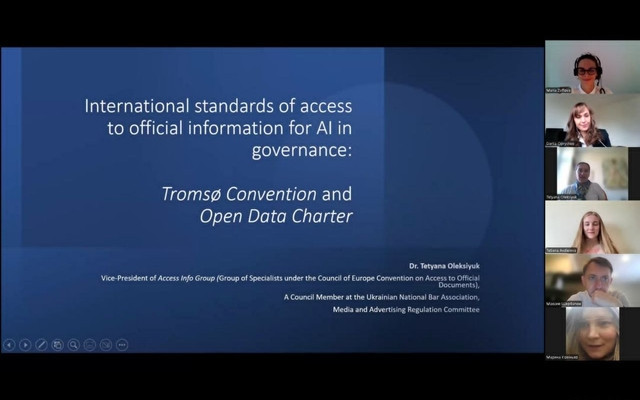
A report on the role of the Council of Europe Convention on Access to Official Documents (Tromso Convention) and international open data standards in the development of artificial intelligence tools was delivered by Tetyana Oleksiyuk, a member of the UNBA Committee on Media and Advertising Law, at the European Regional Conference «Artificial Intelligence for Information Accessibility» (AI4IA), organized by the UNESCO Information for All Program (IFAP) Working Group on Information Accessibility.
The Tromso Convention entered into force in December 2020 and became the first legally binding international instrument to enshrine the right of everyone, without discrimination, to access official information collected and created by public authorities. «Access to official data is a necessary component of transparency, accountability and citizen participation, and the Convention provides, albeit minimal, but fundamental standards for governments to provide access to official data, including in digital formats», - said T. Oleksiyuk. In her opinion, the accumulation of public sector information in digital formats suitable for machine processing will enable the development of e-government and artificial intelligence tools to improve public access to official information.
The Convention defines official documents as any information recorded in any form and held by public authorities, including digital formats such as databases, emails, and audiovisual recordings. This definition expands the scope of access to information in digital formats, which is increasingly replacing traditional paper documents. Therefore, the standards of the Convention can be fully applied to the processes of improving public access to government digital data. And the transition to digital document management opens up opportunities for improving the efficiency of public administration and implementing the principle of openness of public information by default and openness by design.
The governments of the countries that are parties to the Tromso Convention, including Ukraine, are obliged to manage their documents effectively (Article 9 of the Convention), which is extremely important in the context of digitalization. Public authorities are required to establish clear rules for the storage, destruction and accessibility of official information. This provision is consistent with the principles of good governance, ensuring that official data is preserved and structured in a way that facilitates public access.
In addition, public authorities should promote transparency by actively publishing information on the Internet, facilitating direct public access to information without the need for separate requests. The reports of the countries party to the Convention provide examples of successful access to information in digital formats and best practices in implementing proactive data disclosure.
Open data as a component of public information under the Law on Access to Public Information already provides citizens, researchers, and businesses with free access to public sector datasets in a machine-readable format. International open data standards, such as those enshrined in the Open Data Charter, promote the unification of approaches to data publication, which allows for the creation of higher quality and more interoperable datasets. This, in turn, stimulates innovation, as open data can be used to develop new services and products that improve the quality of life and promote economic growth.
According to T. Oleksiyuk, although the Tromso Convention provides a clear framework for improving access to official information, there are still obstacles to the effective implementation of these international standards. The main challenges are the lack of appropriate infrastructure, lack of knowledge and skills of responsible public officials, and insufficient legal literacy of requesters.
To overcome these challenges, governments should invest in digital infrastructure, develop user-friendly data portals, and introduce clear guidelines for publishing and managing public information in digital formats. Public authorities should also engage in awareness-raising campaigns to raise the awareness of civil servants and the public about digital access to public information.
Thus, the Tromso Convention, along with key open data documents, creates the basis for the development of digital public administration based on accurate, timely official information and using artificial intelligence tools. In particular, such tools can significantly accelerate the processing of large volumes of official information by automating the search, analysis, and classification of data. By implementing international open data standards and using AI tools, it will be possible to integrate different sources of information, providing more accessible and understandable interfaces for the public.
© 2026 Unba.org.ua Всі права захищені
"Національна Асоціація Адвокатів України". Передрук та інше використання матеріалів, що розміщені на даному веб-сайті дозволяється за умови посилання на джерело. Інтернет-видання та засоби масової інформації можуть використовувати матеріали сайту, розміщувати відео з офіційного веб-сайту Національної Асоціації Адвокатів України на власних веб-сторінках, за умови гіперпосилання на офіційний веб-сайт Національної Асоціації Адвокатів України. Заборонено передрук та використання матеріалів, у яких міститься посилання на інші інтернет-видання та засоби масової інформації. Матеріали позначені міткою "Реклама", публікуються на правах реклами.