
Time, risk of dismissal and effort to provide rationale: how a court reads a procedural document
When drafting a procedural document, an advocate should take into account three criteria used by the court: the time required to review the materials, the risk of the decision being overturned, and the effort required to provide a rationale for it.
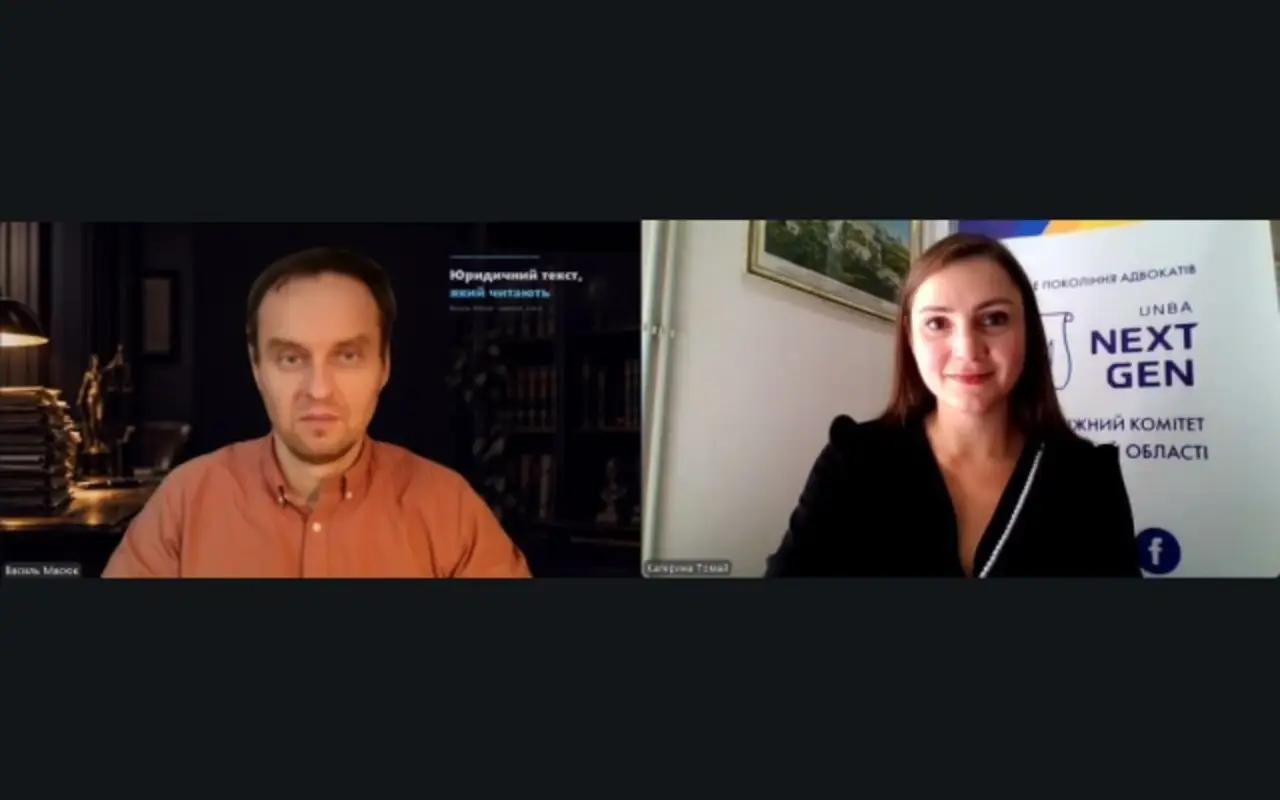
An advocate, candidate of legal sciences and aster of psychology Vasyl Masyuk discussed this during the webinar «Legal texts that get read: the judge at 6:00 p.m. is your primary reader». The event was organized by the UNBA NextGen in the Vinnytsia region.
The speaker explained the title of the event by noting the need to tailor the document to a judge, who has limited attention span after a workday and court hearings. Therefore, the text should be structured so that the court can understand the essence of the case and the party’s claims as quickly as possible.
But in addition to judges and their assistants, a procedural document actually has another reader: artificial intelligence. After all, generative systems can be used to process case materials. The author’s task is to present their position in such a way that its reasoning can be used in the reasoning section of the court decision without unnecessary revision, and the request can be transferred to its operative part.
V. Masyuk suggested structuring the document to accommodate both quick and in-depth reading. The first level consists of the opening paragraph, headings, and subheadings, which immediately clarify the subject of the dispute and what the party is seeking. The second level includes facts, evidence, case law, and a detailed legal rationale for careful review.
The speaker advised beginning the presentation not with standard details such as the case number or the date the contract was signed, but with one or two sentences summarizing the essence of the dispute and the claim being made. This way, the author does not divert the court’s attention to information already contained in the case file.
He divided the practical model of the document into five sections: the case framework, factual circumstances, legal classification, a response to likely objections, and the request. The speaker referred to this preemptive response to an anticipated counterargument as a «vaccine»: it allows the court to immediately see that the party has taken the opponent’s possible objections into account.
V. Masyuk paid special attention to the language of the document. Instead of emotional assessments such as «cynical» or «rude», it is better to cite specific dates, actions, and violated terms; instead of the phrase «the contract was breached», specify exactly which obligation was not fulfilled and which clause establishes it. Headings and bullet points can make reading easier, but an excess of bold text negates this effect.
Speaking about AI, the speaker cautioned that a text that appears professionally formatted may contain fictitious solutions or inaccurate references. Therefore, the value of a lawyer’s work lies not only in drafting a document but, above all, in verifying every factual and legal assertion.
Speaking about AI, the speaker cautioned that a document that appears professionally formatted may, upon review, turn out to be based on references to nonexistent Supreme Court rulings or ECHR case law. In his opinion, the value of a lawyer’s work lies first and foremost in the thorough verification of the text they have drafted.
At the end of the webinar, participants were invited to download a self-check checklist for procedural documents based on three court criteria.
© 2026 Unba.org.ua Всі права захищені
"Національна Асоціація Адвокатів України". Передрук та інше використання матеріалів, що розміщені на даному веб-сайті дозволяється за умови посилання на джерело. Інтернет-видання та засоби масової інформації можуть використовувати матеріали сайту, розміщувати відео з офіційного веб-сайту Національної Асоціації Адвокатів України на власних веб-сторінках, за умови гіперпосилання на офіційний веб-сайт Національної Асоціації Адвокатів України. Заборонено передрук та використання матеріалів, у яких міститься посилання на інші інтернет-видання та засоби масової інформації. Матеріали позначені міткою "Реклама", публікуються на правах реклами.