
A child in the EU, a dispute in Ukraine: the weaknesses of online expertise in family disputes
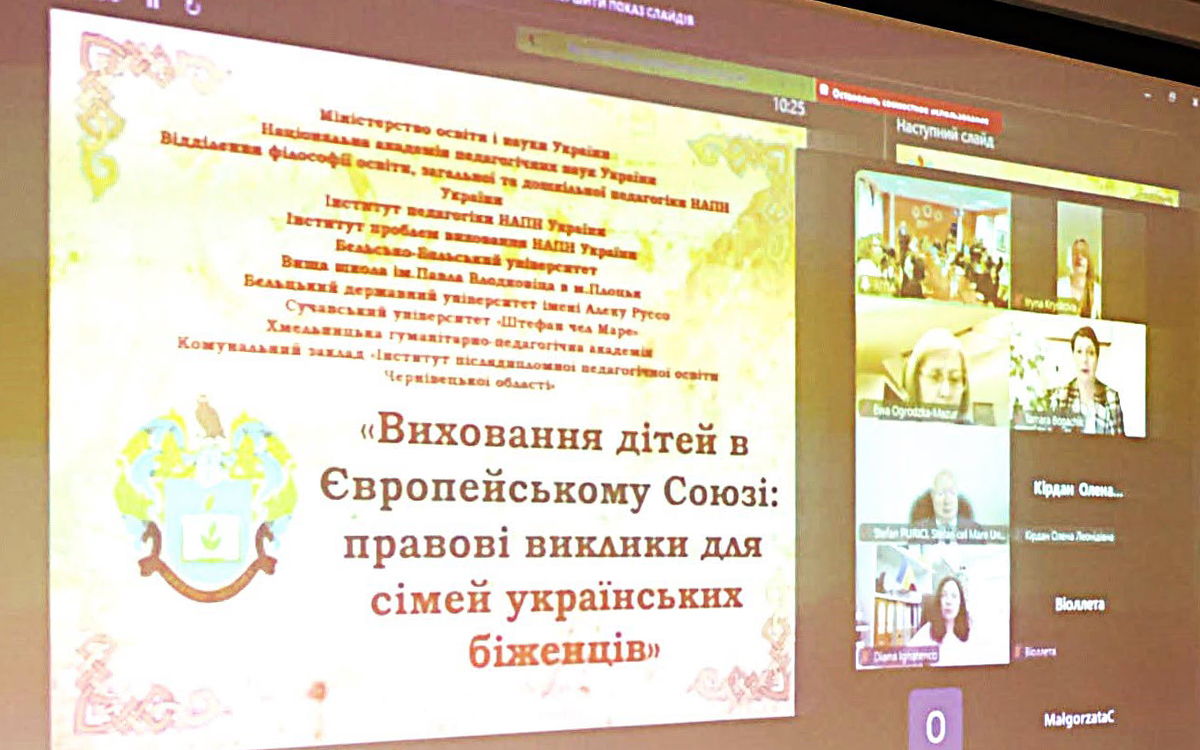
When a child lives with his or her mother in the European Union and a Ukrainian court is hearing a dispute over the child’s place of residence, the conclusion of a forensic psychological evaluation becomes key evidence. However, a conclusion based on the results of an online session may not stand up to scrutiny.
The chairman of the UNBA Committee on expert support for the practice of law Violleta Fedchyshyna explained why during a presentation at the international scientific and practical conference «Raising children in the European Union: legal challenges for families of Ukrainian refugees». The conference was held on October 14, 2026, by the Khmelnytskyi Academy of Humanities and Pedagogy in collaboration with institutes of the National Academy of Pedagogical Sciences of Ukraine and universities in Poland, Romania and Moldova.
According to the speaker, prolonged separation of spouses increases the number of international family disputes regarding a child’s place of residence, return, permission to leave the country, and child support. When a child is abroad and the case is in Ukraine, a forensic psychological evaluation becomes the primary tool for determining the child’s psycho-emotional state, psychological trauma, and attachment to each parent.
Among the expert’s tasks in such cases, V. Fedchyshyna highlighted determining the true nature of the child’s relationship with and attachment to each parent; assessing parental attitudes and parenting styles; evaluating the impact of the conflict and signs of psychological alienation; and assessing the child’s ability to express their own opinion without adult manipulation. The most difficult part is determining which scenario would cause greater harm: living with the father in Ukraine amid the risks of war, or with the mother in the EU, who may be behaving inappropriately or is exhausted by linguistic and social isolation.
It is even more difficult when the assessment is conducted remotely. It is hard to establish meaningful contact with the child and interpret their nonverbal reactions through a screen. There is no single international protocol for online assessments, and the expert cannot guarantee that the child is not under pressure—such as receiving prompts or having the mother present off-camera. According to V. Fedchyshyna, this calls into question the objectivity of the conclusion, which the court evaluates under Article 110 of the Code of Civil Procedure.
For comparison, the Committee chairman cited the European approach: the child is assessed not just once, but through long-term observation at home and at school, involving child welfare agencies and certified child psychologists. In cases involving the return of children under the 1980 Hague Convention, courts determine whether there is a serious risk of psychological or physical harm to the child if returned to a zone of armed conflict (Article 13 of the Convention).
As a solution, V. Fedchyshyna proposed developing a Unified International Methodological Protocol for Cross-Border and Remote Forensic Psychological Evaluations, which would take into account the context of war and the specific nature of war-related trauma.
Previously, V. Fedchyshyna explained why courts need scientific criteria for evaluating expert opinions and discussed when an expert’s opinion loses its evidentiary value. The UNBA Committee on family law compiled the Supreme Court’s case law regarding the child’s place of residence and international child abduction in its bulletin for the second quarter of 2026.
© 2026 Unba.org.ua Всі права захищені
"Національна Асоціація Адвокатів України". Передрук та інше використання матеріалів, що розміщені на даному веб-сайті дозволяється за умови посилання на джерело. Інтернет-видання та засоби масової інформації можуть використовувати матеріали сайту, розміщувати відео з офіційного веб-сайту Національної Асоціації Адвокатів України на власних веб-сторінках, за умови гіперпосилання на офіційний веб-сайт Національної Асоціації Адвокатів України. Заборонено передрук та використання матеріалів, у яких міститься посилання на інші інтернет-видання та засоби масової інформації. Матеріали позначені міткою "Реклама", публікуються на правах реклами.