
Advocates were trained to stop severe bleeding until medical personnel arrived
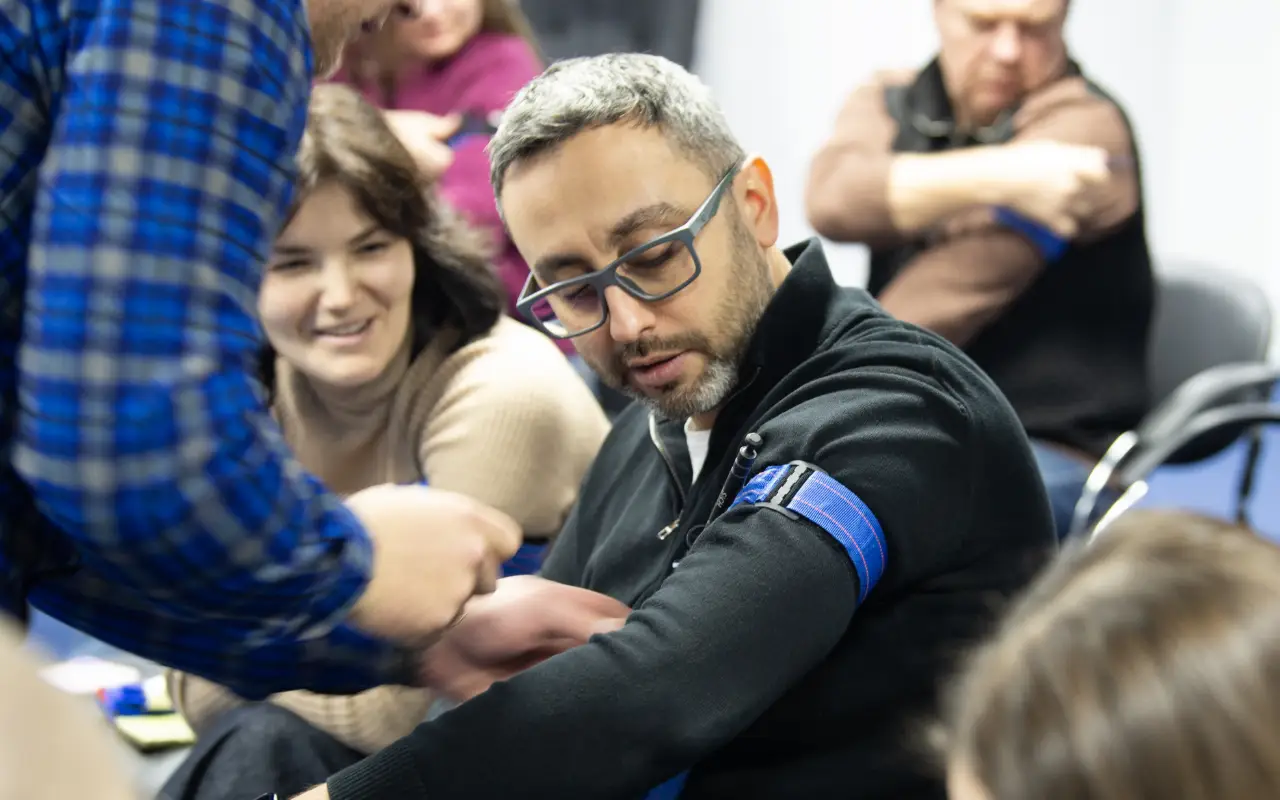
During a shelling, a traffic accident, or an emergency, massive bleeding from a limb can claim a person’s life even before an ambulance arrives. Advocates practiced on mannequins under the supervision of instructors to learn how to recognize such bleeding, stop it, and properly hand the victim over to medical personnel.
The training session, «Stopping massive bleeding under the International educational initiative «Stop the Bleed», took place on November 11 in Kyiv. It was organized by the Ukrainian National Bar Association in collaboration with the nonprofit organization «Alliance for community resilience».
The instructor devoted the theoretical portion to how to distinguish life-threatening bleeding from ordinary bleeding in a matter of seconds. Among the signs mentioned were blood spurting or flowing rapidly from a wound, a pool of blood beneath the victim, blood-soaked clothing, and traumatic amputation.
Next, the participants reviewed the procedure: the rescuer must first ensure their own safety and call for help at 103, and only then begin to stop the bleeding. Depending on the nature and location of the injury, direct pressure on the wound, packing, or a tourniquet is applied. Packing is necessary where a tourniquet cannot be applied: in the armpit, groin, or neck area. A deep wound is tightly packed with a bandage or hemostatic agent and pressed firmly for an extended period.
The practical portion was conducted using mannequins and wound simulators. Each participant applied a tourniquet to themselves and a partner, packed a wound, and checked whether the bleeding had been stopped. The instructor pointed out common mistakes: a tourniquet tied too loosely, which only increases bleeding, and attempts to loosen it before medical personnel arrive. He also advised participants to be sure to record the time the tourniquet was applied.
The final segment covered actions to take after the initial bleeding has been stopped: how to monitor the victim’s condition and maintain their body heat. Participants also discussed exactly what to report to the emergency medical team during the handoff: what happened, what measures were taken, and when the tourniquet was applied.
«Advocates work among people every day: in courts, government offices, and on visits to clients, including in communities near the front lines. So, during shelling or an accident, an advocate may be the first person on the scene with the victim. Unfortunately, today everyone needs the skills to stop massive bleeding. It’s good that we had the opportunity to practice these skills firsthand», - commented one of the event’s participants deputy chairman of the UNBA Committee on legal practice Volodymyr Martynenko.
In May of this year, advocates had already learned how to apply tourniquets during a pilot workshop on tactical medicine, and in September, they underwent firearms training.
© 2026 Unba.org.ua Всі права захищені
"Національна Асоціація Адвокатів України". Передрук та інше використання матеріалів, що розміщені на даному веб-сайті дозволяється за умови посилання на джерело. Інтернет-видання та засоби масової інформації можуть використовувати матеріали сайту, розміщувати відео з офіційного веб-сайту Національної Асоціації Адвокатів України на власних веб-сторінках, за умови гіперпосилання на офіційний веб-сайт Національної Асоціації Адвокатів України. Заборонено передрук та використання матеріалів, у яких міститься посилання на інші інтернет-видання та засоби масової інформації. Матеріали позначені міткою "Реклама", публікуються на правах реклами.