
How a client's PTSD and concussion affect the case
A military client may mix up dates in their statements, miss hearings, or lose their composure due to a delayed response from a government agency. If these behaviors stem from the effects of a concussion or post-traumatic stress disorder, the advocate should take them into account both in organizing their work and in their approach to the case.
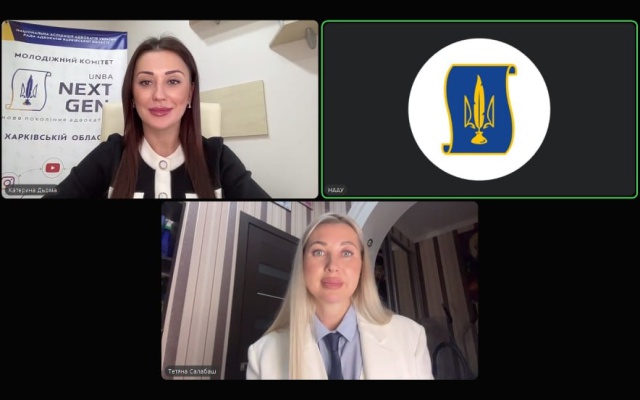
A military and clinical psychologist Tetyana Salabash explained how to recognize such symptoms during the webinar «Communicating with military clients and veterans: avoiding triggers and working with PTSD». The event took place on October 28 at the initiative of the UNBA NextGen in the Kharkiv region. The meeting was moderated by the Committee’s regional representative Kateryna Dyoma.
According to T. Salabash, a traumatized nervous system may perceive requests for clarification of dates, chronology, or documents as doubt or interrogation. Such a person may perceive the rescheduling of hearings and delays in responses from government agencies as sabotage, betrayal, or hostile actions. The speaker distinguished between three states. During an acute reaction to stress, a person’s volitional and cognitive control is impaired, so it is not possible to sign contracts or other documents or provide statements at this time. Post-traumatic stress disorder may not manifest immediately but rather after a civilian stressor, such as a divorce filing or a denial of benefits. The psychologist explained that missing hearings is a symptom of avoidance: the client does not do this to spite the advocate. Complex PTSD, she said, is accompanied by a loss of trust in people, particularly in one’s own advocate. With such clients, it is important to maintain clear boundaries and written agreements. The speaker advised agreeing on communication times, outlining the duration of the meeting in advance, and allowing the client the right to take a break or skip a painful question.
T. Salabash advised taking the effects of a concussion into account during the consultation itself. Cognitive exhaustion typically sets in after 20–25 minutes of conversation, so it’s advisable to offer a five-minute break. The client may forget dates, names, and the sequence of events, and confusion in their explanations does not indicate an attempt to mislead. The speaker advised treating self-medication with alcohol or sedatives as a procedural risk. If an opposing party in court attempts to discredit the client’s testimony because of this, the advocate should present this condition as a comorbid disorder resulting from trauma and confirm it with medical documentation.
The organization of the work itself can also serve as a trigger. The psychologist advised against making abstract promises and recommended outlining a clear plan of action for the next steps after each meeting. The client should be warned even about a two-minute delay.
If the client does lose their temper, the advocate should lower their voice, slow their speech by half, take two steps back, and show open palms. Saying «calm down» is not advisable, and citing legal provisions at such a moment is futile. «It’s not him; it’s the trauma speaking through him. We need to bring back the person we’ll be working with», - explained T. Salabash.
Previously, the UNBA in collaboration with the Ministry of Veterans Affairs prepared guidelines on ethical and accessible communication with veteran clients. Psychologist Yevheniia Zhuravel explained, how to help a client experiencing acute stress.
© 2026 Unba.org.ua Всі права захищені
"Національна Асоціація Адвокатів України". Передрук та інше використання матеріалів, що розміщені на даному веб-сайті дозволяється за умови посилання на джерело. Інтернет-видання та засоби масової інформації можуть використовувати матеріали сайту, розміщувати відео з офіційного веб-сайту Національної Асоціації Адвокатів України на власних веб-сторінках, за умови гіперпосилання на офіційний веб-сайт Національної Асоціації Адвокатів України. Заборонено передрук та використання матеріалів, у яких міститься посилання на інші інтернет-видання та засоби масової інформації. Матеріали позначені міткою "Реклама", публікуються на правах реклами.