
Are you saving the client or yourself? Signs that an advocate is too immersed in a case
An advocate who, after a meeting, mentally continues the conversation with a client and seeks solutions on the client’s behalf is, in fact, often merely soothing their own anxiety. This kind of «rescue» can be recognized by several signs. Afterward, one should return to providing support.
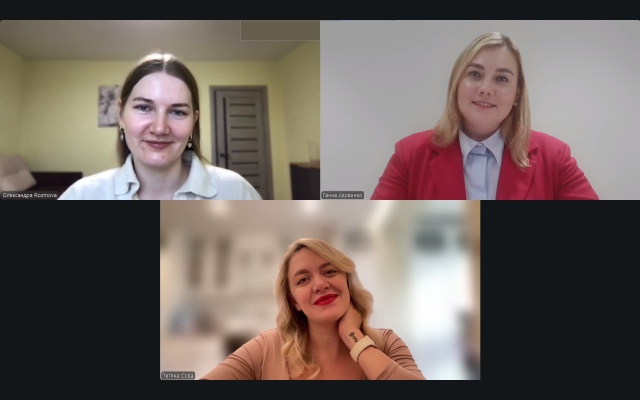
This was emphasized by practical psychologist Tetyana Sova during the webinar «How to support others without losing yourself». The event took place on October 22 at the initiative of the UNBA and with the support of the International Bar Association (IBA) as part of the project «Supporting the mental health of Ukrainian advocates during the war». The meeting was moderated by project coordinator Hanna Udovenko.
According to the speaker, an advocate’s desire to solve someone else’s problem is often driven by an attempt to alleviate their own emotional discomfort. In such cases, one may fail to hear what the other person actually needs. Depending on their own resources, everyone falls somewhere between two extremes: indifference and heroism. As she explained, both are psychological defense mechanisms primarily directed at oneself. But the essence of support lies elsewhere: «My task is not to remove the difficulty from your life, but to help you not be left alone with it», - said T. Sova, articulating the principle of healthy support.
The psychologist identified the first sign of rescue as a situation where a person thinks about a problem more than the person it actually affects: mentally conducting dialogues, coming up with things to say, and returning to the topic on their own. One of the participants noted that this was exactly how she had been feeling over the past few months while defending a client’s rights. The speaker replied that this happens frequently when working with people, so a professional should be aware of this tendency in themselves. If the topic won’t leave you alone even at home, it’s a sign that you’ve already crossed the line.
T. Sova listed other signs: The psychologist also distinguished between empathy and guilt. Empathy is feeling sorry for what is happening to a person. Guilt is a sense of responsibility for their condition, even though you cannot influence it. According to the speaker, a person is responsible for what they can offer, and the other person is responsible for how they use it; therefore, advice that was not accepted should not be a cause for frustration.
- the belief that you are the one who must come up with a ready-made solution;
- systematically neglecting your own needs: sleep, food, and well-being;
- letting your mood depend on someone else’s mood;
- irritation when advice isn’t followed;
- offering help without being asked;
- the habit of «dwelling on» a conversation that’s already over for weeks on end.
To avoid falling into the trap of playing the rescuer, T. Sova advised assessing your energy levels daily using a traffic-light system. In the «green» state, you can provide quality support to others.
In the «yellow» state, you can offer support within clearly defined boundaries. In the «red» state, you need support yourself, so it’s better to postpone the conversation. Before responding to a difficult request or declining it, she recommended checking whether you’re doing so while hungry, exhausted, thirsty or irritated.
In summary, the speaker advised keeping track of your own state so you don’t inadvertently start trying to «rescue» someone, and to clarify with the person exactly what they need from you. The more specific the request, the greater the likelihood that the help will match the need.
Previously, we discussed how an advocate can maintain professional boundaries when dealing with a difficult client, when it’s best to turn down a potential client, how to switch off «advocate mode» at the end of the workday, and what to do if a client is experiencing acute stress.
© 2026 Unba.org.ua Всі права захищені
"Національна Асоціація Адвокатів України". Передрук та інше використання матеріалів, що розміщені на даному веб-сайті дозволяється за умови посилання на джерело. Інтернет-видання та засоби масової інформації можуть використовувати матеріали сайту, розміщувати відео з офіційного веб-сайту Національної Асоціації Адвокатів України на власних веб-сторінках, за умови гіперпосилання на офіційний веб-сайт Національної Асоціації Адвокатів України. Заборонено передрук та використання матеріалів, у яких міститься посилання на інші інтернет-видання та засоби масової інформації. Матеріали позначені міткою "Реклама", публікуються на правах реклами.