An advocate's refusal to provide guarantees does not exempt the investigation from the obligation to ensure them

The participation of a representative of the regional bar association during a search of an advocate's premises (inspection of his home or other property, premises where he carries out his activities, temporary access to his belongings and documents) is a legally established guarantee and does not depend on the will of the advocate himself. The advocate's refusal to allow a representative of the bar association to participate does not exempt the pre-trial investigation body from its obligation to ensure the implementation of this guarantee by all available means.
These conclusions were reached by the Bar Council of Ukraine in its decision of October 18, 2025, No. 115, following consideration of an appeal by an advocate who informed the UNBA of a violation of his professional rights in connection with an urgent search of his apartment.
BCU emphasized that a mandatory condition for conducting a search is the presence of a representative of the regional bar council or, on its behalf, a representative of the Committee for the protection of advocates' rights and guarantees of legal practice. This must be ensured by the investigating authority by notifying the regional bar association in advance, unless otherwise expressly provided for in the rules on urgent investigative actions. This guarantee is aimed at protecting advocate-client privilege and preventing abuse, as the professional activities of advocates are subject to a special legal regime of protection.
Since an advocate is a special subject to whom the guarantees of advocate practice and immunity apply, any interference in the sphere where lawyer-client privilege may be involved (information carriers, documents, electronic devices) must be carried out with maximum restriction of access to such information.
At the same time, it is not permissible to involve third parties (including representatives of bar self-government bodies) in familiarizing themselves with the content of information constituting attorney-client privilege (unless the client has given their express consent or it is provided for by law).
A representative of the regional bar association, although an advocate and performing the functions of advocate self-government, is not a party to the legal assistance agreement within which this secret arose. His task is to monitor compliance with the rights of the advocate and record violations, not to access the confidential content of the «advocate-client» relationship.
The law requires the investigation and the court to prevent access to attorney-client privilege, not to create mechanisms for its disclosure or «filtering» by third parties. The involvement of a representative of the regional bar association or a member of the Committee for the protection of advocates' rights and guarantees of legal practice in the selection or review of seized documents, files, or electronic information during a search of an advocate's office is unacceptable and leads to an expansion of the circle of persons who have access to confidential information.
Representatives of the advocate self-government do not have the authority to access advocate-client privilege. They are authorized only to monitor the observance of the advocate's rights during the search, make comments to the protocol, and prepare relevant reports (certificates) for the Council.
The full text of BCU Decision No. 115 can be viewed at this link.
Popular news
Guarantees of the practice of law
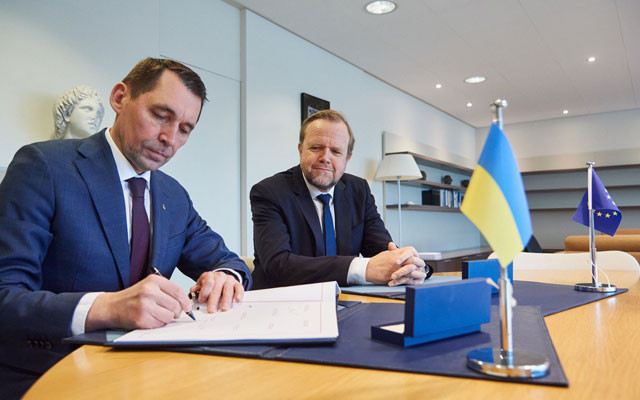
Ukraine has signed the Convention for the Protection of the Profession of Lawyer
Today, on 9 March, Ukraine's Permanent Representative to the Council of Europe Mykola Tochytskyi signed the Council of Europe Convention for the Protection of the Profession of Lawyer. This makes our country the 28th to sign this important international treaty.
European integration
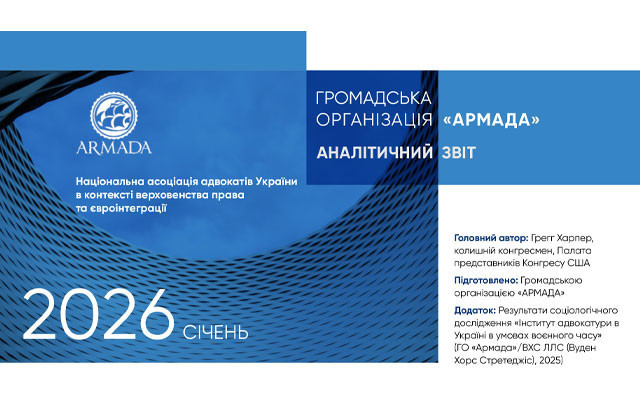
A translation of the report on advocacy presented to the European Parliament has been published
A translation of a research report on the Ukrainian advocacy profession in wartime, previously presented to the European Parliament in Brussels, has been published. The document is presented as a basis for discussion on the rule of law, Ukraine's European integration aspirations, and countering Russian disinformation in the legal sphere.

Legal defence of military personnel
How to formalize discharge from military service: practical workshop
The issue of discharge from military service remains one of the most pressing and complex for Ukrainian defenders and their families. Due to constant changes in legislation, military personnel often face refusals to discharge them from service or even to consider their reports.
Legislation
The Verkhovna Rada Committee criticized the format of the government working group on advocacy
The implementation of the Roadmap on the rule of law (approved by Cabinet of Ministers Resolution No. 475-r of May 14, 2025) in relation to advocacy raises the practical question of who exactly should prepare legislative changes and how.
Self-government
The BCU demands a review of the composition of the government working group on reforming the advocacy profession
The President of the UNBA, BCU Lidiya Izovitova, appealed to the Cabinet of Ministers of Ukraine to review the composition of the working group on improving legislation in the field of advocacy and legal practice.
Guarantees of the practice of law
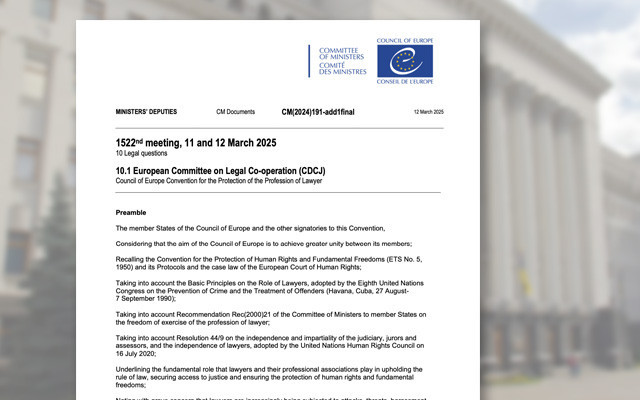
The President has determined, who will sign the Convention for the Protection of the Profession of Lawyer
President of Ukraine Volodymyr Zelenskyy authorized Ukraine's Permanent Representative to the Council of Europe Mykola Tochytskyi to sign the Council of Europe Convention for the Protection of the Profession of Lawyer.
Legislation
After the war amnesty for criminals or exemption from responsibility?
To ensure national reconciliation, rehabilitation of persons who have been persecuted for political reasons, restoration of justice, and establishment of lasting peace, it is proposed to introduce an amnesty after the war.
Discussion
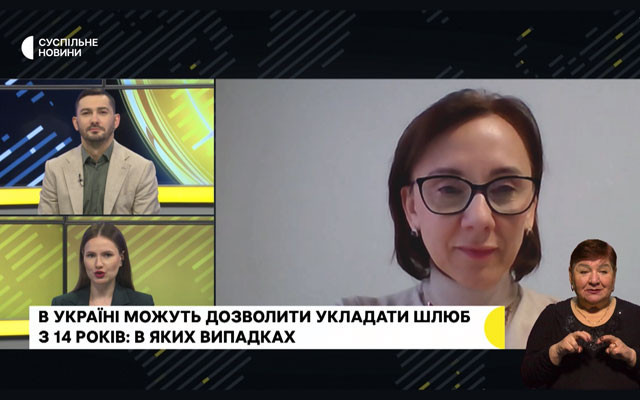
Why lowering the age of marriage lacks legal logic
Although until 2012 there was a provision in family law that allowed children to marry from the age of 14 under certain circumstances, its return to Ukrainian law would contradict international obligations and the logic of criminal law.
Publications

Volodymyr Matsko Extradition during wartime: when the risks outweigh the request

Volodymyr Matsko Extradition as a systemic form of rights violations

Victoria Yakusha, Law and Business The anti-corruption vertical cannot «take care» of the Bar as an institution, - acting head of the HQDCB

Censor.net Protecting advocates – protecting justice: addressing concerns about the new law

Ihor Kolesnykov A BRIEF SUMMARY REGARDING THE APPLICATION OF THE ORDER ON EXTENDED CONFISCATION IN LATVIA REGARDING FINANCIAL ASSETS OF…

Valentyn Gvozdiy WORKING IN A WAR ZONE

Lydia Izovitova Formula of perfection

Sergiy Vylkov Our judicial system is so built that courts do not trust advocates