Public interest and property rights: protection of bona fide purchasers discussed at round table
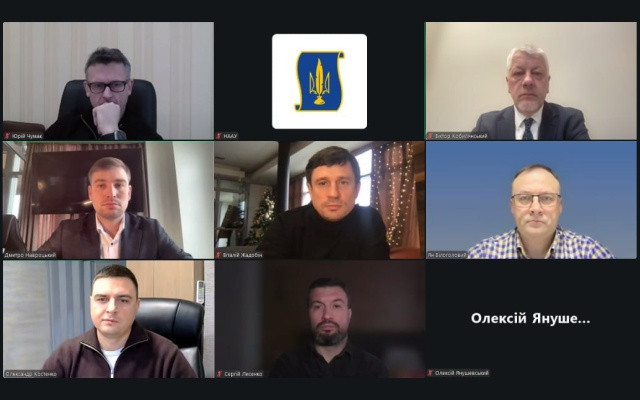
The return of land and real estate from state and municipal ownership conflicts with the protection of bona fide purchasers. When the statute of limitations begins, who proves bad faith, should there be compensation, and how can the balance between public interest and stability of property rights be maintained?
As part of Land Law Week, the UNBA Committee on agricultural, land and environmental law organized and held a roundtable discussion on «Practical aspects of applying the provisions of law No. 4292-IX «On amendments to the Civil Code of Ukraine regarding strengthening the protection of the rights of bona fide acquirers».
The moderator of the event, deputy chairman of the UNBA Committee on agricultural, land and environmental law Dmytro Navrotsky noted that judicial practice had long been pushing for legislative changes: The Supreme Court has increasingly defended bona fide purchasers, distinguished between claims relating to land and related immovable property, and assessed the proportionality of interference with the right to peaceful possession.
Separately, he recalled the approach of the ECHR in the case of Stretch v. the United Kingdom: the consequences of procedural violations by state authorities should not be borne by a person who acted in good faith. D. Navrotsky also described how, during the finalization of the draft law, the initial idea of compensating for losses through claims against officials was transformed into a model of adequate compensation to bona fide acquirers through amendments to Article 390 of the Civil Code and clarification of the rules for the commencement of the limitation period in Article 261 of the Civil Code. The advocate drew attention to the increase in lawsuits filed by prosecutors regarding forest and water fund lands and attempts to justify negative claims as a way to circumvent the statute of limitations. The moderator also outlined two constitutional issues: the Constitutional Court's decision in the case of Reinier Business Group's complaint about the limits of the prosecutor's representation of the state's interests and the Supreme Court's submission on the constitutionality of the retrospective application of certain provisions of Law No. 4292-IX.
Supreme Court Justice Yuriy Chumak said that in his practice he encounters lawsuits filed by the state or local communities against private individuals for the return of property. He explained this by the complexity of proving involuntary disposal in disputes between private entities and the fact that the consequences of privatization errors and alienation of state or communal property are often transferred to private law proceedings.
Y. Chumak emphasized that in commercial proceedings, the good faith of the acquirer is presumed, and the burden of proving bad faith lies with the plaintiff, in particular the prosecutor. The assessment is carried out in each case, primarily with regard to the last acquisition for consideration, without checking the entire history of transfers.
According to his approach, the statute of limitations is calculated from the moment of disposal of the property, and the validity of the reasons for the omission is assessed individually. The judge linked Law No. 4292-IX to the ECHR standards on preventing excessive burden on a bona fide owner and the need for a balance between public interest and stability of property rights.
In terms of time limits, Law No. 4292-IX effectively distinguished between the statute of limitations and the limitation period. This was emphasized by advocate Oleksandr Kostenko. According to him, the general statute of limitations remains three years, but the new part 8 of Article 261 of the Civil Code defines the objective start of its course in disputes over the recovery of real estate that has been removed from state or communal ownership: from the date of state registration of the right of the first acquirer, and if registration was not provided for at that time, from the date of transfer of the property to the first acquirer. Separately, he outlined the changes to Article 388 of the Civil Code: a 10-year limitation period has been introduced, after which the state or community cannot reclaim property from a bona fide acquirer; subsequent resales do not change this period.
Deputy chairman of the UNBA Committee on business protection Serhii Lysenko focused on Part 5 of Article 390 of the Civil Code and noted that its wording leaves room for practical difficulties. According to his explanation, the provision stipulates that if the court reclaims immovable property from a bona fide acquirer in favor of the state or community, the issue of compensation for the value is resolved simultaneously, and the reclaim is possible subject to the prior deposit of funds into the court's deposit account. After the compensation is paid, the state or community has the right to make a counterclaim against the person who is at fault for the loss of the property.
S. Lysenko recalled the related amendments to the Civil Procedure Code and the Civil Procedure Code regarding the obligation to attach evidence of payment and an appraisal document to the claim. Among the problems, he mentioned the lack of budget funds and the issue of ordering an appraisal, since the plaintiff in such disputes is not the owner of the property. He also pointed out that lawsuits based on proving the bad faith of the acquirer may be filed as a way to avoid the application of Part 5 of Article 390. He separately mentioned the approaches that have already been expressed in the legal positions of the Supreme Court and emphasized that the further practice of applying the norm is still being formed.
Deputy chairman of the UNBA Committee on investment and privatization Vitaliy Zhadobin recalled the discussion of Law No. 4292-IX with representatives of the prosecutor's office, where advocates raised questions about the selectivity of lawsuits, as well as the responsibility of officials involved in the disposal of assets from state or communal property. In his opinion, attempts to build lawsuits by proving the bad faith of the acquirer may intensify in practice. Separately, the advocate raised the issue of hydraulic structures as a risk factor for the stability of investments and privatization. He noted that in privatization cases, in particular regarding alcohol factories, potential buyers sought to include hydraulic structures in the privatization pool through inventory records, since water is an element of the technological cycle. At the same time, in his opinion, this approach lays the groundwork for further disputes regarding the legality of privatization and may cause interruptions in economic activity.
Member of the Council of the Committee on agrarian, land and environmental law Yan Bilogolovy added that approaches to the registration of hydraulic structures have changed in practice: at various times, there were positions on the impossibility of registering ownership rights, as well as decisions that prompted local authorities to take such objects on their balance sheet. According to him, the issue is currently under consideration by the Grand Chamber of the Supreme Court, and it is its conclusion that will determine the further approach to the relationship between the status of the structure and the regime of the land plot under it.
Committee chairman Viktor Kobyliansky noted that there are many more issues than those that were touched upon during the round table. Among the practical issues, he specifically mentioned hydraulic structures and raised the question of situations where a person has legally obtained a land plot and legally built a hydraulic structure on it, but it later turns out that in the case of a water fund, such a structure cannot belong to that person. In this context, he mentioned that a relevant case concerning hydraulic structures is to be considered by the Supreme Court in the near future.
V. Kobyliansky also returned to the disputes over water fund and forestry lands and emphasized the initial question: who and how determined that specific lands belong to the water fund or forestry. In his opinion, prosecutors' positions are sometimes dominated by a factual approach based on the external characteristics of the area, whereas legally, the intended purpose arises at a specific moment and according to an established procedure. He noted that in specific cases, the court of cassation proceeds from the facts established by the lower courts, but the very question of properly determining when and on what basis a plot of land acquired its status often remains insufficiently investigated.
Popular news

URAU
Access to advocate contacts in URAU has been restored
The Bar Council of Ukraine has opened up public access to data from the Unified Register of Advocates of Ukraine, which was closed at the start of the full-scale invasion in 2022. The decision was made at a meeting on December 12–13.

Self-government
Members of the QDCB are not required to submit declarations - BCU
Bar Council of Ukraine examined the legal status of members of bar self-government bodies and found that they are not required to submit declarations of persons authorized to perform functions of state or local self-government.

Self-government
BCU has identified 12 areas for implementing the Roadmap for advocacy
During its meeting on December 12, the Bar Council of Ukraine considered the Roadmap on the Rule of Law, approved by Order of the Cabinet of Ministers of Ukraine No. 475-r dated May 14, 2025. The document provides for the development and adoption of a draft law on improving the legal regulation of advocacy by the fourth quarter of 2026.

Guarantees of the practice of law
The Ombudsman acknowledged the problem of violation of the human right to legal aid in the TCC
The Verkhovna Rada Commissioner for human rights Dmytro Lubinets confirmed the existence of a problem with ensuring the constitutional right to professional legal assistance in territorial recruitment and social support centers.

Discussion
Why preventive measures have turned into preventive punishment in Ukraine: round table discussion
The European approach, enshrined in the CPC, provides for detention as an exceptional preventive measure: courts must prove the impossibility of milder alternatives and carefully assess the risks. In practice, however, it is increasingly being applied almost automatically, eroding standards of freedom.
Guarantees of the practice of law
The UNBA presented a report on violations of advocates' rights in the TCC
The Committee for the protection of advocate's rights and guarantees of legal practice of the UNBA has prepared a consolidated report on violations of advocate's professional rights and guarantees of legal practice by territorial recruitment and social support centers for the period from 2022 to the first half of 2025.

Self-government
Statement by the UNBA Committee regarding manipulative journalistic material
Statement by the UNBA Committee on information policy and interaction with the media regarding manipulative journalistic material aimed at discrediting the advocacy institution.

Greetings
Congratulations on the anniversary of the establishment of the Ukrainian National Bar Association
November 17 marks the thirteenth anniversary of the establishment of the Ukrainian National Bar Association, a professional self-governing organization that has united advocates from all regions of the country into a single independent institution.
Publications

Censor.net Protecting advocates – protecting justice: addressing concerns about the new law

Ihor Kolesnykov A BRIEF SUMMARY REGARDING THE APPLICATION OF THE ORDER ON EXTENDED CONFISCATION IN LATVIA REGARDING FINANCIAL ASSETS OF…

Valentyn Gvozdiy WORKING IN A WAR ZONE

Lydia Izovitova Formula of perfection

Sergiy Vylkov Our judicial system is so built that courts do not trust advocates

Iryna Vasylyk Advocacy in the proclamation of Independence of Ukraine

Oleksandr DULSKY When we cross the border of the Supreme Anti-Corruption Court, we get into another department of the National Anti-Corruption…

Vadym Krasnyk The UNBA will work, and all obstacles and restrictions are only temporary inconveniences