The legal limits of war through the eyes of the Red Cross: discussing IHL with advocates
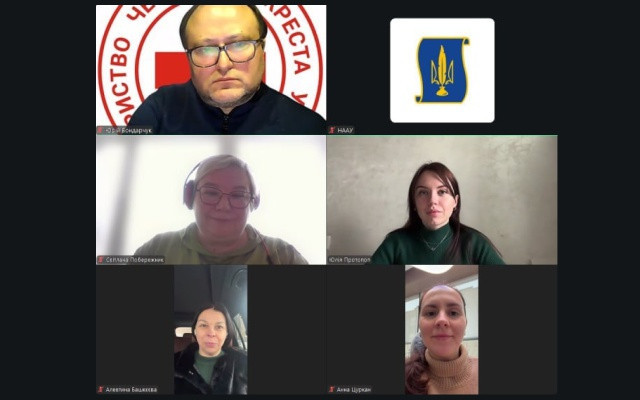
How the rules of international humanitarian law work during armed conflict and what they mean for the protection of people and legal practice was explained to advocates during an online training session on «International humanitarian law: the legal limits of war».
The event was organized by Dnipropetrovsk regional representatives of the UNBA NextGen Alevtina Bashkueva, Anna Tsurkan and Yulia Protopop, in cooperation with the Ukrainian Red Cross Society.
The Society's leading expert Svitlana Poberizhnyk outlined the basic framework of international humanitarian law: when it applies, who it binds, what sources form the rules of «the law of war», and how IHL relates to international human rights law. She also explained the role and functions of the International Red Cross and Red Crescent Movement in the system of humanitarian protection during armed conflicts.
In particular, the lecturer discussed the Red Cross emblem as an instrument of IHL and a practical marker of protection. She explained the difference between the protective use of the emblem, when the designation is intended to indicate medical or spiritual personnel, medical units, or sanitary transport, thereby signaling their special status under the rules of war, and the distinctive use, when the emblem indicates the affiliation of persons or objects to the international movement.
In this context, S. Poberizhnyk pointed out that the right to use the emblem for protection is strictly regulated both in peacetime and during armed conflict. Using the example of the Geneva Conventions and the Law "On the Symbols of the Red Cross, Red Crescent, Red Crystal in Ukraine," she showed who exactly and under what conditions can use the emblem as a means of legal protection, in particular in the activities of medical services and personnel, as well as in cases of involvement of medical units and transport of the national society with the permission and under the control of the competent authorities. Separately, it was noted that not only the emblem is protected, but also the names «Red Cross» and «Geneva Cross», which cannot be used arbitrarily.
Volunteer Yuriy Bondarchuk of the Society spoke about the practical aspects of applying IHL in the current conflict. He explained how the legal regime of occupation works, what obligations the occupying state has towards the civilian population, life support and the medical sphere, and outlined general approaches to distinguishing between the statuses of persons in IHL and to determining objects that are subject to special protection.
In particular, he addressed the issue of direct participation of civilians in hostilities and the related legal consequences. He explained that civilians enjoy protection from attacks, but in the event of direct participation in hostilities, they may lose this protection for the duration of such participation.
The lecturer focused on distinguishing between direct participation (sabotage, erecting barricades, taking prisoners, interfering with computers) and actions that may constitute general support for military efforts but do not in themselves constitute a direct attempt to harm the enemy (financial support, cooking, working in production).
Popular news
Guarantees of the practice of law
Ukraine has signed the Convention for the Protection of the Profession of Lawyer
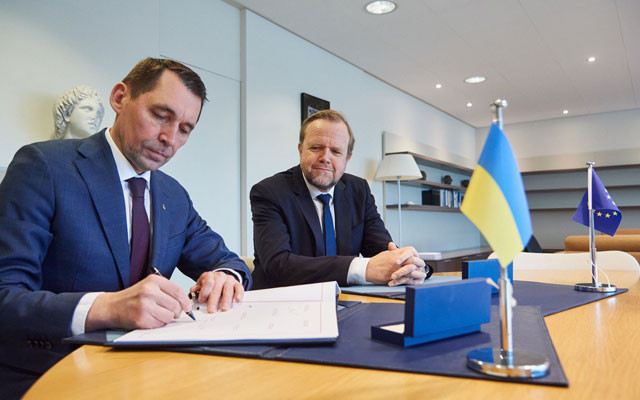
Today, on 9 March, Ukraine's Permanent Representative to the Council of Europe Mykola Tochytskyi signed the Council of Europe Convention for the Protection of the Profession of Lawyer. This makes our country the 28th to sign this important international treaty.
European integration
A translation of the report on advocacy presented to the European Parliament has been published
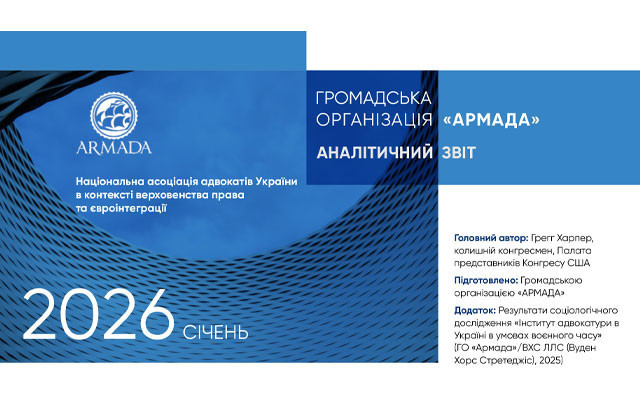
A translation of a research report on the Ukrainian advocacy profession in wartime, previously presented to the European Parliament in Brussels, has been published. The document is presented as a basis for discussion on the rule of law, Ukraine's European integration aspirations, and countering Russian disinformation in the legal sphere.

Legal defence of military personnel
How to formalize discharge from military service: practical workshop
The issue of discharge from military service remains one of the most pressing and complex for Ukrainian defenders and their families. Due to constant changes in legislation, military personnel often face refusals to discharge them from service or even to consider their reports.
Legislation
The Verkhovna Rada Committee criticized the format of the government working group on advocacy
The implementation of the Roadmap on the rule of law (approved by Cabinet of Ministers Resolution No. 475-r of May 14, 2025) in relation to advocacy raises the practical question of who exactly should prepare legislative changes and how.
Self-government
The BCU demands a review of the composition of the government working group on reforming the advocacy profession
The President of the UNBA, BCU Lidiya Izovitova, appealed to the Cabinet of Ministers of Ukraine to review the composition of the working group on improving legislation in the field of advocacy and legal practice.
Guarantees of the practice of law
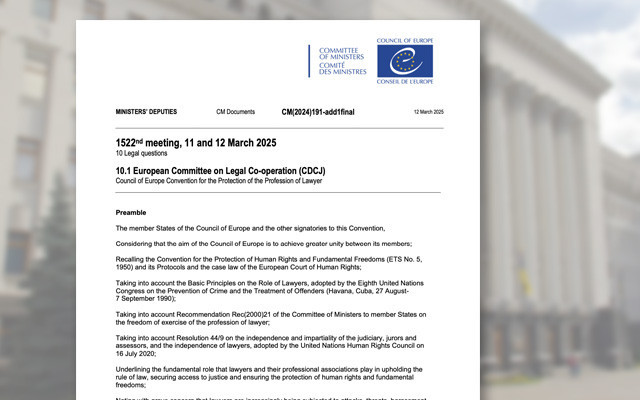
The President has determined, who will sign the Convention for the Protection of the Profession of Lawyer
President of Ukraine Volodymyr Zelenskyy authorized Ukraine's Permanent Representative to the Council of Europe Mykola Tochytskyi to sign the Council of Europe Convention for the Protection of the Profession of Lawyer.
Abroad
Advocate's romance with prosecutor halts criminal case in Canada
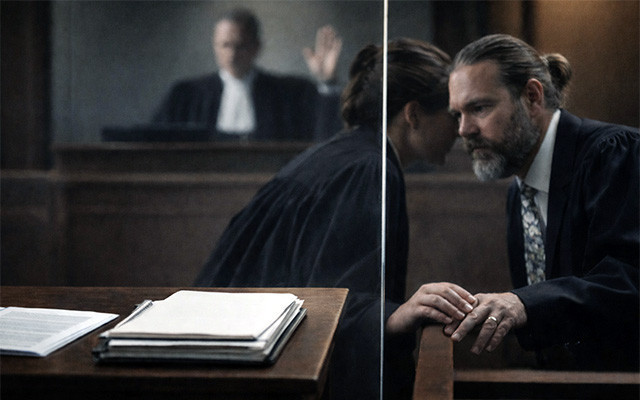
In Montreal (Quebec, Canada), a court suspended proceedings against eight defendants accused of illegal cannabis trafficking and money laundering after it was revealed that the prosecutor in the case and one of the advocates were in a secret intimate relationship.
Legislation
After the war amnesty for criminals or exemption from responsibility?
To ensure national reconciliation, rehabilitation of persons who have been persecuted for political reasons, restoration of justice, and establishment of lasting peace, it is proposed to introduce an amnesty after the war.
Publications

Volodymyr Matsko Extradition during wartime: when the risks outweigh the request

Volodymyr Matsko Extradition as a systemic form of rights violations

Victoria Yakusha, Law and Business The anti-corruption vertical cannot «take care» of the Bar as an institution, - acting head of the HQDCB

Censor.net Protecting advocates – protecting justice: addressing concerns about the new law

Ihor Kolesnykov A BRIEF SUMMARY REGARDING THE APPLICATION OF THE ORDER ON EXTENDED CONFISCATION IN LATVIA REGARDING FINANCIAL ASSETS OF…

Valentyn Gvozdiy WORKING IN A WAR ZONE

Lydia Izovitova Formula of perfection

Sergiy Vylkov Our judicial system is so built that courts do not trust advocates