Tokenization as a right and investment: Ukrainian and international experts discussed the rules

On February 26, as part of the annual Scottish Cyber Awareness Week, the III Annual International Scientific and Practical Conference «Social justice and the digital economy 2026: tokenization» was held.
The event was organized by the Ukrainian National Bar Association, the V.K. Mamutov Institute of Economic and Legal Research of the National Academy of Sciences of Ukraine and the Ukrainian Modern Digital Science Public Organization. The conference brought together Ukrainian and foreign experts to discuss the legal aspects of tokenization, its impact on the real economy, and the prospects for harmonizing national legislation with international standards.
Experts spoke about tokenization as the conversion of real assets and property rights (real estate, business shares, other objects) into digital tokens in distributed registries. They noted that for Ukraine, this is a potential tool for reconstruction and modernization: broader access to investment, faster and cheaper transactions, greater transparency, and trust in the market. At the same time, the technology creates new legal risks. Therefore, the key question is how to regulate: how to recognize digital titles, how to protect investors, prevent fraud and financial crimes, and harmonize rules with international standards.
We separately considered regulatory models where crypto assets are integrated into the general capital market regime: licensing of trading platforms, requirements for asset storage, cybersecurity, reporting, and supervision, as well as the connection with AML/CTF (registration of providers, reporting of suspicious and large transactions). In the Ukrainian context, the concept of digital property in civil law is an interesting issue: digital assets as intangible, controllable, and transferable objects with property value and an open list of types; problematic issues of «ownership» and «possession» and the idea of digital ownership through control within the framework of the Civil Code update.
The practical part concerned forensic investigations: different traceability of blockchains, the dependence of investigations on exchange licensing and access to KYC, the shortcomings of sanctions without reference to wallet addresses, and the need for standards for blockchain analytics. The discussion concluded with a thesis on the need for international coordination and trust between the state, the market, and professional communities.
The conference was moderated by the representative of the UNBA in Edinburgh Oleksandr Chernykh. He emphasized that for the Ukrainian advocacy profession, participation in such events is not only an academic dialogue, but also an effective tool for forming new legal expertise necessary to support innovative financial projects, attract international investment, and conclude cross-border agreements.
Director of the V.K. Mamutov Institute of Economic and Legal Research of the National Academy of Sciences of Ukraine Volodymyr Ustymenko noted that tokenization is a complex legal phenomenon that combines tangible assets with digital rights, so the development of a scientifically sound legal doctrine in this area is a necessary prerequisite for the development of modern legal practice.
Head of the Ukrainian Modern Digital Science NGO Tetiana Dmytrenko outlined international standards for the digital economy and emphasized the key role of advocates in ensuring legal certainty and trust in new financial instruments.
International experience was presented by Canadian advocate Barbara Hendrickson. She analyzed the Canadian model of securitization and tokenization regulation, in particular the requirements for crypto platforms, investment funds, and stablecoin circulation.
Professor Roman Maidanyk of Taras Shevchenko National University of Kyiv revealed the legal nature of digital assets in Ukrainian civil law, the concept of digital ownership, and the prospects for enshrining these provisions in the new Civil Code.
Vice President of a Swiss blockchain analytics company Vladyslav Tsvirkun together with O. Chernykh, presented theoretical and practical methods for detecting fraudulent schemes during public token offerings, in particular, they explored modern blockchain forensics tools and the specifics of cross-border investigations. The challenges of tokenizing real assets were shared by a representative of the Estonian provider of solutions for launching and developing a tokenization ecosystem Daniel Vodolazkyi.
Scientists from the University of Aberdeen Alisdair MacPherson and Burcu Yüksel spoke about the peculiarities of Scottish law regarding the transfer of rights through tokens. And David Christie from Robert Gordon University spoke about the use of smart contracts and tokenization in contractual relationships, particularly in construction.
For reference: the annual Scotland-wide Cyber Awareness Week (CyberScotland Week) took place from February 23 to 28. During these days, online and offline events were held for businesses, communities, organizations, and citizens to raise awareness of cyber risks and strengthen practical resilience to incidents.
Popular news
Guarantees of the practice of law
Ukraine has signed the Convention for the Protection of the Profession of Lawyer
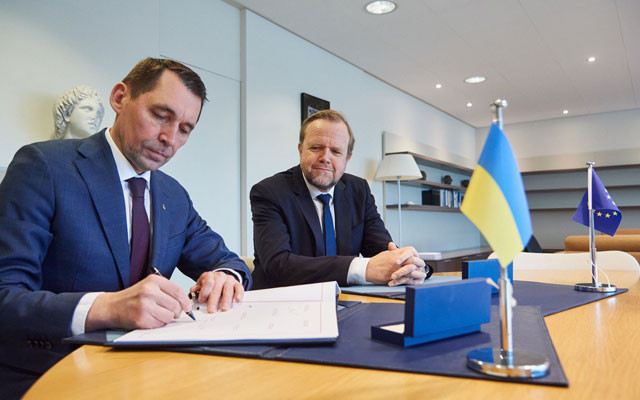
Today, on 9 March, Ukraine's Permanent Representative to the Council of Europe Mykola Tochytskyi signed the Council of Europe Convention for the Protection of the Profession of Lawyer. This makes our country the 28th to sign this important international treaty.
European integration
«Freedom or security» — a false formula: speech by L. Izovitova at the conference of bar presidents
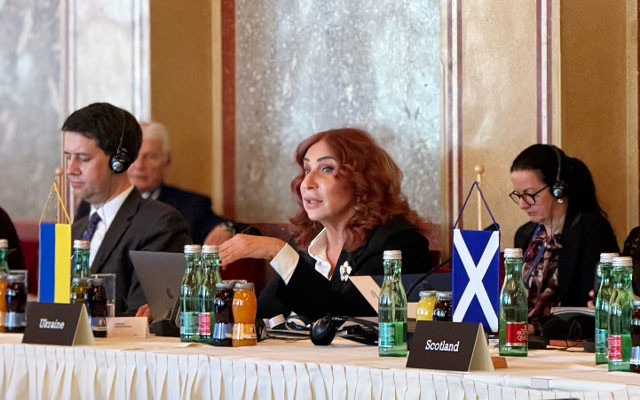
Is the state protecting society from crime today, or is it gradually destroying the rule of law under the guise of this fight? These alarming trends were outlined by the President of the UNBA, BCU Lidiya Izovitova, during her speech at the 54th European Conference of bar presidents.
Discussion
AI in advocacy and justice: ethics, regulation, limits of application
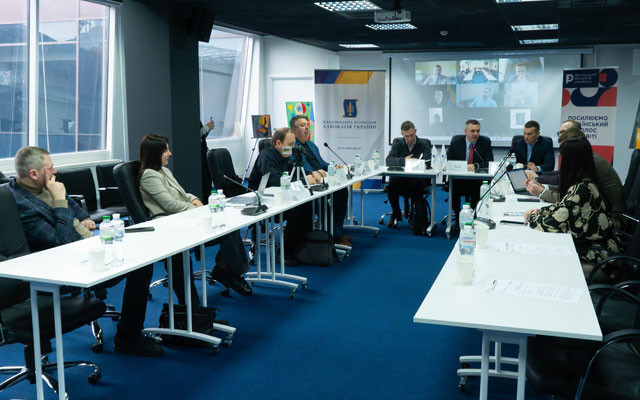
The Ukrainian National Bar Association held a roundtable discussion entitled «Artificial Intelligence in the цork of advocates: ethics, responsibility, legal process engineering». Participants discussed how artificial intelligence systems are already being used in the professional activities of advocates and where the ethical boundaries of what is permissible lie.
European integration
Researchers from the USA explain how shadow reports became a grant service
Shadow reporting often becomes a tool for the grant economy and competition for influence on policy. Such «expertise» replaces impartial analysis with the delegitimization of bar self-government, masks conflicts of interest, and is used as a channel for external pressure on the institution.
European integration
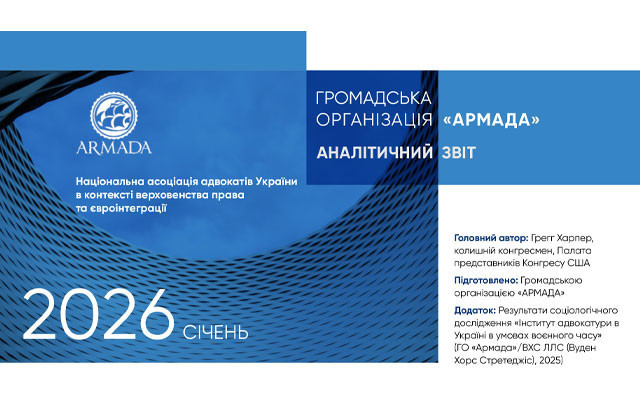
A translation of the report on advocacy presented to the European Parliament has been published
A translation of a research report on the Ukrainian advocacy profession in wartime, previously presented to the European Parliament in Brussels, has been published. The document is presented as a basis for discussion on the rule of law, Ukraine's European integration aspirations, and countering Russian disinformation in the legal sphere.

Legal defence of military personnel
How to formalize discharge from military service: practical workshop
The issue of discharge from military service remains one of the most pressing and complex for Ukrainian defenders and their families. Due to constant changes in legislation, military personnel often face refusals to discharge them from service or even to consider their reports.
Legislation
The Verkhovna Rada Committee criticized the format of the government working group on advocacy
The implementation of the Roadmap on the rule of law (approved by Cabinet of Ministers Resolution No. 475-r of May 14, 2025) in relation to advocacy raises the practical question of who exactly should prepare legislative changes and how.
Self-government
The BCU demands a review of the composition of the government working group on reforming the advocacy profession
The President of the UNBA, BCU Lidiya Izovitova, appealed to the Cabinet of Ministers of Ukraine to review the composition of the working group on improving legislation in the field of advocacy and legal practice.
Publications

Volodymyr Matsko Extradition during wartime: when the risks outweigh the request

Volodymyr Matsko Extradition as a systemic form of rights violations

Victoria Yakusha, Law and Business The anti-corruption vertical cannot «take care» of the Bar as an institution, - acting head of the HQDCB

Censor.net Protecting advocates – protecting justice: addressing concerns about the new law

Ihor Kolesnykov A BRIEF SUMMARY REGARDING THE APPLICATION OF THE ORDER ON EXTENDED CONFISCATION IN LATVIA REGARDING FINANCIAL ASSETS OF…

Valentyn Gvozdiy WORKING IN A WAR ZONE

Lydia Izovitova Formula of perfection

Sergiy Vylkov Our judicial system is so built that courts do not trust advocates