Advocacy, European integration and the limits of intervention: an American report presented in Kyiv
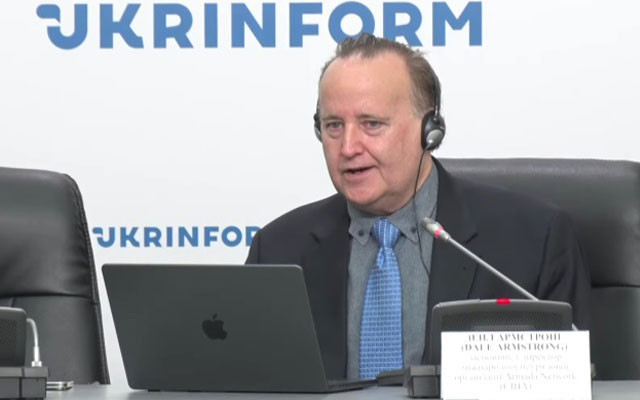
Following its presentation in Brussels, the report «The Ukrainian advocacy in the context of the rule of law and European integration» made its way to Kyiv. It highlighted critical issues both in understanding the very nature of the self-governing profession and in the emergence of a «shadow market» surrounding the Ukrainian advocacy.
Not just a professional issue
During a press conference at Ukrinform, Dale Armstrong, director of Armada Network — the organization that conducted the research, immediately cautioned that today’s discussion on bar self-governance is not merely a professional issue.
«This is not an internal debate that interests only lawyers or legal scholars. After all, advocacy is an important part of the architecture of the rule of law in a country that is fighting for its survival while simultaneously carrying out reforms and moving toward membership in the European Union», - he emphasized.
In wartime, advocacy serves as a guarantor of the right to defense in criminal proceedings, helps maintain the functioning of the judicial system, documents human rights violations and war crimes, and ensures access to international justice mechanisms. That is why, in his view, independent advocacy is not merely a professional corporation, but «part of the infrastructure of the rule of law and, accordingly, part of the state’s resilience».
D. Armstrong illustrated this logic in his response to a question from a UANews journalist about how the state’s attempts to bring advocacy under control could affect advocates’ ability to defend people’s rights.
He boiled this down to a fundamental issue of trust in the justice system: will a person, upon entering the courtroom, be confident that their advocate is working strictly in their best interests, rather than looking to external influences or political pressure? This is precisely why the independence of the advocacy profession is a necessary condition for justice for Ukrainian citizens.
Who is writing the reform script
One of the central focuses of the foreign guest’s speech was the interpretation of the Rule of Law Roadmap regarding the reform of the advocacy profession. According to him, this document is of a framework and programmatic nature.
«The Roadmap sets vital goals: transparency, accountability, efficiency, and modernization of procedures, but does not impose any specific organizational structure, - emphasized D. Armstrong. - It does not require dismantling the existing model and leaves room for national choice, provided that basic European standards of independence and professional autonomy are observed».
Separately, the head of Armada Network noted that what is happening today is not only a discussion about the content of the document, but also a struggle for the right to determine the reform agenda itself.
«When certain participants in the process begin to present their own preferred restructuring model as if it were the sole European solution, they are no longer interpreting the Roadmap correctly. They are replacing it with their own institutional project. This is stated very clearly in our report», - he explained.
Responding to a question from ZIB about the reaction of European politicians to the presentation of the report in the European Parliament, D. Armstrong said that among his interlocutors he saw more interest and surprise than resistance. In European circles, it is well understood that models of advocacy self-governance vary from country to country. In fact, this once again confirms the thesis that there cannot be a single ideal model serving as a universal European standard. In this context, the expert called «external control measures and reforms, in which the advocacy community itself is not even invited to participate», - unacceptable.
Between support and interference
However, the expert is convinced that assistance with reforms is valuable only as long as it is limited to analysis, comparative data, institutional support, and recommendations.
«When technical assistance starts drafting laws, it is no longer technical assistance. If a project supposedly created to support reform ceases to act as an advisor and begins offering the country ready-made legislative formulas, ready-made institutional reorganizations, and ready-made scenarios of what the “correct” reform should look like, it goes beyond the scope of its mandate», - noted D. Armstrong.
It was in this context that he mentioned the EU’s «Pravo-Justice» project, which is formally an instrument of international technical assistance but in practice delves into the very heart of the legislative process.
«It (the project. — Ed. note) does not simply analyze or compare experiences or offer advice. It goes further—it helps formulate how laws should be rewritten, how institutions should be restructured, and what the architecture of sensitive sectors, including advocacy, should look like», - the speaker noted.
In response to a question from a Ukrinform journalist about which external centers influence advocacy, he replied that the so-called «shadow report» by civil society organizations and other materials had been analyzed; according to him, these materials echo one another and create the effect of a closed information environment.
D. Armstrong also emphasized the importance of distinguishing transparency and accountability from external subordination.
«I believe that the UNBA must certainly be accountable. But to Ukrainian advocates, to the professional community, and not to external political, administrative, or donor-driven centers of influence, - he noted. - The roadmap does not provide for the external subordination of advocacy. It does not require the transfer of financial control to the government. On the contrary, it allows for and encourages the creation of stronger mechanisms of internal accountability — mechanisms that are fully compatible with the independence of the legal profession».
«But I have seen in many public discussions that the very nature of a self-governing profession is either misunderstood or ignored», - the expert added.
Hence his other conclusion: approaches developed for state institutions, particularly in the anti-corruption sphere, cannot be mechanically applied to bar self-governing bodies. Because this alters the very nature of an independent profession and creates channels of administrative influence where, by the logic of self-governance, they should not exist.
«It (advocacy — Ed. note) does not exercise state powers and should not be turned into an object of state administration simply because someone decided to call it transparency», - explained D. Armstrong.
The market of problems
The most pointed part of the speech was the section dedicated to what he called the emergence of a «shadow journalism market» surrounding the Ukrainian advocacy profession. According to him, this is no longer about individual critical articles or ordinary professional debate, but about a systemic phenomenon where such materials cease to be a monitoring tool and begin to function as a mechanism of influence — on politics, international perception, and the very institutional architecture of advocacy.
Explaining how this system works, the expert spoke of interconnected grant networks, teams of authors, mutual citation, and coordinated communication support. Under such conditions, he said, a large number of similar documents creates the illusion of expert consensus, although in reality it amounts to the repetition of the same arguments within a closed circle.
«Some of these products function not so much as independent assessments as tools for competing for influence over policy and control over the reform program itself. What is presented as analysis is often a form of advocacy with a predetermined conclusion, - explained D. Armstrong. - Part of the shadow reporting has begun to function as an element of a grant economy, in which criticism and the rhetoric of a «reset» become attractive not because they describe reality, but because they provide visibility, influence, and future funding opportunities. That is why our report refers to this as the «market for problems».
The expert then moved on to a broader conclusion about institutional mimicry. «There are visible signs that a narrow circle of actors exerts a disproportionate influence on how the problem is described, who has the right to interpret it, and which solutions are presented as supposedly inevitable. Our report essentially describes this as an agenda-capture mechanism that operates not through official state levers, but through a monopoly on the channel of certain so-called voices of public experts, - he noted. - The problem is that external partners, donors, and even parts of the state apparatus perceive the position of certain networks as expert opinion or even as the view of the profession».
When the sheer volume of publications, the emotional tone of headlines, and the repetition of the same labels begin to be perceived as evidence of a systemic crisis, a dangerous substitution occurs: media visibility replaces verified analysis.
ZiB asked whether European politicians were surprised by how the Ukrainian grant ecosystem works; D. Armstrong said that European systems, even when they sincerely seek to help, can be exploited and become subject to manipulation. This message must continue to be conveyed, as «shadow accounting creates an economic market that does not reflect reality».
Responding to a question from a representative of the National Union of Journalists of Ukraine about Armada Network’s plans for the future, he stated that the next step would be Washington: the organization plans to work with USA senators and congressmen to ensure they understand the scale of the problem and how it could jeopardize Ukraine’s future and lead to a narrowing of human rights.
D. Armstrong also expressed hope to involve Congressman Greg Harper, one of the key authors of the report, in further discussions.
«I think we will do everything possible to convey the truth, and we also hope that we will be fortunate enough to engage some of those who are genuinely interested in Ukraine’s prosperity», - D. Armstrong concluded.
Without a breach
Thus, the need for change in advocacy is not disputed in and of itself. The problem arises when reform is used as a pretext for externally restructuring a self-governing institution according to a predetermined scenario. And if reform of the advocacy profession is necessary, then it must clearly be evolutionary. The advocacy profession itself should be viewed as a subject of reform, not as the object of someone else’s project.
In this context, what matters is not only how the changes are formally implemented, but also whether they will weaken the institution that ensures the right to defense. In this context, bar self-governance is linked to the stability of the state, the rule of law, and the ability to preserve legal guarantees during wartime.
Prepared by Viktoria Yakusha, «Law and Business».
Popular news
Guarantees of the practice of law
Ukraine has signed the Convention for the Protection of the Profession of Lawyer
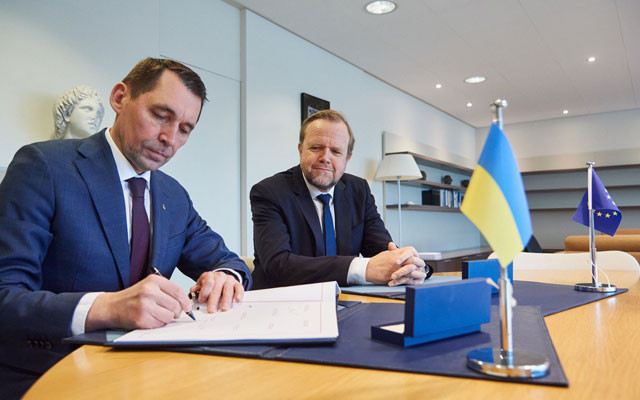
Today, on 9 March, Ukraine's Permanent Representative to the Council of Europe Mykola Tochytskyi signed the Council of Europe Convention for the Protection of the Profession of Lawyer. This makes our country the 28th to sign this important international treaty.
European integration
«Freedom or security» — a false formula: speech by L. Izovitova at the conference of bar presidents
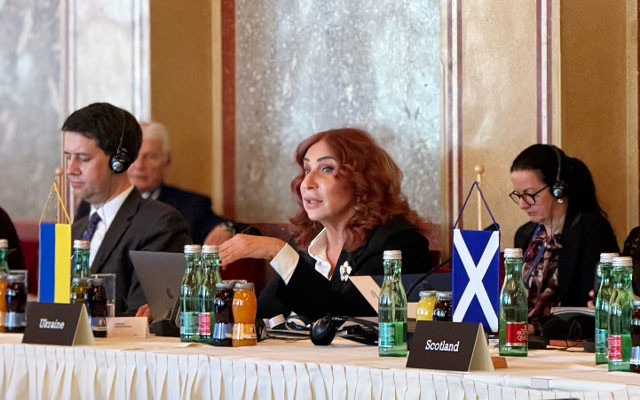
Is the state protecting society from crime today, or is it gradually destroying the rule of law under the guise of this fight? These alarming trends were outlined by the President of the UNBA, BCU Lidiya Izovitova, during her speech at the 54th European Conference of bar presidents.
Discussion
AI in advocacy and justice: ethics, regulation, limits of application
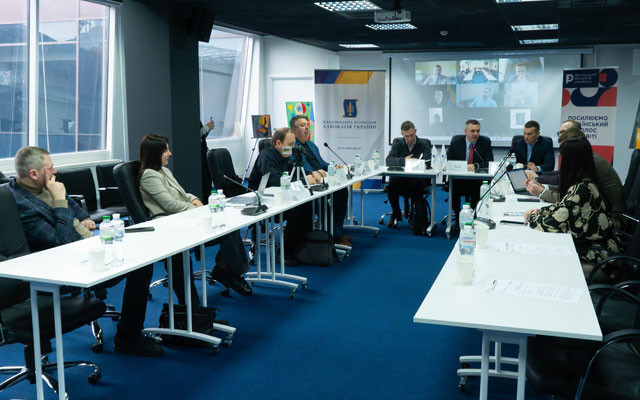
The Ukrainian National Bar Association held a roundtable discussion entitled «Artificial Intelligence in the цork of advocates: ethics, responsibility, legal process engineering». Participants discussed how artificial intelligence systems are already being used in the professional activities of advocates and where the ethical boundaries of what is permissible lie.

European integration
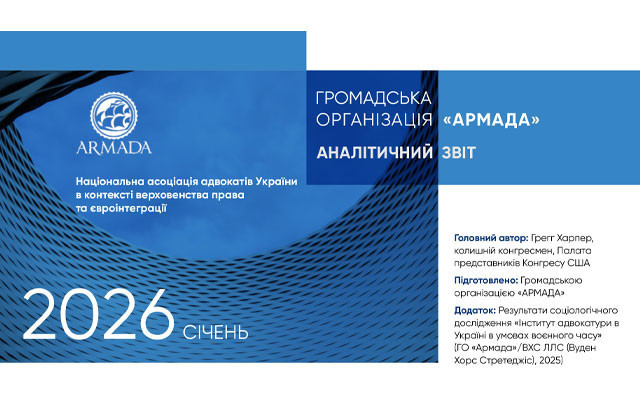
Researchers from the USA explain how shadow reports became a grant service
Shadow reporting often becomes a tool for the grant economy and competition for influence on policy. Such «expertise» replaces impartial analysis with the delegitimization of bar self-government, masks conflicts of interest, and is used as a channel for external pressure on the institution.
European integration
A translation of the report on advocacy presented to the European Parliament has been published
A translation of a research report on the Ukrainian advocacy profession in wartime, previously presented to the European Parliament in Brussels, has been published. The document is presented as a basis for discussion on the rule of law, Ukraine's European integration aspirations, and countering Russian disinformation in the legal sphere.

Legal defence of military personnel
How to formalize discharge from military service: practical workshop
The issue of discharge from military service remains one of the most pressing and complex for Ukrainian defenders and their families. Due to constant changes in legislation, military personnel often face refusals to discharge them from service or even to consider their reports.
Legislation
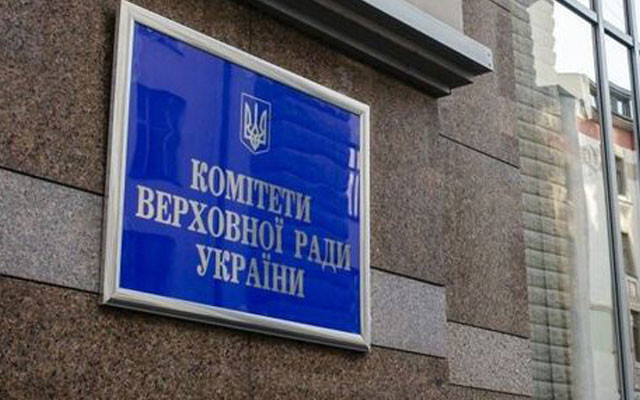
The Verkhovna Rada Committee criticized the format of the government working group on advocacy
The implementation of the Roadmap on the rule of law (approved by Cabinet of Ministers Resolution No. 475-r of May 14, 2025) in relation to advocacy raises the practical question of who exactly should prepare legislative changes and how.

Self-government
The BCU demands a review of the composition of the government working group on reforming the advocacy profession
The President of the UNBA, BCU Lidiya Izovitova, appealed to the Cabinet of Ministers of Ukraine to review the composition of the working group on improving legislation in the field of advocacy and legal practice.
Publications

Volodymyr Matsko Extradition during wartime: when the risks outweigh the request

Volodymyr Matsko Extradition as a systemic form of rights violations

Victoria Yakusha, Law and Business The anti-corruption vertical cannot «take care» of the Bar as an institution, - acting head of the HQDCB

Censor.net Protecting advocates – protecting justice: addressing concerns about the new law

Ihor Kolesnykov A BRIEF SUMMARY REGARDING THE APPLICATION OF THE ORDER ON EXTENDED CONFISCATION IN LATVIA REGARDING FINANCIAL ASSETS OF…

Valentyn Gvozdiy WORKING IN A WAR ZONE

Lydia Izovitova Formula of perfection

Sergiy Vylkov Our judicial system is so built that courts do not trust advocates