


Judicial reform demonstrates discordance with constitutional principles and violation of state sovereignty - Maryna Stavniychuk
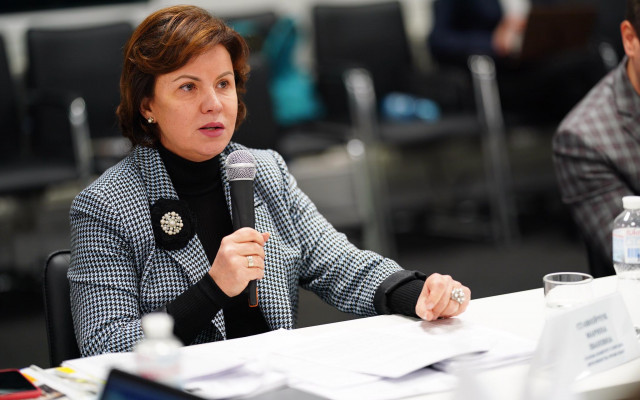
Judicial reform in Ukraine has been going on for 30 years, but the latest stages show the differences between the relevant legislation on the judiciary and the constitutional basis. Besides, some ideas run counter to state sovereignty.
This was stated during the second national discussion "Access to Justice: Realities and Prospects" by the Head of the Committee on the Rule of Law of the UNBA Maryna Stavniychuk.
The former member of the Venice Commission, Maryna Stavniychuk singled out several systemic problems that make it impossible to build a stable and efficient justice system. Thus, first, the positive result of the changes is hindered by the absence of trust of the participants in the reform and the distrust of citizens to public authorities and the judiciary. "We see the efforts of current politicians to transfer the problem of their authority and their perception of the people exclusively to the judiciary. This is a tendency of distrust, " - Maryna Stavniychuk stressed.
Judicial reform is developed without a defined strategy, criteria, goals, and objectives. Each new stage begins without evaluating the results of previous changes. The duration of each stage becomes shorter, which leads to instability of legislation. An example of the lack of an analytical approach is the termination of the powers of the High Qualification Commission of Judges of Ukraine in November 2019 without a proper evaluation of its activities. The failures of judicial reform are also explained by the fact that the proposed changes are not provided by calculations of human and budgetary resources.
"We see differences between the current legislation and the constitutional principles. Proposals are formed from the ceiling, little attention is paid to the provisions of the Constitution, which in terms of the judiciary was reformed only in 2016. In reality, only 4 years have passed, and new proposals are already being made without an analysis of how the implemented changes work,”- said Maryna Stavniychuk.
According to her, the last stage of judicial reform had political goals and was accompanied by a violation of the constitutional procedure for amending the Constitution in the chapter on justice.
It will be recalled that the second national discussion "Access to Justice: Realities and Prospects" took place on November 30. The co-organizers of the event were UNBA and the High Council of Justice. The agenda of the discussion included strategic issues of judicial reform, the role of professional communities in the development of legislation on the judiciary and the bar, the constitutional aspects of the participation of international experts in the formation of judicial governance.
Popular news

War
Are Europe's advocacy associations prepared for a potential war? V. Gvozdiy shared lessons from the Ukrainian experience
The continuity of the bar’s self-governance, the protection of professional registries and archives, as well as equal guarantees of employment for advocates, judges, and prosecutors must be enshrined in advance in legislation in the event of war or another emergency.

Educational events
How DISC helps manage «tigers», «monkeys», «elephants» and «turtles»
The same instruction from a manager may motivate one employee to take action, while leaving another without the necessary guidance. People perceive work tasks differently: for some, a deadline and the expected outcome are enough, while others need explanations, time or a detailed plan.

Legislation
The Verkhovna Rada is preparing a bill to implement the Convention on the Protection of the Professions of Lawyer
Members of Parliament plan to introduce a bill in the near future to implement the main provisions of the Council of Europe Convention on the Protection of the Professions of Lawyer. This parliamentary initiative may also prompt the government to expedite the preparation of the ratification package.
Educational events
What an advocate should consider when a fee dispute escalates into a complaint to the QDBC
If an advocate files a lawsuit seeking to recover fees from a client, the client may in turn file a complaint with the High Qualification and Disciplinary Commission of the Bar in an effort to compel the advocate to withdraw the lawsuit. How do the advocacy’s disciplinary bodies handle such cases?

Educational events
Energy, focus and priorities: how an advocate should plan their day
A rigid workday schedule becomes irrelevant when your routine depends on air raid alerts and disrupted sleep caused by nighttime explosions. Under such conditions, advocates should assess the resources they can actually manage.

Greetings
The UNBA honored the winners of the «In the language of prose» contest and opened a fashion exhibition
The competition was organized by the UNBA Committee on humanitarian issues and creative initiatives in cooperation with the Center for advocacy and legal research. Two dozen advocates from various regions of Ukraine submitted their works to the competition committee for consideration. The entries were evaluated based on originality, the relevance of the chosen topic and the level of technical skill.

Discussion
What is holding back funding for gas-fired power generation – discussion between businesses and banks at the UNBA
To provide loans for new gas-fired power generation projects, banks require a predictable cash flow, an investor’s equity contribution, and risk-sharing mechanisms. A business model that relies solely on a preferential gas price is not a sufficient basis for financing.
European integration
Ukraine's representative to the Council of Europe explained the importance of protecting advocates in the context of European…
In addition to the legal implications, the ratification and subsequent implementation of the Council of Europe Convention on the Protection of the Legal Profession will have significant political implications for Ukraine. This will confirm the state’s readiness to fulfill the requirements necessary for future membership in the European Union.
Publications

Vasyl Kolishnyi, «Law and Business» Supporting mental health should become part of the professional culture of the Bar, - H. Udovenko

Volodymyr Matsko Extradition during wartime: when the risks outweigh the request

Volodymyr Matsko Extradition as a systemic form of rights violations

Victoria Yakusha, Law and Business The anti-corruption vertical cannot «take care» of the Bar as an institution, - acting head of the HQDCB

Censor.net Protecting advocates – protecting justice: addressing concerns about the new law

Ihor Kolesnykov A BRIEF SUMMARY REGARDING THE APPLICATION OF THE ORDER ON EXTENDED CONFISCATION IN LATVIA REGARDING FINANCIAL ASSETS OF…

Valentyn Gvozdiy WORKING IN A WAR ZONE

Lydia Izovitova Formula of perfection