New rules, old problems: the UNBA discussed the work of the ETAIDF and MMC
The reform of medical-social assessment and military medical commissions has changed procedures but has not resolved practical issues. People face situations where documents are not issued, decisions are based on technicalities, assessments are delayed, and they struggle to demonstrate their actual health status in specific life situations.
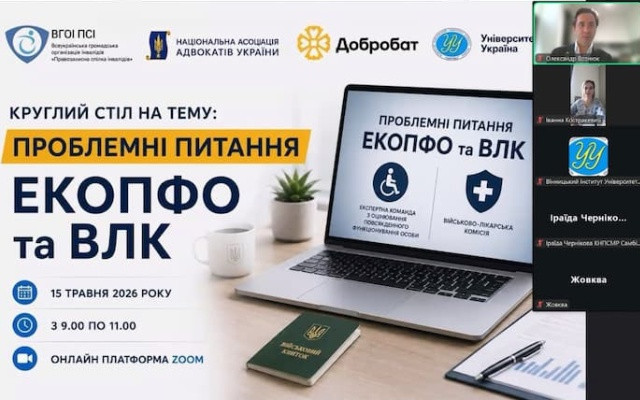
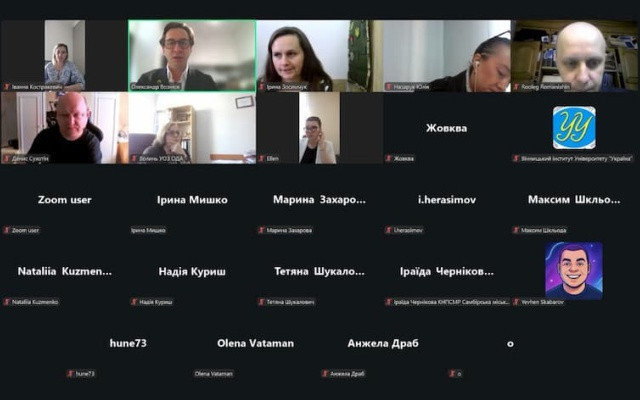
These issues were explored during the roundtable «Challenges facing the ETAIDF and Military Medical Commissions», organized by the UNBA Committee on the protection of the rights of persons with disabilities in collaboration with civil society organizations.
Participants discussed the reform of the Medical and Social Expert Commission (MSEC), the practice of appealing decisions by the Medical and Labor Commission (MLC) and expert teams assessing a person’s daily functioning (ETAIDF), as well as the challenges faced by conscripts, military personnel, and civilians with disabilities.
Reform in question
The meeting was opened by the chairman of the UNBA Committee Oleksandr Voznyuk, who explained that its goal was to discuss new trends in reforming the Medical and Social Examination Commission (MSEC) and the system for assessing individuals’ functioning, as well as the mistakes that arise during the implementation of this reform. He outlined the main topics of discussion: whether the reform has taken place, whether the decisions of expert teams have improved, whether patients and doctors are satisfied, whether time spent has decreased, and whether any shortcomings remain.
O. Voznyuk also mentioned his participation in work with the Ministry of Health, various departments, and researchers on Law No. 4170-IX of December 19, 2024, regarding the reform of medical and social expertise and the introduction of assessments of a person’s daily functioning, as well as on Cabinet Resolution No. 1338 of November 15, 2024, «Certain issues regarding the introduction of the assessment of an individual’s daily functioning».
Separately, the advocate drew attention to the reform of the Medical and Social Expert Commission (MSEC). In his assessment, this area is one of the most complex, and the most difficult changes are being advanced in cooperation with the Ministry of Defense.
A certificate that does not exist
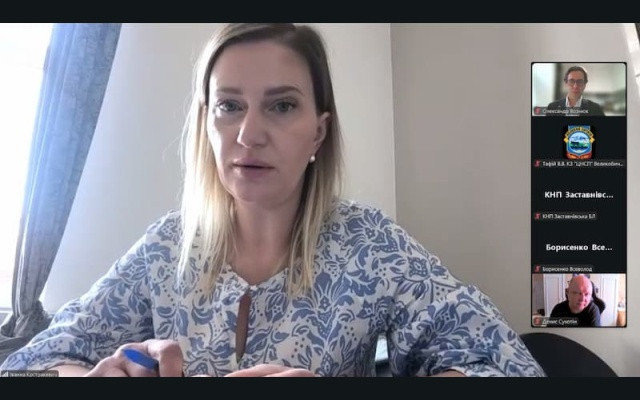
Member of the Committee Ivanna Kostrakevych focused on appeals against decisions of the Medical and Social Examination Commission (MSEC) at the TCC and the Specialized Medical Commission (SMC) during conscription and regarding military personnel. She noted that the commission issues resolutions in the form of a medical certificate or a statement of illness, and the appeal period is one month.
One of the practical problems the advocate highlighted is that, during conscription, conscripts are not issued with the Medical Examination Commission’s certificates, even though the documents are generated electronically. Because of this, advocates are forced to request them from the TCC, and the person effectively does not have a document in hand that they can use to appeal. In her opinion, MMC certificates should be available in electronic form in «Reserve+», since the loss of paper documents subsequently complicates the retrieval of medical records and materials.
Separately, I. Kostrakevych drew attention to the handling of medical data. She noted that starting in 2025, medical documents from municipal and state institutions will be generated in the Unified Health Care System (UHCS) and MMC members will be able to view information about the conscript’s health status during examinations. At the same time, she said, in practice, not all members of the Medical Examination Commission take this data into account or properly assess existing conditions and the severity of their symptoms.
As examples, she cited situations where medical records contained information about illnesses but were not properly reflected in the Medical Examination Commission’s conclusion, as well as a case in which an individual was deemed fit for military service following psychiatric treatment despite the existence of medical records in the UHS.
Not the diagnosis, but the functions
The ETAIDF’s decision lies at the intersection of medicine and law, and the quality of the initial decision often determines whether a legal dispute will arise later. This argument was put forward by member of the Committee Oleg Romanishyn, who emphasized that an administrative appeal is the mechanism through which the substance of the medical assessment is actually reviewed, whereas the court does not reassess the individual’s functional status and primarily reviews the procedure. Therefore, according to him, it is not only the initial decision itself that matters, but also the content of the complaint filed by the patient or their representative.
Among the problems, O. Romanishyn noted that the ETAIDF decision is effectively a form-based document with minimal reasoning. Because of this, the patient does not understand the reasons for the refusal to establish a disability group or the causal link; the advocate does not see what exactly to challenge; and the doctor who issued the referral does not see where his conclusion was not taken into account or how the diagnosis was correlated with the disability group.
Denis Sukhotin of the Transcarpathian Regional Association of Persons with Disabilities noted that the issue of medical commissions has become more prominent not only because of the number of cases but also due to the military’s active efforts to appeal decisions regarding their health status. At the same time, people with congenital disabilities or disabilities not related to military service often have less psychological resilience and fewer resources to navigate challenges in the healthcare system.
The implementation of the ETAIDF, according to the speaker, has complicated the procedures, particularly due to the system’s slowness and the technical unpreparedness of some doctors for digitalization. As an example, D. Sukhotin cited the case of a woman with a congenital visual impairment who needed to renew her old MSEC certificate and obtain a new medical opinion, but the process had been ongoing since March, and she had still not received a referral to the ETAIDF. According to him, the problem began because the doctor did not know how to record the case in the electronic system.
Among other examples, he cited a case where a person, due to a deterioration in their health, needed a wheelchair instead of crutches, but the process took 12 months. There was also a case of an internally displaced person abroad who submitted German medical documents with an official translation to Ukrainian doctors, but the doctors did not know how to process them.
D. Sukhotin emphasized that for people with disabilities, what matters is not a formal list of regulations, but a clear, practical path: from the start of the procedure to the final outcome.
***
Summarizing the discussion, O. Voznyuk noted that practical cases are being collected to change the rules and simplify procedures for all parties. According to him, the ETAIDF system remains imperfect, and some doctors perceive it as an additional technical burden. At the same time, the war has accelerated the development of medical law, so new rules in this area must be formulated with an eye toward the real-life situations faced by patients, doctors, and advocates.
Popular news
European integration
Lidiya Izovitova: In the context of European integration reforms, advocacy is a partner of the state, not a target of reform
The war has significantly altered the working conditions for advocates, while European integration has presented the profession with new institutional challenges. The ongoing negotiation process covers issues such as the rule of law, judicial independence, fundamental rights, justice, freedom and security.
Guarantees of the practice of law
The Verkhovna Rada discussed the next steps for ratifying the Convention on the Protection of the Professions of Lawyer
The Verkhovna Rada Committee on legal policy held a working meeting to prepare for the ratification of the Convention for the Protection of the Profession of Lawyer. The meeting was attended by members of parliament, representatives of the Office of the President, the Ministry of Justice, the Ministry of Foreign Affairs and the Ukrainian National Bar Association.
Guarantees of the practice of law
Valentin Gvozdiy: Ukraine’s ratification of the Convention for the Protection of the Profession of Lawyer – is a matter…
Exactly one year ago, on May 13, 2025, in Luxembourg, during the 134th session of the Committee of Ministers of the Council of Europe, the Convention for the Protection of the Profession of Lawyer was opened for signature. Today, the Verkhovna Rada Committee on legal policy held a working meeting to prepare for its ratification. Between these two dates lies a year, during which (on March 9) Ukraine became the 28th signatory state. We spoke about this new phase with the Vice President of the UNBA, BCU Valentin Gvozdiy, who was personally involved in the preparation of this international instrument.
Support
Mental health, archives and cybersecurity: The UNBA and the IBA reviewed the progress of joint projects
The Ukrainian National Bar Association and the International Bar Association (IBA) reviewed the progress of joint projects that are of practical importance in the context of the war: supporting the mental health of advocates, digitizing archives, and strengthening the cybersecurity of the legal infrastructure.
Rule of Law Roadmap
The UNBA is developing a model for reforming the legal profession
The reform of the advocacy profession is part of the negotiation process regarding Ukraine’s accession to the European Union, and the Rule of Law Roadmap explicitly identifies the Ukrainian National Bar Association as one of the key stakeholders in the process.

Legal defence of military personnel
Missing in action: advocates explain the procedure to the families of servicemembers
As part of the «Advocate+» pilot project, advocates continue to work with military personnel in the brigades, helping to resolve practical legal issues — ranging from social benefits and payments to undergoing medical examinations and processing paperwork.
Guarantees of the practice of law
Police to investigate the NACP's attempts to reform advocacy
The Office of the Prosecutor General has opened a criminal investigation into alleged abuse of power by employees of the National Agency for Corruption Prevention.
Interaction
Advocates and patent attorneys combine their expertise in the field of intellectual property
Joint legislative proposals, expert opinions on regulatory changes and professional discussions on key issues in the field of intellectual property will form the basis of cooperation between the Ukrainian National Bar Association and the National Association of Patent Attorneys of Ukraine.
Publications

Volodymyr Matsko Extradition during wartime: when the risks outweigh the request

Volodymyr Matsko Extradition as a systemic form of rights violations

Victoria Yakusha, Law and Business The anti-corruption vertical cannot «take care» of the Bar as an institution, - acting head of the HQDCB

Censor.net Protecting advocates – protecting justice: addressing concerns about the new law

Ihor Kolesnykov A BRIEF SUMMARY REGARDING THE APPLICATION OF THE ORDER ON EXTENDED CONFISCATION IN LATVIA REGARDING FINANCIAL ASSETS OF…

Valentyn Gvozdiy WORKING IN A WAR ZONE

Lydia Izovitova Formula of perfection

Sergiy Vylkov Our judicial system is so built that courts do not trust advocates